
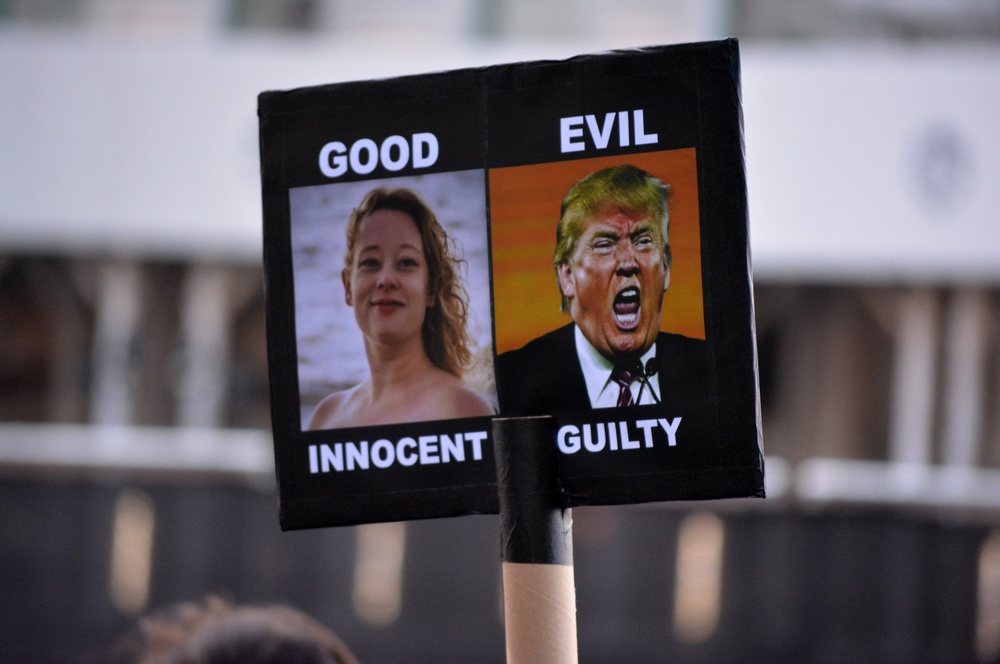
Two weeks ago, an Immigration and Customs Enforcement (ICE) agent shot dead a U.S. citizen and mother of three in Minneapolis, Minnesota, setting off mass protests and a storm of questions across the country. The executive branch has offered a set of answers about who Renee Good was, what she believed, and the nature of the agent’s mental state in order to justify the killing of a civilian in the street of a peaceful city.
These answers suggest that Donald Trump is following four authoritarian rules that he seems to have lifted from the playbooks of Russian President Vladimir Putin and Belarusian President Alexander Lukashenko.
This case of a killing of an American citizen may prove a turning point for the United States. Will the American people defend democracy—or walk away from it?
- Grab as much as you can—and consolidate it.
Although this rule concerns executive power and state resources, it equally extends to the economy and finance. It is the first step in any dictatorial project; everything else depends on its success. Absolute power takes longer than a couple months or even years to be established. Dissenters will always try to pull authority back toward citizens and representative democracy. That is why the foundations of the latter must be removed first. Once the cornerstones are gone, the entire structure collapses on its own. The slow erosion of democratic institutions works in the dictator’s favor. It can also be accelerated through corruption and nepotism at the local level.
Although Putin spent more than a decade building his personal empire, Lukashenko could claim absolute, indisputable power only after 26 years in office. The Belarusian dictator began by violently dispersing parliament in 1996 and replacing it with loyalists regrouped as the National Assembly, a pocket chamber that allowed his personal decrees to override national law. For years, Lukashenko maintained power through a social contract: rights and liberties in exchange for stability and minimal guaranteed benefits. That contract collapsed in 2020 when mass protests against his unjust rule erupted nationwide. By then, the repression machine that he built was fully operational, so it could crush popular dissent over the following months.
Putin started with the Supreme Court, forcing its chair to resign and replacing him with a loyal, controllable figure. Parliament—the so-called State Duma—came next. It took longer than in Belarus, but by the time Russia invaded Ukraine, it had become a rubber-stamp institution. Putin also seized control of key industries like oil, gas, metallurgy and effectively privatized the financial system through Bank Rossiya. Beyond personal enrichment, this allowed him to accumulate more than $100 billion in the National Welfare Fund, later used to finance the war. His social contract rested on non-interference: “I don’t bother you, and you don’t touch me.” Unlike Lukashenko, Putin did not seek total control over the emerging middle class. Instead, he tolerated tax evasion and other “sins,” even lowering income taxes in the 2000s. In return, society was expected to stay out of his business, each side keeping its own skeletons in the closet.
Trump followed the same pattern. Like his dictatorial predecessors, he began with the Supreme Court, reshaping it through appointments to ensure loyalty. Congress followed. By winning control of both chambers through populist and isolationist rhetoric, Trump’s party brought the legislative branch under his influence. The U.S. presidency—already stronger than most of its European counterparts—now possessed everything required to move toward absolute power. Trump’s social contract closely mirrors those of Putin and Lukashenko: “safe” and “clean” cities, purged of demonized groups such as immigrants; subsidies for obsolete energy industries and technologies; lower taxes and pressure on the central bank to cut interest rates.
The result of this policy is tangible today in the weak or silent congressional response to the deployment of the National Guard in blue states and cities, and to the recent unlawful killing of U.S. citizen Renée Nicole Good by an ICE officer.
So, when Trump told journalists that the only thing capable of limiting his actions was his own conscience and morality, he was telling the truth. All other constraints were neutralized during the process of power-grabbing and consolidation—or rendered ineffective. The catastrophe is less immediate than it might be only because natural cognitive decline and a limited attention span now act as unintended restraints.
- Don’t back down
The path to autocracy or totalitarian rule is never paved only with roses. It is littered with bombs and mines—and carries real immediate dangers for the dictator himself. Putin and Lukashenko learned this logic from old KGB manuals that, for decades if not centuries, ensured continuity of repression in Russia and its former colonies. Both consistently applied the “strongman” strategy by eliminating any possibility of retreat. There is no reverse gear in their systems; their ships move in only one direction.
During Putin’s first term, his failures were still visible to society because independent media existed. His cold indifference to the Kursk submarine disaster, in which the entire crew died due to negligence, and the massive civilian toll of the Chechen wars were fiercely criticized. Lukashenko faced similar outrage after ordering the murder of political opponents (though his response to the 2020 protests was even more brutal). Escalation became the only option left to both leaders and the systems they built.
In this framework, war is a logical outcome of Putin’s power paradigm. For Lukashenko, the war is against his own people. For Trump, it is both.
Trump has never apologized, never retreated, or paused—demonstrating the same commitment to totalitarian logic. His response to the outrage in Minneapolis followed the same pattern: no excuses, no remorse, only escalation. As protests spread after the killing of Renée Nicole Good, he sent hundreds more ICE agents into the city. Like Putin, Trump appears to see war as a central instrument of foreign policy. That is why he oscillates between Iran, Venezuela, and even Greenland, searching for the place where he might begin a ground operation.
- People are everything—but you need the right ones.
Absolute concentration of power is impossible without the direct assistance of people who actively support the process, often without fully realizing what they are serving. Once recruited, they can’t be allowed to leave the game. Extreme punishment awaits those who try, like Russian ex-agent Sergei Skripal and his daughter, who were victims of poisoning in the UK. Selecting such personnel is the most difficult task of any authoritarian project, and Trump has handled it no worse than Putin or Lukashenko, likely by following similar methods.
Lukashenko, the most overtly personalistic of the three, carefully selected and appointed loyalists for his governing system. Putin was less meticulous but followed the same logic, beginning with some friends from his youth on the Leningrad streets. At the same time, both relied on a classic KGB recruitment principle: never hire people who are clean. The flaws and problems serve as instruments of control. At the lowest level, this principle operates in Belarus and Russia through the recruitment of people with criminal records, little education, or minimal training into repressive agencies or the army. At the highest level, control is maintained through corruption and shared responsibility for wrongdoing.
Trump applied both mechanisms during just the first year of his second term. That is why insider stock trading in Congress went unchecked. That is also why, alongside a shortage of qualified personnel, his administration elevated demonstrably unfit figures—officials entangled in corruption scandals and ICE recruits after standards were lowered. The tragedy in Minneapolis was not an accident but a predictable outcome of this policy.
- Punish difference and dissent—ruthlessly, relentlessly, and totally.
The current campaign that Trump has launched against his political opponents in blue states and cities is as ruthless and comprehensive in nature as Lukashenko’s crackdown on political opposition after 2020. Strikingly similar details even suggest direct borrowing. It was Lukashenko who created combat squads to suppress dissent—masked men without identifying insignia who broke into the homes and cars of protesters without legal justification, kidnapping, beating, or killing them. To make repression more efficient and avoid targeting people indiscriminately, Lukashenko’s security services began identifying dissidents through a centralized surveillance system. This system included outdoor surveillance cameras, advanced facial-recognition software purchased from the United States, and an army of police officers scouring social media for targets.
At the same time, innocence itself offers no protection, reflecting the Stalinist principle that “when you chop down a forest, chips fly.” This approach leads to the often-inhumane punishment of ordinary citizens—such as Renee Nicole Good—or of bystanders with no connection to opposition movements or oppressed groups.
The United States is now passing through a critical stage in the formation of a mature dictatorship, following the playbooks of Putin and Lukashenko. Resistance—by citizens, organizations, and institutions—will play a decisive role in determining whether dictatorship is fully established or ultimately prevented.