Two weeks before Nigeria’s election, Ike Okonta takes aim at progressive politics in Nigeria – or the lack thereof. He traces the crisis back to the rule of General Ibrahim Babangida in the 1980s, when universities were devastated by economic policy.
Libya: Where Are the BRICs?
Following the vote at the UN Security Council, the United Kingdom, France, and the United States have embarked on military action against Gaddafi’s forces in Libya. They have been careful to include a few Arab states in this new coalition of the willing. But these three countries are the driving force behind the imposition of a no-fly zone and the attacks on the government’s military positions and forces. Yet among the permanent and non-permanent member of the Council who were asked to authorize “all necessary measures” to protect civilians rebelling against the regime, the BRIC powers of Brazil, Russia, India, and China were conspicuously absent.
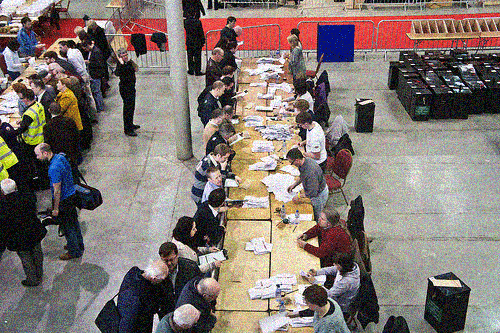
Left Bares Its Claws in Irish Vote
If the Irish can come up with a strategy to resist shifting the financial crisis onto the backs of those least able to pay for it, that might be a blueprint for other countries ravaged by debt and economic malaise.
Obama Surrenders on Settlements
The recent U.S. veto of a UN Security Council resolution denouncing Israel’s settlement policy is a tragicomic way for the Obama administration to abandon its claim to global leadership. But that is what Ambassador Susan Rice’s “nay” vote on February 18 signifies. The battle for a rational foreign policy in Washington has been over for some time. This veto represents surrender.
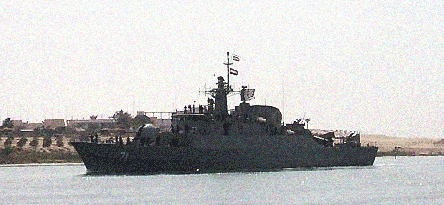
New Arab Democratic Governments May Neither Demonize Nor Embrace Iran
By allowing Iranian ships through the Suez Canal and refusing to continue to help strangle Gaza, Egyptians are simply opting out of a U.S. regional strategy of confronting Iran.
Raymond Davis: Insert Your Conspiracy Theory Here
The United States is claiming diplomatic immunity for a man who’s obviously no diplomat.
Last Thing Washington Needs Is to Share Blame if Egypt Becomes Another Pakistan
Washington’s optimal position may be as a concerned bystander to developments in post-revolutionary Egypt.
Egyptian Protesters Dared to Stand on the “Edge of Chaos”
What if, facing a hyper-speed revolution in Egypt, Secretary of State Clinton and her advisors had sat together examining fractal structures, nonlinear dynamical systems, and models of self-organization? Say what?
Why Washington Clings to a Failed Middle-East Strategy
We face the distinct possibility that the U.S. national security bureaucracy will continue to deny the disastrous consequences of our client-regime national-security strategy.
How Lebanon Got So Complicated
In many ways, Lebanon resembled Ireland, where religion was used to drive a wedge between landless Catholics and privileged Protestants.