The Bush administration has justifiably criticized the Zimbabwean regime of liberator-turned-dictator Robert Mugabe. It has joined a unanimous UN Security Council resolution condemning the campaign of violence unleashed upon pro-democracy activists and calling for increased diplomatic sanctions in the face of yet another sham election. In addition, both the House and the Senate have passed strongly worded resolutions of solidarity with the people of Zimbabwe in support of their struggle for freedom and democracy.
John McCain and the International Republican Institute
Senator John McCain presents himself as a what-you-see is what-you-get presidential candidate: clean, pragmatic, following his convictions even when not politically expedient. He considers himself to be someone who would make an excellent foreign policy president.
Sharp Attack Unwarranted
Gene Sharp, an 80-year-old scholar of strategic nonviolent action and veteran of radical pacifist causes, is under attack by a number of foreign governments that claim that he and his small research institute are key players in a Bush administration plot against them.
Picturing Genocide
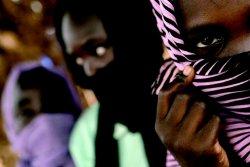
Sudanese girls seen in Darfur, Sudan, June 25, 2005. The 12-year-old girl wearing the striped scarf, front, reported how she was separated from her two friends, and raped by soldiers from the Sudanese government. Photo by R. Haviv
Hungry for Justice
When Paul Konar left his native India for the United States in 2006, he could never have imagined that less than two years later, he and several of his co-workers would be giving a lesson in Indian-style change making. Yet Konar, joined by his supporters and fellow fasters, has been on a vigil in Washington, DC for 17 days. He hasn’t eaten anything since May 14.
Strategic Dialogue on the Beijing Olympics
In their contributions to the Foreign Policy In Focus strategic dialogue on the Beijing Olympics, James Nolt argues in Counterproductive Olympic Protests that protesters are not spurring change in China only an upsurge in patriotism. Eric Reeves, in On Boycotting the Beijing Olympics, makes a case for the international community to send a signal to China over its Sudan policy by boycotting the opening ceremonies. Here they respond to each other by focusing on the question of Darfur.
On Boycotting the Beijing Olympics
Recent events — in Darfur, in Tibet, in Burma, and within China — force an inevitable debate about the appropriate political and moral response to China’s hosting of the Summer 2008 Games, and in particular whether some form of boycott is warranted. Unfortunately, if predictably, there has been a good deal more heat than light generated by this debate, which too often reflects clashing axioms rather than informed argument. Since my own expertise lies in understanding Sudan, and in particular the ongoing genocide in Darfur, I’ll necessarily focus on this part of the debate. But few working on Sudan are unaware of the controversies associated with Chinese economic policy and human rights standards elsewhere in Africa.
Counterproductive Olympic Protests
Whatever the intent of those organizing protests around the Chinese-hosted Olympics, the effect is largely counterproductive. Protesting a peaceful symbol of national pride merely insults all Chinese people rather than targeting action against the specific and unrelated actions of the Chinese government that protesters oppose. There is no doubt whatsoever that the Olympic Games are themselves a peaceful activity, offensive to nobody. Those wishing to protest specific Chinese government actions focus their protest on the Olympics only to opportunistically exploit the media attention on China during this popular event. This is an understandable tactic in this world of media-driven politics. However, many of the organizers of these protests have no idea of the real affect they have within China.
Penn State’s Frightening Defense
Standing in the student section of Penn State’s Beaver Stadium during football season always felt like witnessing a war unfold before your eyes. First the band would enter, marching in military-like formation and literally drumming up support from the crowd, while the cheerleaders would start up the most boastfully imposing chant in all of college sports: "We Are…Penn State." Then our four-star general, Coach Joe Paterno would run on the field flanked by his army of All-American linebackers and various other defensive backs, ends, and tackles because offense was always second to a strong defense in JoePa’s book. Even as a student, during perhaps the bleakest years of an otherwise dominating half-century of college football, I knew Pennsylvania State University was just as likely to be called "Linebacker U" as Penn State.
Postcard from…Ljubljana
The huge yellow banners on the façade of the building under renovation contain short statements that could be part of an advertising campaign or perhaps a conceptual art project. But the stories that are now appearing on this building (pictured) and bus shelters throughout downtown Ljubljana, the capital of the former Yugoslav republic of Slovenia, are far more subversive than that.