Does the quest for Israel-Palestine pece still accord with U.S. interests? Is it still the key to Middle-East stability?
Reader Challenge: Is the Middle-East Peace Process an Artifact of Another Age?
read more

Does the quest for Israel-Palestine pece still accord with U.S. interests? Is it still the key to Middle-East stability?
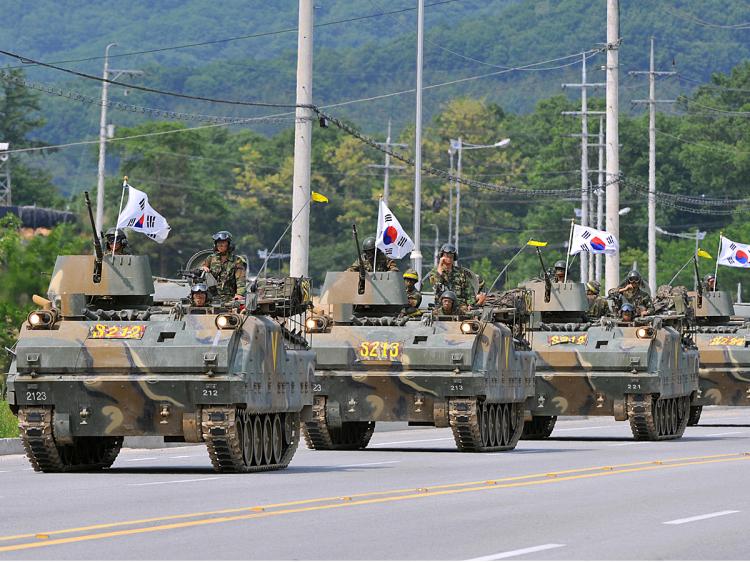
The Republic of Korea has rapidly increased its defense budget in recent years. Last year’s spending of 26.6 trillion won represents a twofold increase from ten years ago. Now the Ministry of National Defense projects an annual average increase of 7.6 percent to 53.3 trillion won by 2020, another doubling over the next decade. South Korea, notably, raised its defense spending at a higher rate than North Korea at a time when Seoul was taking a more conciliatory policy of engagement. While the Roh Moo-hyun administration increased defense spending ostensibly in response to its policy goal to build a more autonomous military, the U.S.-Korea alliance motivated and shaped South Korea’s military transformation. This article examines the degree to which external threats, domestic interests, and the alliance have affected the South’s military spending and transformation.
United States presidents rarely visit the U.S. territory of Guam (or Guåhan in the Chamorro language), but President Obama may visit in June 2010. This will be a significant stop for residents of this small island, 30 miles long and eight miles wide, dubbed, “Where America’s day begins.” Guam is the southern-most island in the Northern Mariana chain that also includes Rota, Tinian, and Saipan. It is the homeland of indigenous Chamorro people whose ancestors first came to the islands nearly 4,000 years ago. Formed from two volcanoes, Guam’s rocky core now constitutes an “unsinkable aircraft carrier” for the United States military in the words of Brig. Gen. Douglas H. Owens, a former commanding officer of Guam’s Andersen Air Force Base.1
In case you hadn’t noticed, our Afghan War, like some oil-slicked bird in the Gulf of Mexico, has been dragged under the waves. It’s largely off front pages and out of the TV spotlight (despite the possible linkage of the Times Square failed car bombing to the Pakistani Taliban). As a result, most Americans undoubtedly have little idea just how large the American war effort there has grown. The president’s massive surge — not just of troops, but of State Department civilians, CIA agents, drones, contractors, base building, and who knows what else — is actually going (if you’ll excuse the phrase) great guns.
Last summer, the Economist published a letter from hawkish Arizona Senator John Kyl (currently neck deep in the springtime of his state’s immigrant shame). Cole Harvey of the James Martin Center for Nonproliferation Studies reports that Kyl wrote: “Every nuclear weapons power— with the exception of the US — is currently modernising its nuclear weapons and weapons delivery systems…Yet the US continues to permit its nuclear forces to atrophy and decline.”
The bubble is bursting.
I’m not talking about the Greek economy, the collapse of which has bankers and finance ministers trembling from Athens to Antarctica. Nor am I talking about the oil spill in the Gulf of Mexico, which reminds us once again that our current energy security rests on shaky foundations.

Afghan President Hamid Karzai is in Washington this week, where he’ll be meeting with President Obama on Wednesday. Afghan government officials have said that a top priority for these talks is to win President Obama’s full support for the Afghan government’s efforts to reconcile with senior leaders of the Afghan Taliban insurgency in order to end the war.
Maybe not as much fun to speculate about as the DYI garage shop cruise missile, but a potential game changer.

The recent military budget increases in East Asia are motivated by various factors—flash point-driven, hedging strategy-driven, or governance-driven—but they do necessarily trigger an arms race in the region. Domestic politics within Japan, South Korea, China, and the United States have had a complicated impact on regional security. Furthermore, the potential crisis points on the Korean peninsula and in the Taiwan Strait are also driving factors that test the stability of the region. Despite competing interests and challenges, the U.S.-led system seems to be enduring and a great-power rivalry stemming from the increases in military spending between the United States and China appears unlikely.
Japan’s military budget has held steady at below one percent of its GDP. Japan spends heavily on personnel for its Self-Defense Forces, support of U.S. bases in Japan, and development of its ballistic missile defense and space development. Yet in recent times, the Japanese business community has also demanded an amendment to Article 9 of the constitution for the promotion of military-civil integrated space development and an end to the ban on arms exports. With the future of Japan’s security policy still uncertain after the election of the new Hatoyama administration, innovative disarmament cooperation would better serve the stability of the region than Japan’s development of high-tech, offensive military capabilities.