
Originally published in Gad World.
Anti-Muslim sentiment is on the rise in the United States, and yet Muslim political candidates are enjoying a banner year.
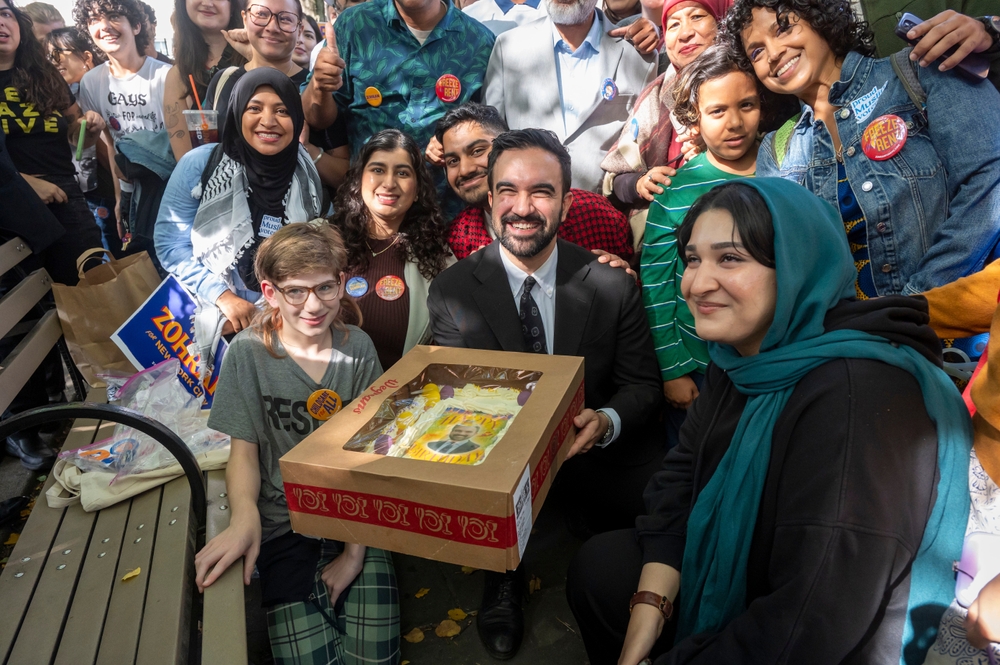
Zohran Mamdani was elected the first Muslim mayor of New York City in 2025. This year, Abdul El-Sayed won the Democratic primary in Michigan and stands a good chance of becoming the country’s first Muslim senator. The number of Muslims in the House of Representatives could rise to as many as seven after the upcoming November elections. According to the Council on American-Islamic Relations (CAIR), a record 255 Muslim elected officials now serve in 26 states, including four members of Congress, 11 mayors, and 46 members of state legislatures.
At the same time, however, America experienced a major increase in Islamophobia last year—8,683 cases of discrimination, the highest since CAIR began tracking such developments in 1996. The surge has been particularly visible in states such as Florida, Minnesota, and Texas. One Republican candidate for state office in Texas, Bo French, wrote on social media this summer that “I won’t rest until every Muslim is gone” from the state.
This sentiment, however, isn’t restricted to the level of the states. Nancy Mace, a Republican member of Congress, has said that “every single Muslim holding public office in America” is “a threat to both national security and our republic.”
The rise in anti-Muslim discrimination—and the sheer virulence of it—certainly owes much to the policies and rhetoric of Donald Trump. His campaign to deport all undocumented residents of the United States has unleashed xenophobia at all levels of society, but it has taken an anti-Muslim form when applied to the Somalis, Sudanese, and Afghans that the administration has targeted for removal. Trump has said, for instance, that Somalia “stinks” and that Rep. Ilhan Omar, a Somali-American member of Congress from Minnesota, “garbage.”
The war against Iran has also contributed to the ratcheting up of Islamophobia. Although the Trump administration has maintained close relations with a number of majority-Muslim countries—Turkey, Saudi Arabia, United Arab Emirates—it has often framed the war in Christian nationalist terms. Referring to Iran, House Speaker Mike Johnson stated that “we’re the Great Satan in their analogy and their misguided religion.” The Center for the Study of Organized Hate has reported a spike in Islamophobic content on social media that coincided with the outbreak of hostilities.
Through his own abusive rhetoric, Trump has encouraged more open expressions of bigotry. In the last major outbreak of Islamophobia in the United States after the September 11 attacks, President George W. Bush made an effort to calm the waters by visiting a mosque and, for the most part, avoiding statements that demonized entire cultures. Trump, however, delights in just such forms of bullying.
Trump’s policies have naturally produced a backlash. Communities targeted by his administration have mobilized politically, and that includes Muslim Americans. In Minneapolis, for example, Muslim clergy have organized to defend the Somali community, and they have received support from an interfaith coalition. During Trump’s first term, Muslim Americans came out in large numbers to deny him a second term.
These aren’t the first such mobilizations. The earlier wave of Islamophobia in the early 2000s prompted Muslim Americans to seek political power. At that time, conservative activists were deploying widespread misinformation and invective in their high-visibility campaigns to stop the construction of mosques and ban “sharia law” at the state level. But these campaigns also pushed Muslim Americans to fight back. In 2006, five years after the September 11 attacks, voters sent the first Muslim American, Keith Ellison, to Congress.
Although most Muslim Americans tend to vote for and run as Democrats, they also refuse to be taken for granted by the party. During the 2024 elections, Muslim Americans in Michigan launched the “Uncommitted” campaign to deny Democratic frontrunner Joe Biden their votes. They were angry that the Biden administration had failed to advocate more effectively for Palestinians during the Israeli war in Gaza. This frustration with mainstream Democrats has also motivated a number of Muslim Americans—including Mamdani and El-Sayed—to run as progressives. To compensate for their lack of support from the Democratic Party apparatus, they have bypassed traditional media outlets by releasing viral videos, like those of Mamdani walking around Manhattan and El-Sayed dancing at a Zumba class.
The political success of Muslim Americans, particularly those on the progressive wing of the Democratic Party, stems in part from the shift in public opinion on Israel and Palestine. The brutality of the Israeli response to the Hamas attacks on October 7, 2022—killing tens of thousands of Palestinians in Gaza, accelerating settlements in the West Bank, and launching military operations in Lebanon, Syria, and against Iran—has caused a reversal of sympathy among Americans. According to a 2026 Gallup poll, 41 percent of Americans now view Palestinians more favorably while only 36 percent sympathize more with Israelis. Only a year ago, Israelis had a sizable lead in American affections, capturing 46 percent compared to 33 percent for Palestinians.
This shift is evident among American Jews as well, with 61 percent believing that Israel has committed war crimes in Gaza and nearly 40 percent labeling Israeli actions “genocide.” The disaffection has become so dramatic that American Jews now feel considerably more positive toward Zohran Mamdani than toward right-wing Prime Minister Benjamin Netanyahu, according to a June 2026 poll.
The backlash to Trump’s policies goes well beyond his policies on Israel and his deference to Netanyahu. The U.S. president and his MAGA coalition have aggressively promoted the viewpoints of white, Christian conservatives. They have imposed on the United States precisely the kind of religious extremism that they have falsely accused Muslims of preparing to unleash. The religious war initiated by Trump allies has stripped women of their reproductive rights, mandated Christian texts and teaching in public schools in several states, and dramatically increased the power of churches in public policy. The Trump administration has also passed laws that have allowed the rich to grow incomparably richer while hurting the middle class and the working poor.
It’s not just Muslim Americans who are jumping into politics to fight these trends and ensure that America reembarks on its long journey toward a more just and pluralistic union. In Michigan, where the Latino community helped Abdul El-Sayed win his primary, Latino voter turnout increased dramatically since the last midterm election and helped propel eight Latino candidates to victory in their primaries. As Abdul El-Sayed said on the day after his primary victory, “This is the best place in the world to be Abdul.” He was speaking of Michigan, but he could have been talking about the United States as a whole. Muslim Americans, alongside everyone who belongs to groups demonized by Trump and his cohort, are fighting to make such statements true again.