
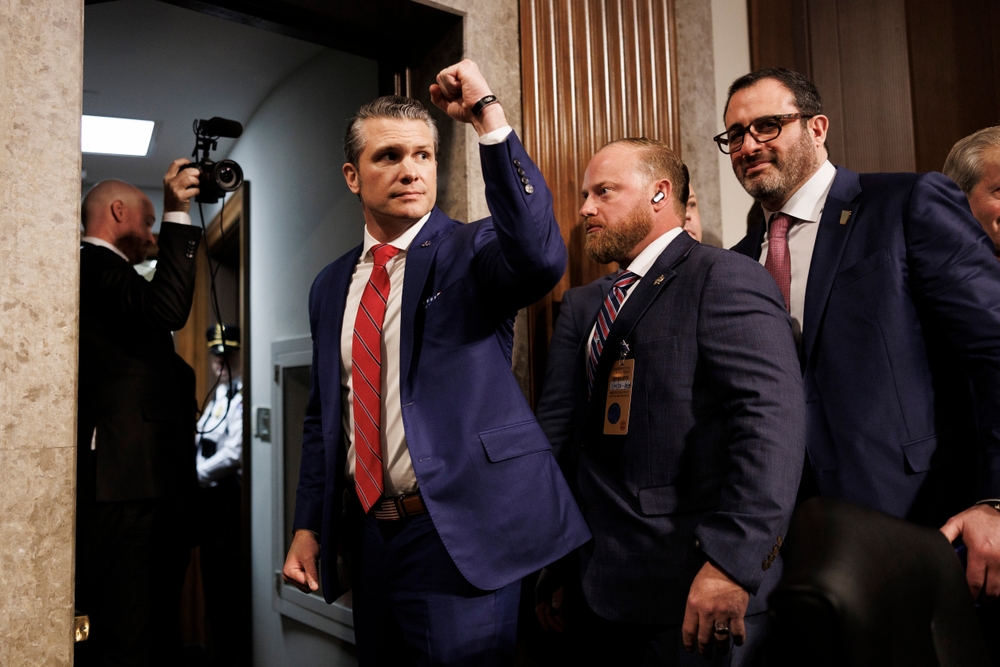
This week, Secretary of War Pete Hegseth was on hand in Normandy for the eighty-second anniversary of the D-Day invasion. He made the usual remarks about U.S. dedication to defending freedom, just as he did last year on a similar occasion.
This time around, however, Hegseth veered off into controversial territory.
Not that you can figure this out from the War Department’s anodyne summary of Hegseth’s speech. Unlike last year, the U.S. government hasn’t seen fit to provide a transcript of Hegseth’s remarks. You have to nose around the Internet to find out what Hegseth said that raised so many eyebrows.
Did the Pentagon chief use the D-Day commemoration to denounce the current specter of fascism that is haunting Europe?
No.
Did he warn of the threat that Russia poses to the continent?
Hardly.
Hegseth denounced an invasion of an entirely different sort. “Today, different European beaches are stormed by different dangerous ideologies,” he said. “Boats and men arrive. When will European capitals do something about that invasion? Or is it too late?”
Between his speech last year and the one this year, Hegseth has evidently gotten his marching orders. Ever since JD Vance lectured his elders and betters at the Munich summit last year, the Trump administration has united around the theme that immigrants threaten European “civilization.” Vance wasn’t even being original. Both his and Hegseth’s talking points come straight out of the mouths of the European far right. Unlike the usual game of telephone, where the message is garbled through misheard repetition, the fulminations of Trump’s henchmen are loud and clear.
The Trump administration is all about defending white “civilization” from the impertinent contributions of Black and brown people. At home, that means scrubbing all government websites, National Park inscriptions, and federal grants of any reference to “woke” ideologies, which used to be known as anti-racism, diversity, or just plain common sense. It has meant restricting refugee policy to the only group the Trump administration perceives as meeting the need-based criteria—white South Africans. It has meant an industrial-strength deportation campaign.
Abroad, the Trump administration is trying to “save” Europe from the immigrants that are in reality keeping European societies afloat in the face of demographic decline. In this effort, it has joined hands with the most repulsive extremists on the continent. Greg Bovino, who headed up Trump’s immigration crackdown in the United States as the commander-at-large of the U.S. Border Patrol, recently showed up in Europe to headline an event in Portugal populated by white supremacists and neo-Nazis. The era of covert alliances and dog-whistling is long past.
But the D-Day speech was something different: a historical commemoration that has usually avoided contemporary politics. Prompted to reflect on present-day “invasions,” the European heads of state listening to Hegseth’s speech might have been thinking of an entirely different group of men and boats. The Trump administration has talked about the possibility of storming the beaches of Greenland to seize the island, an eerie echo of Nazi Germany’s blitzkrieg seizure of Poland in 1939. On this anniversary of D-Day, Americans in boats are the last thing Europeans want to see approaching the fringes of the continent.
“Different dangerous ideologies, indeed,” the Europeans in the audience must have been thinking. Having been warned on numerous occasions, European capitals are certainly doing something to prepare for the impact of the ideologies dominating the Trump administration. It’s hard to know if Europeans really take seriously the prospect of an invasion coming from the West. But they are certainly worried about the failure of the United States to honor its D-Day commitments in the future.
The Immigration Obsession
The European far right has made its name by playing up the “threat” of immigration. Keeping out immigrants was a central plank in Viktor Orban’s platform in Hungary as well as that of Law and Justice Party in Poland, both of which have subsequently lost power. No matter: other parties are on the ascendant. The far right Alternative for Deutschland, having weaponized the issue of immigration, is on the verge of taking control of its first German region in elections in September in Saxony-Anhalt. Similar anti-migrant far-right parties are in coalition governments in Finland and Croatia and dominate the parliament in The Netherlands.
Then there’s Italy. Although she has diverged from the Trump administration on a number of issues, including their views of the current Pope, Prime Minister Giorgia Meloni remains vehemently anti-immigrant, pushing ahead with the country’s expulsion of migrants and asylum-seekers to detention centers in Albania, despite legal pushback from Italian courts and EU bodies.
What might have once been a fringe opinion has now moved front and center in Europe. As a result of rising far-right influence, the EU is now using Italy’s detention centers in Albania as a model for “detention hubs” planned for Africa. “This deal will give governments much broader powers to detain and deport people,” Marta Welander of the International Rescue Committee told PBS. “It looks set to normalize immigration raids, expand the use of detention in prison-like facilities outside EU territory that are essentially legal black holes, and increase the risk of people being deported to countries where they could face persecution, torture or worse.”
So much for Europe stepping forward in the Trump era to uphold the rules-based order. At least on immigration policy, the EU is instead following Trump’s lead. Hegseth, in addition to his other failings, didn’t even read the newspaper before giving his D-Day speech. Even as he was channeling the rhetoric of the European far right, European capitals have already been channeling Trump’s immigration policies.
The Real Threats
It’s frankly astonishing that an American politician could discuss D-Day and invasions at this historical moment without mentioning the single most destabilizing invasion since World War II.
Russia’s full-scale invasion of Ukraine in 2022 was a deliberate attempt to remake the European order. Violating international law by disregarding Ukrainian sovereignty was unsettling to be sure, but that was just a means to an end. The incorporation of as much of Ukraine as he could digest was designed to expand Russian power at the expense of the European Union and its cohesiveness.
Although Putin and his mouthpieces have droned on about the threats of NATO expansion—and, to be sure, rapid NATO expansion eastward was a mistake—the real threat to Putin’s dominion has always been the accession of Eastern European and then post-Soviet states into the European Union. A model of economic prosperity, democratic governance, and unrestricted travel, if extended to Ukrainians, Moldovans, and Georgians, would inevitably get Russians to thinking: why not us? Putin has always worried more about the threat from within, like a color revolution, than threats from without, like NATO expansion.
Against the liberalism of the EU, Putin has offered instead a vision of ethnic counter-expansion that appeals to the aggrieved Russian sense of self. Adoption of the euro, the right to work in Paris, the freedom to gather outside the Kremlin to protest: none of these can compete against toxic masculinity, blood and belonging, and the appeal of an iron fist.
Putin’s alternate conception of illiberalism, with its emphasis on conservative values and ethnonationalist triumphalism, is now threatening Europe in turn. Some of Putin’s allies have gone down for the count, but his rhetoric still resonates in the speeches of far-right figures throughout the continent. A number of leaders are scrambling to be the next Viktor Orban—Robert Fico of Slovakia, Andrej Babis of the Czech Republic, and, most ominously, the frontrunner in next year’s French presidential race, Jordan Bardella of the National Rally.
Putin is not so dumb as to double down on his Ukrainian blunder by sending military forces into Poland or even the Baltic states. Cyberattacks and clandestine operations can be more effective since they don’t cross the threshold that mandates a NATO counterattack. Meanwhile, influence operations—disinformation campaigns, strategic political alliances, and the marketing of illiberalism—are even more effective in undermining the ideological underpinnings of the EU.
This latter campaign has more than double the impact when it’s mirrored on the Atlantic side by the actions of Trump, Vance, and Hegseth.
European Response
Europe is not in full-fledged revolt against Trump. The shift in EU immigration strategy demonstrates that some European leaders don’t want to just flatter Trump; they want to imitate him as well.
Still, there are pockets of resistance. A number of European countries defied the Trump administration in 2025 to recognize Palestine. Spain’s Pedro Sanchez refused to toe the U.S. line on Iran. Denmark has led the charge to beat back the administration’s efforts to secure Greenland.
European capitals are preparing in more institutional ways to address the much larger threat of Americans in boats, this time the ones that don’t arrive for a future battle as their counterparts did so reliably on D-Day. Trump has variously threatened to leave NATO or ignore U.S. Article 5 commitments to defend fellow NATO members in the event of an attack. This month, the Pentagon announced a decrease in the forces that the United States will make available—aircraft, ships—during a crisis in Europe.
Europeans have gotten the message. They’re not just increasing their military spending. They’re building up their capacity to produce their own weapons rather than rely on the U.S. military-industrial complex. They’re talking about creating an autonomous European army. They don’t want to be caught flat-footed by American ambivalence.
In the wake of Trump’s decision to go to war against Iran, Europeans are also eager to wean themselves of dependency on U.S. fossil fuels. Fresh from their campaign to reduce imports of Russian fossil fuels, more far-seeing Europeans want to make sure that they’re not yoking themselves to American gas and oil. The better option: full speed ahead on home-grown renewables.
“The European Union can’t fully trust US President Donald Trump to keep Europe out of the cold next Winter,” writes Linda Aziz-Rohlje of Renew Europe. “We are risking our democracy, our prosperity and our security if we do not take action. That’s why liberals and democrats call for an energy-independent Europe, with a more integrated energy market.”
Finally, Europeans are worried about their reliance on U.S. technology. “European leaders have become increasingly alarmed by the reliance on American technology in areas like artificial intelligence, cloud computing and semiconductors,” reports Adam Satariano in The New York Times. “Many worry the dependence creates a ‘kill switch’ that the Trump administration or future U.S. presidents could exploit to block access to essential tech services.”
On weapons, energy, and tech, Europe is groping toward a declaration of independence from America.
Against this background, Pete Hegseth has attempted to remind Europeans of how much the United States came to their aid during a time of crisis. And he has attempted to warn them of grave threats lying beyond their borders.
Mr. Hegseth: you are that threat.
Hegseth and everything he stands for, from the effort to grab Greenland to the attacks on European liberalism, should persuade the French to rescind any invitation to next year’s ceremonies in Normandy.