The shift in Congressional Medal of Honor emphasis may reflect a national ambiguity about our wars.
Revisiting the Neutered Medal of Honor Argument
read more

The shift in Congressional Medal of Honor emphasis may reflect a national ambiguity about our wars.
Despite the Obama administration’s repeated assurances to the contrary, the war in Afghanistan has taken a turn for the worse since the troop surge. Public opinion in the United States, NATO countries, and Afghanistan itself increasingly oppose the war. Corruption remains rampant, President Karzai’s influence barely extends beyond Kabul, and the military’s “counterinsurgency” strategy has translated into stepping up aerial bombings and night raids. At $8 billion a month, the war is bankrupting the United States with very few results to show for it.
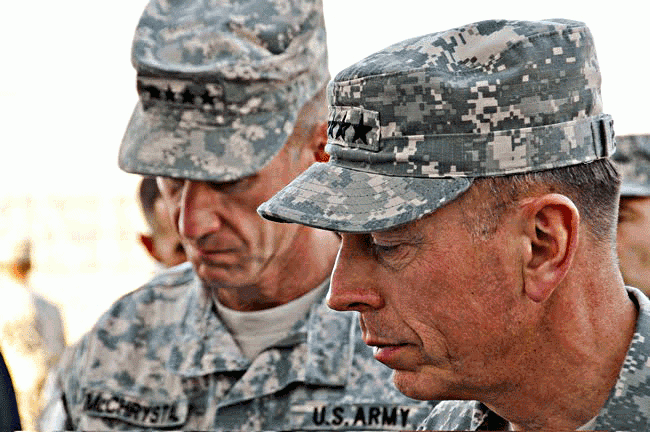
Does anybody really know what counterinsurgency is anymore?
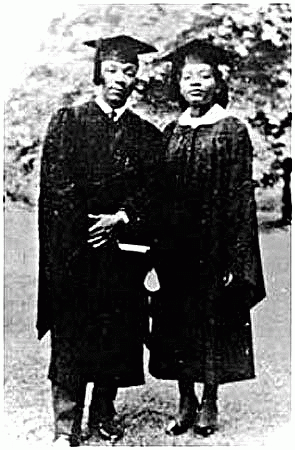
Did Defense Department general counsel Jeh C. Johnson really think invoking Martin Luther King, Jr.’s name in the service of our presence in Afghanistan would fly?

Foreign occupation is the common thread tying suicide terrorism together the world over. In Dying to Win and again in Cutting the Fuse, Robert Pape argues that the United States must endeavor to draw down its occupation of Middle Eastern countries and return to a policy of offshore balancing to maintain its regional interests.

In spite of a White House report that “progress” is being made in Afghanistan, by virtually any measure the war has significantly deteriorated since the Obama administration surged troops into Kandahar and Helmand provinces. This past year has been the deadliest on record for U.S. and coalition troops. According to the International Committee of the Red Cross, security has worsened throughout the country. Civilian casualties are on the rise. U.S. allies are falling away, and the central government in Kabul has never been so isolated. Polls in Afghanistan, the United States, and Europe reflect growing opposition to the nine-year conflict.
Just as 2010 ended, the American military’s urge to surge resurfaced in a significant way. It seems that “leaders” in the Obama administration and “senior American military commanders” in Afghanistan were acting as a veritable WikiLeaks machine. They slipped information to New York Times reporters Mark Mazzetti and Dexter Filkins about secret planning to increase pressure in the Pakistani tribal borderlands, possibly on the tinderbox province of Baluchistan, and undoubtedly on the Pakistani government and military via cross-border raids by U.S. Special Operations forces in the new year.
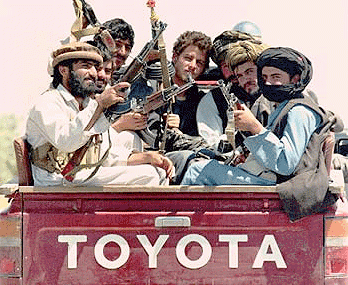
The individual or group, such as the Taliban, with more available options — harassing, pursuing or retreating — is most likely to prevail.
Remember as the invasion of Iraq was about to begin, when the Bush administration decided to seriously enforce a Pentagon ban, in existence since the first Gulf War, on media coverage and images of the American dead arriving home at Dover Air Force Base in Delaware? In fact, the Bush-era ban did more than that. As the Washington Post’s Dana Milbank wrote then, it “ended the public dissemination of such images by banning news coverage and photography of dead soldiers’ homecomings on all military bases.”
Lowering the benchmark for COIN success.