The real story of why American industry moves to China may never be told in the mainstream media.
True Reason for China’s Appeal to American Industry Even More Shameful Than Low Wages
read more

The real story of why American industry moves to China may never be told in the mainstream media.

Sounding the alarm about various threats posed by a rising China has become a cottage industry among pundits and politicians. One of the oldest warnings is that China’s increasing demand for food will wreak havoc on international markets, causing mass starvation in food-importing countries. But this concern ignores the safeguards China has in place for food shortages and the lessons the rest of the world could learn from this approach.

On the surface, the antagonism between China and the United States resembles the imperial competition between Britain and Germany at end of the 19th century. But the world of 2011 is very different than in 1914. It is far more connected, far more interdependent, with the consequences from rivalries far more dangerous. Now every time either side brings in its military, tensions increase and solutions turn elusive.

U.S. support for an authoritarian regime is by no means a new phenomenon nor is it peculiar to the Middle East.

As in the United States, the military and big business in China aren’t shy about challenging the executive office.
Is China smartening up its environmental and social act in Africa? It certainly wants to be seen as doing just that. One telling example was the recent Chinese government-sponsored ‘top Chinese enterprises in Africa’ competition, won by China Road and Bridge Corporation [CRBC].

The United States is, by far, the Philippines’ most important strategic security partner. China’s ascent as a regional Asia Pacific powerhouse, coupled with the relative decline of the United States, has threatened to reconfigure this equation. Yet China’s growing assertiveness over territorial claims from Northeast Asia to the South China Sea might also unravel two decades of its relatively successful charm offensive, which calmed the nerves of many anxious Southeast Asian nations. Any display of aggression by China in the South China Sea could compromise its relations with the Philippines.
The attempt to revise the weapons export ban is part of a dual-hedge strategy of Japan’s defense policy and its alliance with the United States.
North Korea may feel that the time has come to establish relations with the United States as a hedge against unpredictable future relations with Beijing.
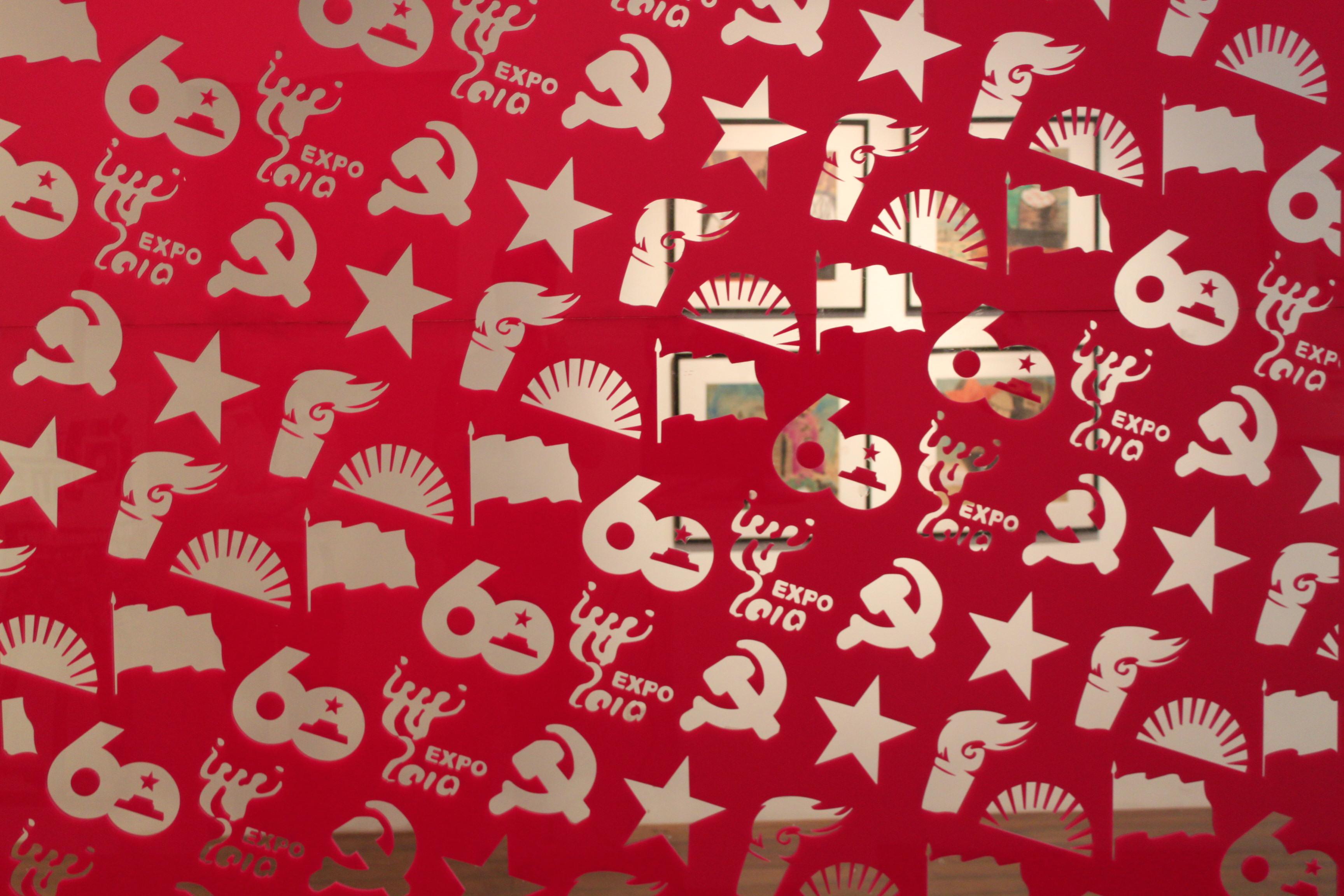
This photo was taken in Shanghai’s stylish former French Concession district while, across town, the 2010 World Expo ushered in hundreds of thousands of visitors per day. The contemporary art piece on display by Beijing artist Ren Hong juxtaposes the potent political images of the Expo, Beijing’s Olympics, and the People’s Republic’s 60th anniversary celebration. The attendant moral complexities of these spectacles are filtered out through simplistic official symbols. Her work is a fitting eulogy for the Expo that closed in October.