When pundits talk about the U.S. elections and foreign policy, they focus on Iraq and Iran. But the third member of the infamous “axis of evil” may prove to be just as influential.
Stealth Crisis
read more

When pundits talk about the U.S. elections and foreign policy, they focus on Iraq and Iran. But the third member of the infamous “axis of evil” may prove to be just as influential.

"There are no heroes in sports. Athletes today are often referred to as heroes or warriors, when in reality, they’re neither." These are the opening remarks of a speech given in memory of Pat Tillman, a professional football player who gave up his career to join the United States Army shortly after September 11, 2001.
Over the past half decade a broad consensus has emerged among informed observers in the Middle East that recent U.S. policies in the region – from Iraq and Iran to our approach to the Palestinian-Israeli conflict, Syria, Hamas, and Hezbollah – have been ill-conceived and executed, and have damaged both America’s standing in the region and prospects for peace and stability in the area. Yet a series of local initiatives this year suggests that an important restructuring of relationships across the region might lead to some resolution to a number of the region’s thorniest problems.
As a journalist who has reported extensively on the death and destruction that is U.S.- occupied Iraq, perhaps I should be happy about the prosecution of former Marine Corps Sergeant Jose Luis Nazario Jr. Standing accused of killing unarmed four detainees in Fallujah in 2004, Nazario is the first Iraq War veteran to be tried for war crimes in a civilian court. His trial, which began in Southern California this week, marks a new chapter in American jurisprudence – with the long arm of the law reaching past the jurisdiction of a military court martial. If convicted of all charges, Nazario could face more than 10 years in prison, according to the Associated Press.
The United States is in a huge foreign policy muddle in the Middle East. It wants to dominate and control Iran but requires the support of the world community to accomplish its aims. Diplomacy and sanctions require only a low level of support. On the other hand, to launch a military attack or green-light one by Israel, the United States needs far more backing.
While overall levels of violence in Iraq have significantly dropped from their peak in 2006, every day seems to bring news of yet another ghastly suicide bombing, only now the bomber often comes in a black abaya, the full-length robe worn by many Iraqi women. For the one deadly number that has risen substantially since the U.S. military "surge" and widely touted adoption of a new "hearts and minds" counterinsurgency strategy in early 2007 has been the dramatic increase in suicide bombings carried out by Iraqi women.
Diplomacy between Iran and the United States has entered the opening gambit stage and Iran appears to be winning at this point.
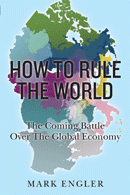
Just as many books have been written as there are individual viewpoints on the crises related to globalization. Mark Engler’s new title How to Rule the World: the Coming Battle Over the Global Economy has some unique offerings. It offers insight about the different currents at play in globalization, along with some new analysis about the rise of a distinct globalization that promotes social and economic democracy. This new movement is people-powered, and its future is promising.
The United States’ rather muted, lackadaisical response to the constitutional conflagration set to engulf the future of Turkey’s ruling Justice and Development Party (AKP) should be of grave concern to those committed to the achievement of greater stabilization and liberal democratization within the Middle East. The pending decision of the Turkish Constitutional Court over whether or not to ban the democratically elected AKP, as well as the international response towards such proceedings, are setting important, potentially dangerous, precedents for both Iraq and Afghanistan’s already fledgling, nascent democracies.
Some neoconservatives in Washington are obsessed with attacking Iran before President Bush leaves office at the end of this year. Hence, they have been pushing the Bush administration for increased economic and political isolation of Iran in order to weaken its current regime. Crucial to this plan is the support of Turkey, a traditional U.S. ally and an increasingly critical player in the region.