Even sending Bill Murray to negotiate with North Korea is preferable to Obama’s Bush-like hard line, complete with sanctions.
The people of South Korea, North Korea and the United States are already paying a tax, not for reunification, but for preparation for war
Relations between the United States and North Korea, never particularly warm, have truly frosted over in recent months. The Obama administration, in the wake of the Cheonan incident, has added financial sanctions to a lengthening list of efforts to box in Pyongyang. In conjunction with Seoul, Washington has ramped up military exercises in the region. Six Party Talks have been suspended since the end of the Bush administration, and there haven’t been bilateral discussions for more than six months. Hillary Clinton has continued to speak of U.S. willingness to sit down and negotiate. But in Washington, engagement with North Korea is about as popular as BP stock. Anti-American rhetoric and threats, meanwhile, remain de rigueur in Pyongyang.
Regime change in North Korea not likely due to Kim Jong-il’s ingenuity as well as a lack of international consensus on how to proceed.
Two respected Korean-American researchers cast new doubt on South Korea’s conclusion that North Korea sunk the Cheonan.
Recent scrutiny of U.S.-Japan base realignment and Okinawan anti-base opposition has overshadowed U.S. military issues in South Korea. As others have argued, the struggle in Okinawa represents only one facet of the larger global struggle against U.S. bases.3
Instead of a torpedo, was the Cheonan sinking the result of grounding, a collision, or friendly fire?
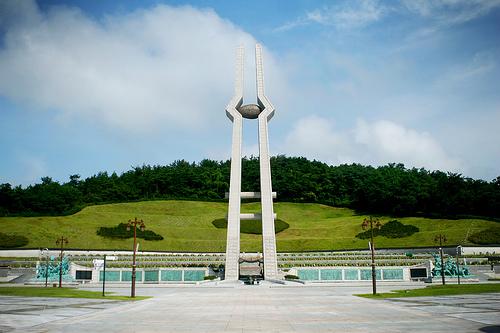
Last week marked the 30th anniversary of the Kwangju Citizens’ Uprising in South Korea, a pivotal event that inspired the Korean democratic movement through its ultimate victory in the late 1980s. In Kwangju, where hundreds died in the uprising, the event was marked by solemn remembrances and the presence of political leaders from both left and right, including representatives of President Lee Myung-bak, South Korea’s most conservative leader in over a decade. But the event drew hardly a passing glance in the United States, which is South Korea’s closest ally.
It was probably North Korea behind the sinking of the South Korean ship. But we still need to respond with a hand and not a fist.
The Republic of Korea has rapidly increased its defense budget in recent years. Last year’s spending of 26.6 trillion won represents a twofold increase from ten years ago. Now the Ministry of National Defense projects an annual average increase of 7.6 percent to 53.3 trillion won by 2020, another doubling over the next decade. South Korea, notably, raised its defense spending at a higher rate than North Korea at a time when Seoul was taking a more conciliatory policy of engagement. While the Roh Moo-hyun administration increased defense spending ostensibly in response to its policy goal to build a more autonomous military, the U.S.-Korea alliance motivated and shaped South Korea’s military transformation. This article examines the degree to which external threats, domestic interests, and the alliance have affected the South’s military spending and transformation.