If it weren’t for decades of Western-backed political and economic repression, the Philippines might have joined the Asian Tigers years ago.

Typhoons and Tigers: Why Taiwan Has Outpaced the Philippines
read more

If it weren’t for decades of Western-backed political and economic repression, the Philippines might have joined the Asian Tigers years ago.
China has grown more willing to assert historical claims to its sphere of influence, but it would be a mistake to regard this as “aggression” that requires an American response.
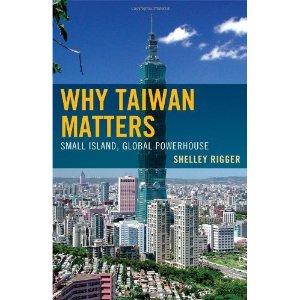
Taiwan, according to Shelley Rigger, is a small and beautiful island, but also a global powerhouse. A professor at Davidson College, Rigger has been living and visiting Taiwan for nearly three decades. Her new book, Why Taiwan Matters, reveals her extensive knowledge of the history of the island and its relationship to mainland China.

In a rare show of bipartisanship, Senators Robert Menendez (D-NJ) and John Cornyn (R-Tx) jointly introduced legislation demanding that the administration sell F-16s to Taiwan.
Long before the most recent round of cherry-picking intelligence was the cherry picking of political science theories, particularly the “democracy-peace” genre. The theory goes that democracies are the most peace-loving because they haven’t fought among themselves since 1700, and therefore so more democracies must lead to more peace. Around the time of the U.S. invasion of Iraq in 2003, this invention of American political scientists assumed the brave new label of the “reverse domino theory.” A democratic Iraq was supposed to set off a chain reaction transforming an entire region.
Neville Chamberlain famously excused the abandonment of Czechoslovakia at Munich by calling the victim “a faraway country of which we know little.” His infamy is not totally deserved. Britain had no treaty ties to Prague, nor did it have the military capacity to take on Germany at the time, and Chamberlain on his return immediately kick-started British rearmament.
For years, dealing with Pyongyang has been the most difficult diplomatic endeavor for Beijing. This was the case even before the outbreak of the Korea War when Kim Il Sung, father of the current North Korean leader Kim Jong Il, worked out a war plan with Soviet leader Stalin and then sold it to Mao. The day after the North attacked the South, President Truman ordered the 7th Fleet back to the Taiwan Strait and hence the Mainland lost Taiwan. During the three-year conflict, China bore the brunt of the fighting and suffered hundreds of thousands of casualties. The post-war North Korean official propaganda, however, scarcely acknowledged China’s role. Last October, the Democratic People’s Republic of Korea (DPRK) tested its nuclear device despite China’s warning and efforts to resolve the nuclear issue peacefully. Now, after years of China’s hard work to host many rounds of six-party talks, a North-South summit early this month in Pyongyang went as far as to suggest that China may not be a party “directly concerned” with a “permanent peace regime” on the peninsula.
President George W. Bush decided April 23rd to offer Taiwan the largest arms package since his father sold various warships and F-16 fighters to Taiwan a decade ago. Bush did deny Taiwan the most expensive and controversial items on Taiwan’s shopping list: four Arleigh Burke-class destroyers equipped with advanced Aegis radar systems. Bush did approve two other weapons systems that mainland China strongly protests: eight submarines and twelve P-3C Orion anti-submarine patrol aircraft (a different version of the same model involved in the recent spy plane incident with China). Also offered for sale are four older Kidd-class missile destroyers. Although these are not nearly as sophisticated as the Arleigh Burke-class, they are twice as big as any existing Taiwanese warship and much more capable than most Chinese destroyers. They would be a major addition to Taiwan’s navy.
One year after Taiwan’s first democratic transfer of political power from the long-ruling KMT, the island’s political system has quickly taken on many of the most illustrious characteristics of American democracy: presidential victory by plurality, intra-party conflict, impeachment talk, sex scandal, and legislative gridlock. Yet, Taiwan is in a far different position than the United States; it exists in a precarious international limbo, and it has an exceedingly short democratic history. Consequently, although Taiwan’s prospects for democratic consolidation seem good, its new president faces special challenges in his quest to ensure Taiwan’s continued international security and domestic prosperity.