Since the U.S. is a secular, not a Judaeo-Christian state, there is no need for Muslims to be “tolerated” because they’re already as much a part of the state as any group.
Coining a clever euphemism and co-opting a key nuclear term aid pro-nuclear forces in furthering their agenda.
Embracing Armageddon, as well as creating the conditions for it, is blatantly un-Christian.
By attacking the Ground Zero Islamic Center, conservatives are both inciting attacks on American Muslims and undermining the Afghan strategy of General Petraeus.
Kavitha Rajagopalan’s book, Muslims of Metropolis, chronicles the struggles of three Muslim immigrants and their families as they vie to establish themselves in this unwelcoming environment. An immigration scholar, Rajagopalan offers accounts that are at once broad and detailed, clinical and intimate, providing scholarly insight and sociological context with a deft touch.
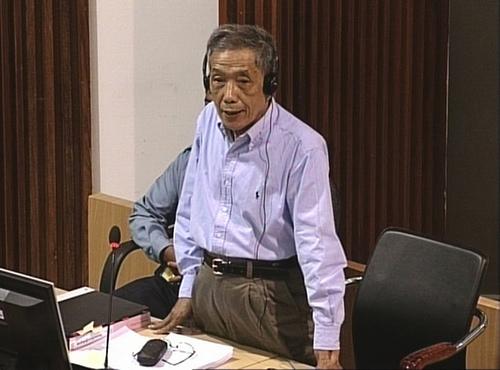
The Khmer Rouge Tribunal delivered its first verdict in July against Kaing Guek Euv, alias “Duch,” the director of the notorious S-21 prison, a torture and extermination center under the rule of Cambodian dictator Pol Pot. After a 77-day trial, the five judges — two international and three Cambodian — unanimously convicted Duch of committing crimes against humanity. He was sentenced to 35 years in prison.
Iraq has between 25 and 50 percent unemployment, a dysfunctional parliament, rampant disease, an epidemic of mental illness, and sprawling slums. The killing of innocent people has become part of daily life. What a havoc the United States has wreaked in Iraq.
In the raging currents of world history, the framework of Cold War-style “alliance diplomacy” has reached its limit. In particular, the mechanism of the US-Japan alliance that has become fixed by inertia and vested interests in the 65 years since the end of the war has clearly begun to squeak, and the need for the rejuvenation of this alliance is becoming sharply visible.
On July 1, 2010, Costa Rica’s Legislative Assembly authorized the U.S. military to undertake policing duties in Costa Rica, based on an expired “Cooperation Agreement.” Just one small problem: Costa Rica abolished its army in 1949 and since then has had no national military forces.
In last month’s blitzkrieg tour of Central and Southeast Asia, two of the four stops Secretary Clinton made share the unfortunate bond of enduring an invasion by U.S. air and ground forces. In the space of a few days, Clinton visited both Vietnam and Afghanistan, thus physically linking what had once been, and then what has now become the United States’ longest war. One of the more insidious links that tie these conflicts together was highlighted in a few of the news stories about Clinton’s trip. That link, in a word, is agribusiness.