In 2010 for the first time, the Secretaries of Defense and State and the Chair of the Joint Chiefs of Staff have all expressed support for a unified national security budget (USB). This endorses the recommendations of the Task Force on a Unified Security Budget, which releases its yearly report (link) today.
Whose Hands? Whose Blood? Killing Civilians in Afghanistan and Iraq
Consider the following statement offered by Admiral Mike Mullen, chairman of the Joint Chiefs of Staff, at a news conference last week. He was discussing Julian Assange, the founder of Wikileaks as well as the person who has taken responsibility for the vast, still ongoing Afghan War document dump at that site. “Mr. Assange,” Mullen commented, “can say whatever he likes about the greater good he thinks he and his source are doing, but the truth is they might already have on their hands the blood of some young soldier or that of an Afghan family.”
The Great Myth: Counterinsurgency
There are moments that define a war. Just such a one occurred on June 21, when Special Envoy Richard Holbrooke and U.S. Ambassador to Afghanistan Karl Eikenberry helicoptered into Marjah for a photo op with the locals. It was to be a capstone event, the fruit of a four-month counterinsurgency offensive by Marines, North Atlantic Treaty Organization (NATO) allies, and the newly minted Afghan National Army (ANA) to drive the Taliban out of the area and bring in good government.
Here We Go With the Pallets of Cash Again (Remember Paul Bremer?)
On the heels of the firing of Gen. McChrystal, the $3 billion in cash openly flown out of Kabul International Airport in the past three years provides further impetus for the drawdown of our troops from Afghanistan.
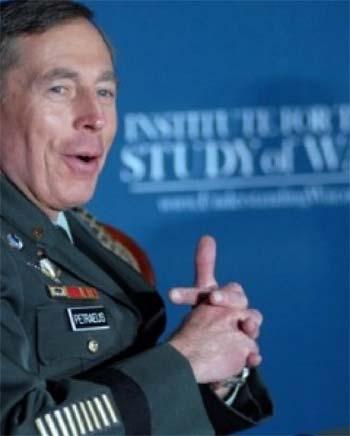
A Confirmation for Petraeus Is a Confirmation of the Surge Narrative
Ever since the surge narrative took root, there has been little public debate about the situation in Iraq. Thus, it is no surprise that, instead of an ongoing conflict, Iraq figured into the Petraeus confirmation hearings as an historical event.
The Surge of Ideas
In recent years, there has been a growing tendency for think tanks and military brass to jointly pursue policy objectives, some of which are opposed by the public or the White House—take, for example, the campaigns to build support for the troop “surges” in both Iraq and Afghanistan. This trend, say critics, raises important questions about the appropriate role of the military in promoting particular policies and whether there is enough transparency and accountability in the work of policy groups. And, just as importantly, will there be a new joint campaign aimed at pressuring the Obama administration to delay troop withdrawal from Afghanistan?
Are Foreign Lives of Equal Worth to Ours?
The mechanization of war has resulted in treating other nations’ citizens as less than equal to citizens of the United States. U.S. military actions kill innocent civilians in a repeated and almost routine manner. However, modern communications are informing people around the world that U.S. policies value other citizens less than its own.
Worst Fears May be Realized In Iraq
Can you imagine that candidate Obama would have campaigned on the promise of having 125,000 personnel in Iraq by the end of summer 2010?
Sliding Backwards on Iraq?
Last week, President Obama’s out-of-control military brass once again leaked a statement contrary to the president’s position. This time the statement came from Army Gen. Ray Odierno, the top U.S. commander in Iraq, who officially requested to keep a combat brigade in the northern part of the country beyond the August 2010 deadline.
Obama’s State of the Union
Despite two ongoing wars, it was striking that Obama focused so little in his first State of the Union speech on the world outside our borders other than the call to be competitive in the global economy. Indeed, he dedicated only eight minutes of the 70-minute speech to foreign policy.