It was probably North Korea behind the sinking of the South Korean ship. But we still need to respond with a hand and not a fist.

Cheonan: Retaliate with Diplomacy
read more

It was probably North Korea behind the sinking of the South Korean ship. But we still need to respond with a hand and not a fist.
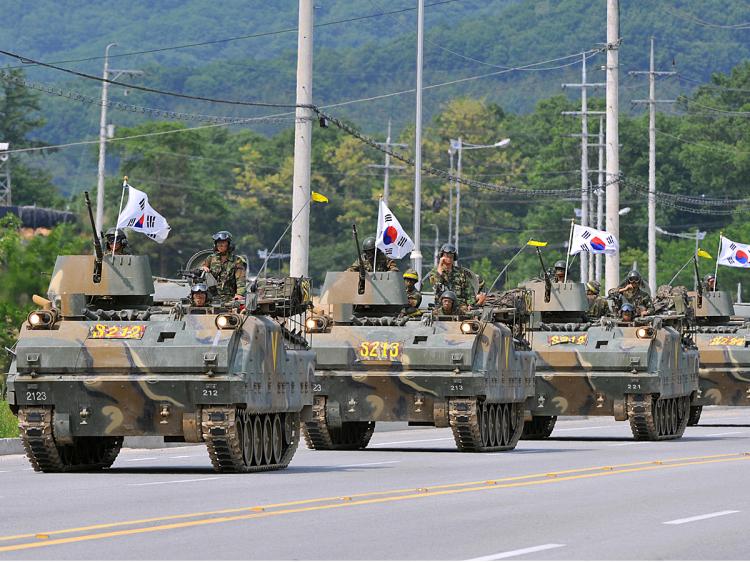
The Republic of Korea has rapidly increased its defense budget in recent years. Last year’s spending of 26.6 trillion won represents a twofold increase from ten years ago. Now the Ministry of National Defense projects an annual average increase of 7.6 percent to 53.3 trillion won by 2020, another doubling over the next decade. South Korea, notably, raised its defense spending at a higher rate than North Korea at a time when Seoul was taking a more conciliatory policy of engagement. While the Roh Moo-hyun administration increased defense spending ostensibly in response to its policy goal to build a more autonomous military, the U.S.-Korea alliance motivated and shaped South Korea’s military transformation. This article examines the degree to which external threats, domestic interests, and the alliance have affected the South’s military spending and transformation.
At the recent off-the-record meeting between U.S. and North Korean representatives at a conference in California, journalists were eager for any crumb of information about what the two interlocutors said to each other. The dialogue was “useful,” according to the North Korean representative. The U.S. side remarked that the mood was “better than we’ve seen in months.”
Japan has been a one-party oligarchy for a very long time. This may not be a polite thing to say about a democracy and a U.S. ally. But Japan has been ruled by the Liberal Democratic Party (LDP) for the last 54 years, except for a few nanoseconds after the Cold War when the ruling party temporarily lost its grip on power. Because of this stifling consensus among a small political elite, “Japanese democracy” has an oxymoronic connotation and Japanese politics has been one of the most boring topics in the world.
The “sunshine generation” is coming to an end. In South Korea, Kim Dae-Jung’s death comes hard on the heels of Roh Moo-Hyun’s suicide. In North Korea, meanwhile, Kim Jong-Il has been planning for his own succession. These three men were responsible for two inter-Korean summits and a host of agreements, exchanges, and political breakthroughs. As the “sunshine generation” — named after the “sunshine policy” of Kim Dae Jung — they worked together to show Koreans a glimpse of the light at the end of the long tunnel of the Cold War. The recent progress in North-South relations — a released South Korean detainee, an agreement to reenergize several key projects — suggests that the policies of this generation are still bearing fruit.
The two pariahs of Asia, North Korea and Burma, often get mentioned in the same breath. With no one else to depend on, these two countries would appear to be natural partners. Indeed, the Obama administration has been gathering circumstantial evidence that North Korea is providing Burma with nuclear technology so that they can both thumb their noses more aggressively at the international community. There are satellite images of Burma’s underground tunnels. The Japanese recently arrested a North Korean and two Japanese businessmen for attempting to sell Burma a magnetometer, a component of missile guidance systems. The Kang Nam, the North Korean ship that the Pentagon was recently tracking, was bound for Burma with a pile of who-knows-what on board.
When I was a boy, I devoured the great work of escape fiction, Papillon, which chronicled the astonishing life of Henri Charriere. The French courts sent Charriere to a series of penal colonies off the coast of South America, for a crime he didn’t commit. Nicknamed Papillon (butterfly) for the tattoo on his chest, Charriere managed to break out of several prisons, including a harrowing escape on a raft of coconuts from the virtually inescapable Devil’s Island.
North Korea has conducted its second nuclear test. The big question now is whether the world’s response will recognize the unique features of this most recent intensification of the crisis, and so effectively answer Pyongyang’s latest challenge to global nuclear stability and the embryonic disarmament renaissance.
The pundits and publics breathed a sigh of relief after the recent summit: President Barack Obama and President Lee Myung-bak get along.
The United States has basically thrown up its hands in the current crisis with North Korea. Washington has mounted an aggressive campaign at the UN to further isolate the world’s noisiest nuclear aspirant. But no one thinks that UN actions will have much effort.