
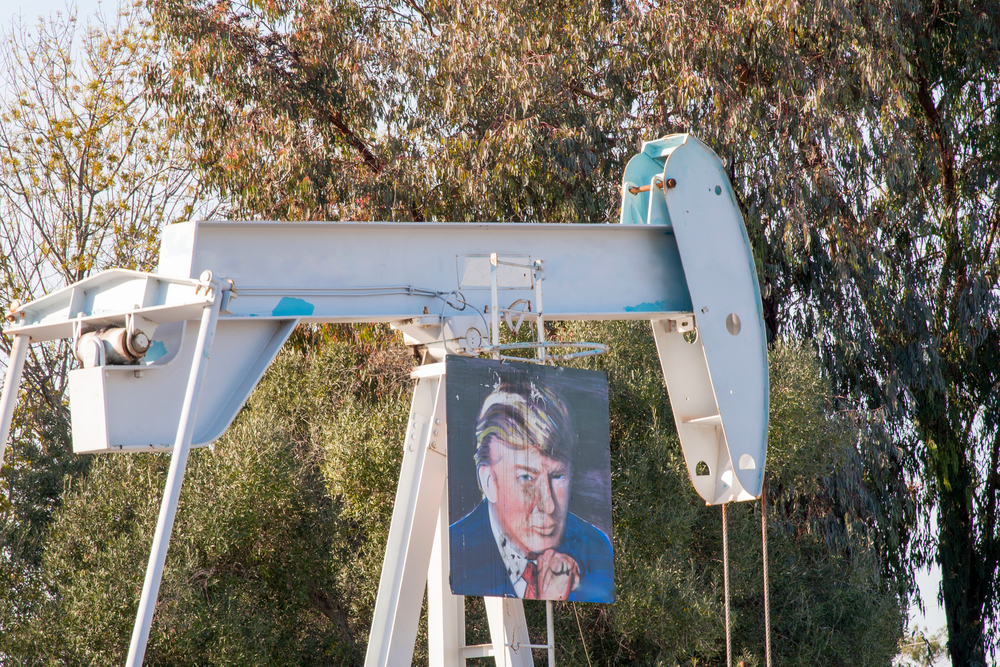
When Stalin wanted to get rid of someone, he didn’t just have them executed with a shot to the back of the head. He attempted to remove the offending person from history as well by excising their name from encyclopedias and airbrushing their image from photographs. In one infamous photo of two dozen Communist leaders from 1920, so many of them were declared “enemies of the people” in subsequent years that the official photo ended up with only Lenin and writer Maxim Gorky standing on the steps of a conspicuously empty porch. In other altered snapshots, Stalin stands alone in the depopulated space.
Donald Trump is no stranger to such visual manipulations, though he tends to add himself rather than subtract others. He has depicted himself as Jesus, as a U.S. Olympic hockey player scoring a goal and beating up Canadian opponents, as a sunbather with other Cabinet members in the Lincoln Memorial reflecting pool. One of his ardent followers in the House, Anna Paulina Luna (R-FL), proposed a bill last year to add Trump to Mt. Rushmore, though Trump beat her to the punch five year earlier with a tweet inserting himself next to the Founding Fathers.
Despite his preference to overpopulate the visual universe with his own image, Trump has also developed his own process of elimination. He has compiled an enemy list—former FBI director James Comey, New York Attorney General Letitia James, Senator Mark Kelly—that he’s been targeting with legal suits and character assassination campaigns. Not content to focus on the present, he has actively been trying to expunge from federal websites, publications, and parks all the non-white, non-male historical figures that previous campaigns saved from obscurity.
But perhaps the most dangerous effort at air-brushing involves climate change. Trump has gone out of his way to turn the United States from a lukewarm advocate of measures to reduce carbon emissions to a stone-cold denier that climate change is even happening. Trump is notoriously upset at not being at the top of every list—best president, smartest guy in the room, most creative hairstyle. Let’s throw in one more list: greatest threat to humanity. Perhaps in order to top that list, too, the president has downgraded the threat of climate change to the point of non-existence. Like Stalin, Trump now stands alone.
The administration’s campaign started with the scrubbing of all references to climate change from federal websites. It has encouraged more widespread self-censorship: anyone who wants to keep their federal job or apply for a federal grant has tactically removed anything Green-related from their descriptions and applications. This animus toward anything climate-related has also shaped many of the administration’s latest budget cuts: the Environmental Protection Agency (EPA) budget halved, $1.6 billion cut from National Oceanic and Atmospheric Administration, the $4 billion Low Income Home Energy Assistance Program eliminated, $449 million in renewable energy funding slashed.
It’s no surprise that the administration has gone after states that have retained strong climate policies. The Justice Department has targeted Vermont and New York for their polluter-pay approaches as well as California for its cap-and-trade system. Despite these attacks, a number of states have actually moved forward with their emissions-reduction and energy-transition strategies. The 24 states in the U.S. Climate Alliance have cut their emissions 24 percent below 2005 levels and promoted the development and adoption of clean-energy technologies.
The administration’s approach can also be seen in the carrot side of the equation. It has approved pipelines like the recent Bridger Pipeline Extension, green-lighted deep-water oil drilling in the Gulf of Mexico, opened up the Arctic National Wildlife Refuge in Alaska to oil companies, and tried to prop up the dying coal industry. The administration has paid out $2 billion to companies to cancel their wind power projects and invest instead in fossil fuels. Deregulation and lack of enforcement—of pollution standards, of safety and health requirements, of environmental permitting—have been huge gifts to companies spewing greenhouse gasses into the atmosphere.
More ominously, the administration has altered the very DNA of regulatory governance by repealing the “endangerment finding.” According to a 2007 Supreme Court ruling, the EPA is required to ascertain if climate change is a danger and, if so, to take steps to address it. Under subsequent administrations, the EPA did just that. But Lee Zeldin, the EPA head determined to destroy his own agency, recently stomped on nearly 20 years of legal precedence by repealing the “endangerment finding.”
At a press conference with Trump at the White House, he said that revoking the finding would save Americans $1.3 trillion, mostly in the form of lower car prices. He neglected to mention the costs of the move, which, by the EPA’s own estimates, could top $1.4 trillion, and this is not even counting the expenses associated with greater warming.
Roughly half the states of the union have joined together to challenge Zeldin and bring the case to the Supreme Court.
In the best of all possible worlds, the Trump assault on climate science, energy transition funding, and regulatory mechanisms is the last hurrah of the fossil fuel cult. After all, the price of renewable energy is dropping, the scientific community remains united in its dour assessments, and most of the rest of the world is committed to doing something about the gathering storm. Even Trump’s all-out bid to save the U.S. coal industry must reckon with the inexorable laws of the market. Because coal-fired power plants are old and just plain uneconomical, Trump has presided over the closure of more of these plants than any other U.S. president.
But this isn’t the best of all possible worlds. Trump’s rearguard actions come at a perilous time when even half-hearted attempts to address climate change are plainly insufficient. Only industrial-strength collective action against fossil fuels can mitigate the worst impacts of climate change. Instead, Trump is playing to the strengths of polluting industries in an attempt to destroy any last hope of restoring a measure of equilibrium to the planet.
The Climate Keeps a Changin’
Although almost every country in the world has pledged to cut its emissions of greenhouse gasses, the overall amount of carbon spewed into the atmosphere continues to grow. In 2025, spurred by a 4.1 percent increase in emissions associated with the oil and gas sector, emissions hit a new record. Methane emissions, considerably more dangerous than those of carbon-dioxide, also increased to a new high after a small decline in 2024.
The total increased in part because of a surge in U.S. emissions. In 2023 and 2024, U.S. greenhouse gas emissions actually declined. Equally important, U.S. policies managed to sever the link between economic growth and emissions, with the former increasing even as the latter declined. In 2025, however, emissions increased by 2.4 percent, once again faster than economic growth.
Just as the impact of Pentagon spending on global military expenditures will not be measured until the figures are released for this year, Trump’s policies on climate won’t begin to register in the statistics until the end of 2026. The increase in emissions last year was more a function of an unusually cold winter and the expansion of both data centers and crypto mining, not Trump’s fossil-fuel-friendly policies.
It’s not all bad news. China, the world’s biggest emitter in total numbers by a long shot, is approaching peak carbon dioxide emissions while also boosting exports of solar panels, batteries, and wind turbines to record levels so that other countries can transition to these renewables. European emissions continue to drop. In 2025, solar became the first renewable energy source to lead the growth in electricity supply. Wind and solar now account for a larger share of electricity generation than coal.
The Iran War, meanwhile, is an unintended inflection point in the trajectory of energy politics. The blockade of the Strait of Hormuz has created a huge energy crisis, with many countries reporting major shortages in oil and gas. As Zoya Teirstein and Jake Bittle write in Grist,
As prices rise and supplies dwindle, countries around the globe are reevaluating their energy futures. While some have fallen back on dirty fuels to fill the gaps caused by the closure of the Strait of Hormuz, others have announced significant investments in clean energy to chart a path away from the sources of energy they have relied on for more than a hundred years.
Trump and company dreamed of accessing Iranian fossil fuels and driving down prices at the pump. So far, they are getting the exact opposite of what they wanted. The same may well hold for their war against renewable energy.
Attempting to Kneecap the International Response
As part of his effort to destroy the “green new scam,” Trump hasn’t been content to dismantle the domestic infrastructure of emission reduction and energy transition. He has taken the United States out of every major international initiative to address climate change, beginning with the Paris Agreement and the UN agency that administers it, the UN Framework Convention on Climate Change (UNFCCC).
So far, however, there hasn’t been a rush to the exits in the wake of U.S. withdrawal. No other countries have exited the Paris Agreement, not Russia, not any of the Gulf Countries, not even Nicaragua and Syria (both of which initially didn’t sign the agreement). Three countries have signed but not ratified the agreement—Iran, Libya, Yemen—but internal turmoil plays a role in their foot-dragging. Meanwhile, all UN members remain part of the UNFCCC.
So, the United States stands alone in its refusal to acknowledge that the world is endangered by climate change.
In general, international responses have been inadequate to the scale of the challenge. Only a trickle of funding is going toward helping countries reduce emissions (mitigation), addressing the ongoing impact of climate change (adaptation), and making the transition away from fossil fuels. But the world minus the United States is at least inching up its commitments to fund these three efforts. Global action continues to address the preservation of biodiversity and the 23 targets identified in the Kunming-Montreal Global Biodiversity Framework.
The Trump administration has turned its back on climate science, slashing funding and even planning to disband the National Center for Atmospheric Research. But the rest of the world has no problem poaching U.S. scientists and surpassing the United States in Green patent filings. In this way, Trump is steering the United States into a high-tech cul-de-sac.
Trump took office with a plan to remake the world with his tariffs, his military interventions, his refocus on fossil fuels, and his preference for authoritarianism. The world has certainly taken note. Given the size of the U.S. economy and the U.S. military, it is impossible to ignore Trump. When it comes to the imperative of climate change, however, the world has shrugged. The international community is not accelerating at the speed necessary to save the world, but it also isn’t slowing down to defer to Donald Trump.
Donald Trump is leading the United States in a great leap backward. The rest of the world, at least when it comes to climate science, is refusing to take that leap with him.