
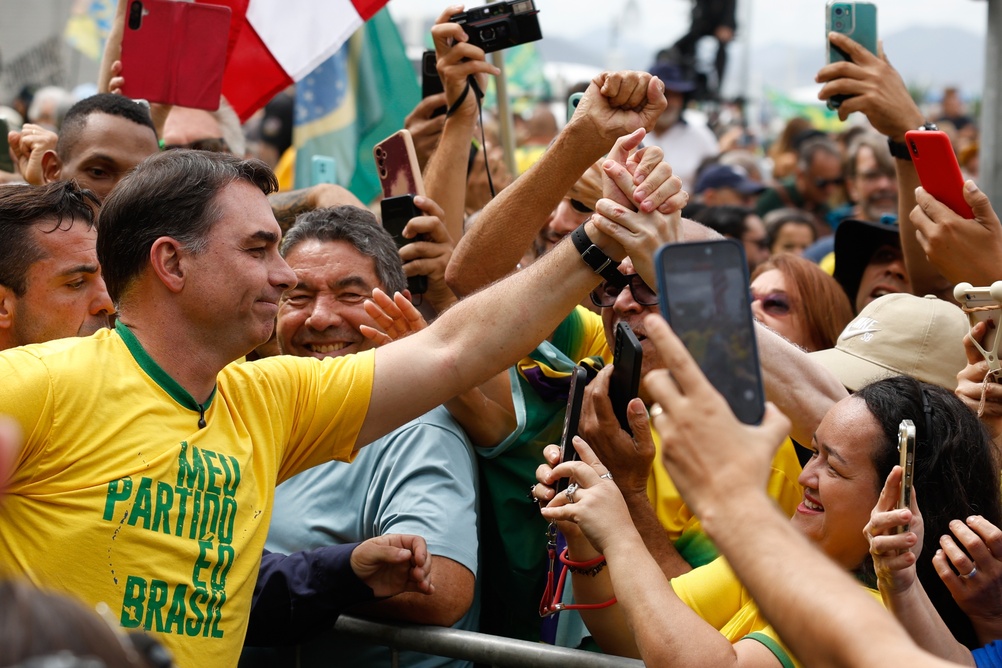
If Flávio Bolsonaro wins the presidential run-off in Brazil on October 25, he would extend the region’s run of Trump-aligned right-wing governments. His opponent, incumbent Luiz Inácio ‘Lula’ da Silva, ran two percentage points behind Bolsonaro in the first round. No candidate finishing second has won since the institution of democratic elections in 1989. Meanwhile, the remaining candidates that captured nearly 8 percent of the vote are largely center-right.
So, Lula’s chances don’t look particularly strong.
A Bolsonaro win would push Latin America’s largest progressive democracy rightward. It would leave only Claudia Sheinbaum hanging on in Mexico City. This is, in effect, the biggest shift to the right in Latin America since the days of Operation Condor.
The Lula Years and Their Limits
Brazil is no longer the country Lula governed in 2003, nor is it the one that returned him to power in 2023 as a democratic bulwark against Flávio Bolsonaro’s father. Lula’s first administrations benefited enormously from the commodity boom of the 2000s, particularly Chinese demand for agricultural and mineral exports.
Those revenues were put into redistribution, to visible effect. Inequality fell substantially, as around 20 million people were lifted from destitution. Access to electricity, public services, education and healthcare expanded, and university participation rose. Lula’s flagship program, the Bolsa Família, established conditional cash transfers as an effective social-policy instrument. Millions of households acquired consumer goods and financial services previously beyond their reach, while real incomes and formal employment increased. It was a veritable social transformation.
But much of that depended on a one-time commodity windfall that evaporated after 2014, pushing Brazil into recession that lasted until late 2016. The crisis years under Dilma Rousseff exposed the limitation of Lula’s model, which did not convert the commodity tailwinds into sufficient productivity growth and sustained dynamism.
That history matters now. In 2026, unemployment was 5.3 percent in the quarter ending July (though informal private-sector employment rose 3.6 percent over the previous quarter) and GDP growth slowed to 0.5 percent. Household consumption fell 0.4 percent amid high interest rates and indebtedness. Brazil has a severe debt problem, both public and private, making fiscal pressures severe. Gross public debt reached 82.5 percent of GDP in July 2026, well above the 60 percent comfort zone. The interest bill alone consumed 8.7 percent of GDP over the preceding 12 months.
To make matters worse, savings are evaporating, and the investment rate remains merely 16.1 percent of GDP, limiting sustained productivity growth. The central bank has begun easing monetary policy from a near 20-year peak. But with the policy rate still around 14 percent, borrowing costs remain high. Lower rates may offer some relief, but they cannot by themselves resolve the fiscal pressures or reverse Brazil’s chronic investment shortfall.
The challenge, then, is to make Brazil’s social transformation economically durable. The larger lower-middle class created under Lula now wants more than redistribution. It is calling for affordable credit, less bureaucracy, better infrastructure, and greater opportunity. Lula’s exemption of monthly incomes up to R$5,000 from income tax, effective January 2026, is his clearest response. But tax relief and social protection cannot substitute for productivity growth.
These contradictions may soon confront Flávio Bolsonaro. He would inherit an economy where preserving Lula’s gains would require fiscal stabilization, higher investment, and stronger productivity. A movement built on opposition to Lula and reactionary cultural issues has yet to offer an economic model capable of meeting these demands.
Security and Democratic Accountability
The homicide rate fell to 20.1 per 100,000 in 2024, its lowest since the mid-1990s, but organized criminal groups remain powerful. Meanwhile, estimated concealed homicides rose 88.6 percent in a single year, from 3,755 in 2023 to 7,083 in 2024. Once these are included, the apparent improvement in lethal violence becomes considerably less reassuring.
Higher incomes cannot compensate for extortion or unsafe neighborhoods. Stronger state capacity against organized crime requires intelligence, policing, prosecution, and financial enforcement capable of dismantling criminal networks rather than relying on indiscriminate violence.
The October 2025 Rio de Janeiro operation, the deadliest police action in Brazilian history, exposed the limits of the latter approach. More than 100 people died, including four police officers, yet none of those killed appeared on the prosecutors’ list of suspects underpinning the operation, and the gang’s leading figures remain at large. The result was a devastating loss of life without convincing evidence that the organization’s grip on the affected communities had been broken.
Washington’s designation of two Brazilian criminal groups as terrorist organizations, after Flávio Bolsonaro lobbied for it at the White House over Lula’s objections, opens the door to U.S. sanctions and, potentially, military action.
The grievances Bolsonarismo exploits are real, but there is a distinction between a legitimate conservative challenge and Jair Bolsonaro’s legacy. His attempt to overturn the 2022 defeat, his role in the January 8, 2023 attacks, and his conviction for undermining the constitutional order have made democratic accountability unavoidable. Sentenced to 27 years and in custody since August 2025, he has nevertheless seen Congress soften that accountability. In April 2026, it overrode Lula’s veto of a sentencing law that could reduce his term to around 22 years; Justice Alexandre de Moraes suspended the law pending a constitutionality ruling. The Supreme Court resisted threats to constitutional government, though its extraordinary measures have raised concerns about judicial overreach.
Meanwhile, Bolsonaro’s family remains central to Brazilian politics. Wife Michelle and sons Carlos and Jair Renan won congressional seats on October 4, while another son, Eduardo, has sought U.S. pressure over his father’s prosecution. Flávio has pledged amnesty, making a Flávio Bolsonaro presidency another potential test for the Court.
Pentecostal churches are central to this coalition because they have expanded precisely among the urban poor who once formed much of the Brazilian left’s social base. They offer community, practical support, and a language of individual advancement in the place of government services. The Bolsonaros’ emphasis on family and opposition to abortion and LGBTQ rights has helped turn this constituency into a powerful source of political support.
As Fernando Brancoli argues in Bolsonarismo: The Global Origins and Future of Brazil’s Far Right, however, the movement behind Flávio is a fragmented coalition of neo-evangelicals, military actors, and market-oriented ideologues, increasingly connected to international far-right networks. Antipetismo (opposition to Lula’s Workers’ Party, the PT) and evangelical churches anchor it more firmly than Milei-style liberalism.
Brazil in the World
Lula has long treated foreign policy as development politics, using Brazil’s Global South weight to promote multilateralism, South-South cooperation, and autonomy. In Africa, this includes renewed engagement with the Portuguese-speaking world: Brazil joined the African Development Bank’s Lusophone Compact in 2024, while the state oil company Petrobras resumed African exploration. The Community of Portuguese-Speaking Countries gives Brazil an institutional presence in Africa unmatched elsewhere in Latin America.
Globally, Lula’s government hosted the 2025 BRICS summit, used Brazil’s G20 presidency to launch a global alliance against hunger, and hosted COP30 in Belém, where Brazil launched the Tropical Forest Forever Facility with more than $6 billion in initial pledges.
Under Jair Bolsonaro, by contrast, Amazon deforestation surged by about 60 percent, with more than 45,000 square kilometers cleared between 2019 and 2022, making fears of renewed extractive pressure under Flávio more than hypothetical.
BRICS is also where the camps differ most visibly. Flávio has said he would reassess membership, while Lula’s diplomacy has sought a global progressivism that is neither subordinate to Washington nor defined by anti-Westernism, though his positions on Ukraine and Taiwan among others betray the influence of Moscow and Beijing. Nonetheless, even Lula has opposed the bloc’s expansion and sought to keep BRICS reformist rather than revolutionary.
Neither candidate has a clear strategy for managing dependence on China, which sets a hard limit on Brazilian autonomy, regardless of the party in office. Beijing bought about $100 billion of Brazilian goods in 2025, comprising nearly 29 percent of Brazil’s exports, including most of its exportable soybeans, iron ore, and oil. With the Brazilian right dependent on the agribusiness lobby, even Jair Bolsonaro’s anti-China rhetoric faded in office. He stayed in BRICS and even hosted its 2019 summit.
Flávio’s program proposes joining the U.S.-led Shield of the Americas, seeking a bilateral free-trade agreement, offering Washington concessions on rare earths, energy, and agribusiness, and keeping its PIX instant payment system away from non-Western settlement arrangements. But absent pragmatic negotiation with Beijing, he too may have little room for maneuver.
Trump’s Shadow
Since 2025, Washington has used visa restrictions, Magnitsky sanctions, tariffs, and terrorist designations against Brazilian targets, including measures tied to the Bolsonaro case. Eduardo Bolsonaro claimed credit after a 50 percent tariff was announced against his own country, though it was later struck down by the U.S. Supreme Court. In July 2026, Washington imposed new Section 301 duties of 25 percent, plus a further 12.5 percent on Brazilian goods, citing PIX, Brazilian court orders against U.S. social-media platforms, ethanol, and deforestation. U.S. officials have portrayed Justice Moraes’s orders against hate speech as censorship, turning Brazil’s regulation of digital platforms into a trade dispute.
The broader context is Trump’s renewed assertion of U.S. influence in the Western hemisphere, reviving the controversial Monroe Doctrine. The Trump administration sees Brazil as a major remaining obstacle to a sweep of Trump-aligned governments in its “backyard” after the removal of Nicolas Maduro in Venezuela, intense pressure on Cuba, and right-wing victories in Chile, Colombia, Honduras, and Peru.
Brazil’s defining question is what follows should the far right win again. Flávio Bolsonaro’s political inheritance and growing alignment with the Trump administration would confront a country whose social transformation has created demands it cannot easily satisfy. Whether Brazil’s institutions can contain that coalition, while preserving the gains and democratic freedoms of the past two decades, may determine not only the country’s future but the direction of Latin America as a whole.