
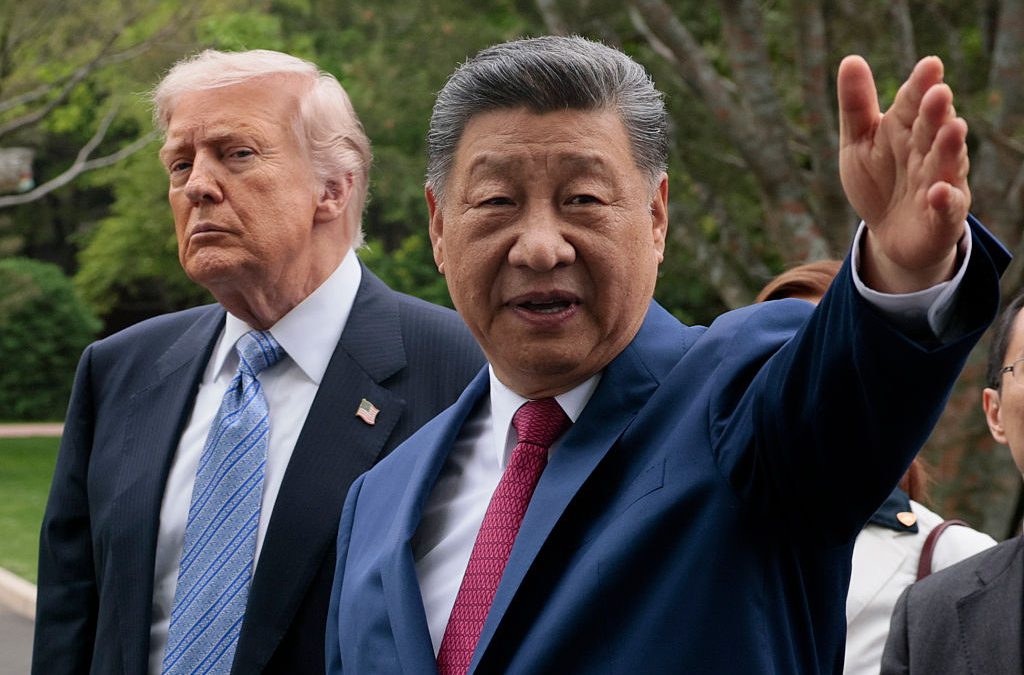
The conclusion of the high-stakes Beijing summit between U.S. President Donald Trump and Chinese President Xi Jinping on May 14 marked a critical pivot in the structural architecture of the international system.
This meeting matters profoundly because it introduces an unexpected floor to a relationship that many analysts predicted would enter a terminal downward spiral under a second Trump administration. Rather than a standard diplomatic gridlock, the summit produced a relatively coherent framework for what Beijing is calling constructive strategic stability.
For global policymakers and volatile international markets, the event signals a systemic pause in aggressive economic fracturing, proving that both capitals are currently prioritizing domestic economic insulation over unmanageable geopolitical escalation.
According to the dominant media narrative prior to the summit, Washington and Beijing were marching deterministically toward total economic separation and inevitable military conflict. This view has been proven to be overstated. The Beijing summit revealed a highly calculated, deeply pragmatic effort by both sides—predominantly by China—to engineer a general reconciliation on virtually all structural matters, with the deliberate exception of Taiwan.
By systematically decoupling trade, technology, and global governance from the combustible issue of cross-strait sovereignty, Beijing has successfully offered the Trump administration a transactional, high-yield partnership. This strategy appeals directly to Washington’s preference for bilateral deal-making while preserving China’s core national red lines. Comprehending this shifting dynamic requires an examination of the systematic mechanics of the reconciliation effort through a clear, analytical framework driven by distinct structural pillars.
The groundwork for this diplomatic pivot was laid well before President Trump arrived at the Great Hall of the People. In a highly deliberate pre-summit statement, President Xi explicitly asked whether China and the United States could overcome the historical “Thucydides trap”—by which a rising power challenges the existing hegemonic power—to create a new paradigm of major-country relations.
This was not mere rhetorical fluff. It was a calculated signal to the incoming American delegation that Beijing was ready to rewrite the rules of engagement. This narrative positioning was rapidly converted into institutional action during the post-summit phase. Foreign Minister Wang Yi outlined the mechanical reality of this new paradigm during his post-summit press briefing, emphasizing that constructive strategic stability requires a positive equilibrium where cooperation remains the mainstay.
By framing the relationship around manageable competition rather than systemic hostility, Beijing provided a diplomatic off-ramp for an American administration that is simultaneously managing a widening conflict in the Middle East.
The most tangible evidence of China’s reconciliation push is found in the economic sphere, where Beijing deployed a massive charm offensive to appeal to the commercial interests of the American delegation. Just days prior to the main event, on May 12 and 13, Vice Premier He Lifeng led an intensive diplomatic effort, holding a targeted bilateral consultation in South Korea to resolve preliminary economic friction points directly with U.S. Treasury Secretary Scott Bessent.
Following the summit, the Chinese Ministry of Commerce announced that these parallel tracks yielded highly positive outcomes. Instead of defensive posturing, Beijing took the initiative by sending multiple high-level trade delegations to buy American agricultural goods, renew U.S. beef export approvals, and propose reciprocal tariff reductions on products of mutual concern. The establishment of a new bilateral trade council and an investment council proves that China is seeking to institutionalize this relationship, shifting away from volatile executive decrees and moving toward structured, predictable commercial bargaining.
The most forward-looking aspect of the summit was the mutual consensus to explore a joint AI global governance body combining the structural power of the United States and China. This development reveals a profound shift in how both empires view technological competition. Although Washington maintains strict export curbs on advanced semiconductors, both capitals realize that unregulated, weaponized artificial intelligence presents a risk to domestic governance and global systemic stability. By establishing a bilateral framework to oversee AI safety standards and deployment, Beijing and Washington are creating a duopoly over the primary engine of the modern global economy, effectively locking out secondary states and creating a structured, institutionalized tech-truce.
This shift completely alters the geopolitical scenario for the time being. The immediate threat of a catastrophic, blanket tariff war is being replaced by a system of managed, sector-specific trade negotiations. From a South Asian vantage point, this elite-level bilateral reconciliation looks very different than it does from Washington or Brussels. For developing economies across the Global South, the sudden stabilization between the world’s two largest markets offers a much-needed sigh of relief, lowering the threat of forced fragmentation in trade and technology standards.
However, it also brings a sharp dose of realism. When Washington and Beijing decide to establish exclusive, bilateral bodies to govern frontiers like artificial intelligence, it signals that the broader international community is being sidelined. This is not a return to a rules-based multilateral order, but rather the birth of a cold, transactional condominium where the two superpowers partition global economic governance to suit their own domestic requirements.
The post-summit reality can thus be divided into five precise dimensions.
First, there is one absolute red line, as China made it explicitly clear that Taiwan remains entirely non-negotiable. Although Beijing is willing to compromise on market access, supply chains, and tariffs, any perceived threat to its cross-strait sovereignty will immediately short-circuit the broader reconciliation.
Second, the framework introduces two parallel economic councils, establishing dedicated trade and investment bodies that provide a structural cushion to manage future industrial shocks, effectively protecting corporate supply chains from sudden political flare-ups.
Third, the agreement secures three years of a strategic runway, as the envisioned path for constructive strategic stability is explicitly designed to guide bilateral relations through the intermediate term, aligning perfectly with the domestic political timelines of both leaders.
Fourth, the architecture relies on four institutional pillars of stability, which Foreign Minister Wang Yi articulated as positive stability, healthy competition, manageable differences, and an enduring promise of peace to prevent accidental military friction.
Fifth, the deal proposes a bilateral technological duopoly, utilizing the joint AI governance body to create a powerful mechanism for the world’s two dominant tech empires to dictate global software and security standards, leaving third-party states with little choice but to adapt to their rules.
Policymakers must not mistake this tactical pause for permanent peace. China’s comprehensive effort to reconcile with the United States on trade, artificial intelligence, and regional security is a highly sophisticated exercise in strategic risk management. By giving the Trump administration immediate, quantifiable economic victories, Beijing has bought the time and space it needs to fortify its internal markets and accelerate its domestic innovation loops.
The ultimate warning for Washington is clear: accepting these short-term transactional wins without a cohesive, long-term strategy will allow China to dictate the terms of the global economic architecture for the next decade. Transactional diplomacy can easily manage an immediate crisis, but it cannot replace a rigorous, long-term grand strategy.