
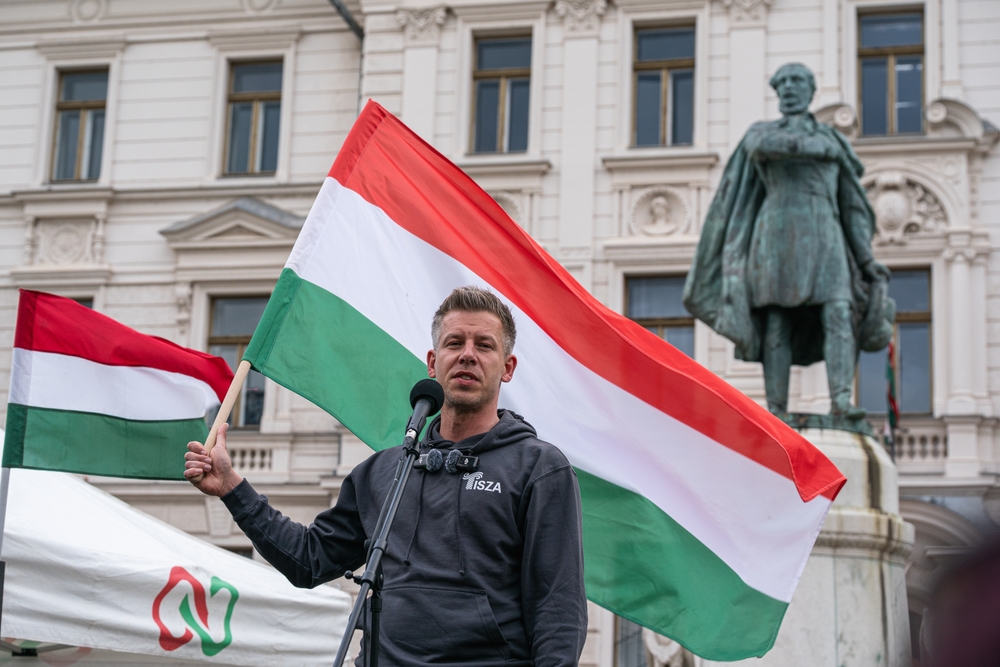
On April 12, Viktor Orbán conceded defeat in Hungary’s parliamentary election after 16 years in power. Three million voters handed a two-thirds supermajority to Péter Magyar, a 45-year-old lawyer who, until two years ago, was a Fidesz party member. Europe’s most durable illiberal leader had finally been broken by a determined opposition. The frame is incomplete.
The real story is who beat Orbán. Magyar was not a liberal dissident or a civil society champion. He worked in the prime minister’s Office. He ran a government-linked financial institution. His ex-wife was Orbán’s justice minister. He was, by any definition, an insider.
After a pardon scandal involving the coverup of child sexual abuse, Magyar broke with the regime in 2024, exposing what he called a system where “a few families own half the country.” He took over a minor party, renamed it Tisza, and spent two years visiting six towns a day across Hungary. He won 138 of 199 parliamentary seats.
Here is the pattern nobody is discussing. When modern electoral autocracies fall via the ballot box, the winning challengers almost never come from the traditional opposition. They come from inside the regime. A 2019 study in the American Political Science Review found that co-opting the opposition stabilizes an autocracy externally but leaves insiders “disgruntled and prone to defection.”
Orbán spent 16 years neutralizing every external threat. Opposition parties, media, NGOs, universities, the judiciary: all were co-opted or destroyed. The EU threw conditionality at him and lost. The liberal opposition united in 2022 and got crushed. What he could not neutralize was the threat from within. Magyar knew the system because he had helped build it. He could speak to conservative voters in rural Hungary without triggering the cultural defenses Orbán had cultivated against “Budapest liberals.” Days before the election, leaked transcripts revealed that Hungary’s foreign minister had been coordinating with Moscow to weaken EU sanctions. The leak had the hallmarks of an inside job.
The pattern repeats. In Ecuador, Lenín Moreno, Correa’s own vice president, reversed Correa’s institutional capture after 2017. In Slovakia’s 1998 democratic restoration, the coalition that defeated Vladimír Mečiar included defectors from his own movement.
This matters for Brussels. For more than a decade, European leaders treated Hungary as a structural problem with no clean solution. Conditionality failed. Article 7 proceedings stalled. Frozen funds were quietly released. The implicit assumption was that institutional capture, once achieved, was effectively permanent. Magyar’s victory suggests otherwise. The architecture Orbán built had a single point of failure: the people who built it. An insider who defects carries two weapons no outside challenger possesses. The first is operational knowledge of the system’s real vulnerabilities. The second is cultural credibility with the system’s own base. Neither sanctions nor opposition platforms can manufacture either.
The celebration may prove premature. Orbán’s appointees sit on the Constitutional Court for 12-year terms. A 500-outlet media conglomerate was exempted from competition law. A €10 billion Russian nuclear plant expansion is contractually locked in. The V-Dem Institute finds that democratic reversals take an average of nine years. Ecuador’s post-Correa restoration collapsed within five years. Whether Magyar can dismantle Orbán’s architecture without becoming what he replaced is an open question.
But the structural lesson is clear. The mechanism that broke Orbán’s grip was not sanctions, or conditionality, or foreign pressure. It was a man who sat inside the machine, understood how it worked, and decided to take it apart. That is the defector’s gambit. It is a weakness that autocrats, for all their institutional engineering, have never figured out how to prevent. And the European political movements that studied Orbán’s playbook chapter by chapter, from Warsaw to Rome to The Hague, never studied this one.