
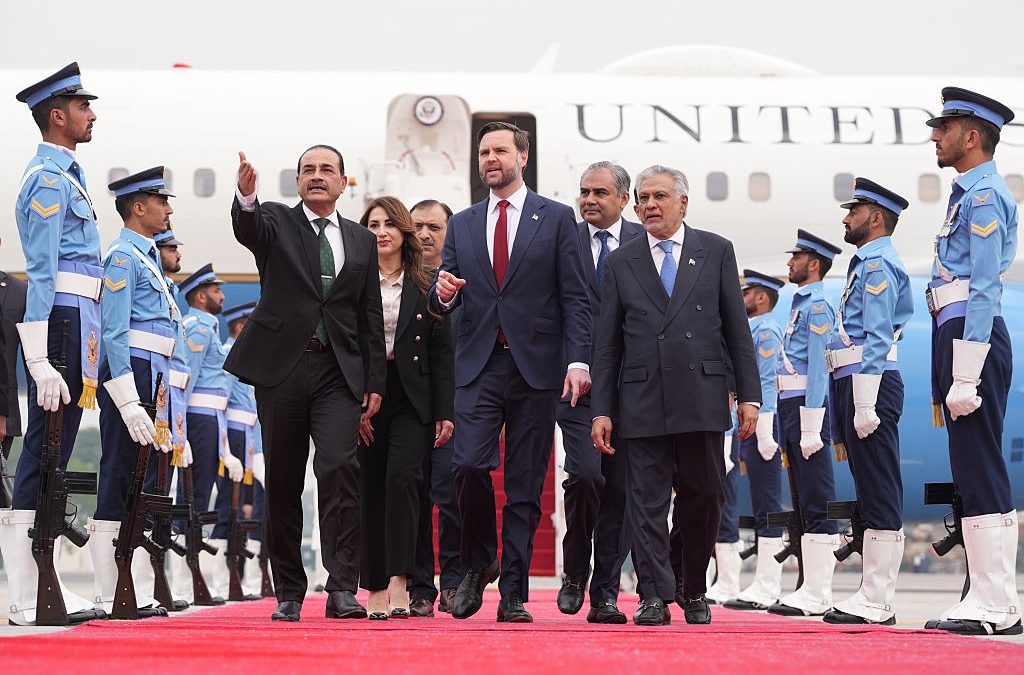
Ever since Pakistan emerged as a mediator between Iran and the United States, Pakistan’s military chief, General Asim Munir, has been praised in Washington for being a statesman and a reliable security partner. President Trump has repeatedly called him his “favorite field marshal.”
Washington has made this bet before, and lost.
For decades, successive U.S. administrations supported Pakistan’s military rulers to advance their geopolitical agendas, overlooking—and at times reinforcing—authoritarianism in exchange for stability and cooperation.
The Trump administration is repeating the same bargain. It has defined counterterrorism, critical minerals, and managing regional competition with China among core U.S. interests. And yet, each of these is threatened by the very institution the United States has relied on to preserve them. The Democratic-controlled Congress now has an opportunity to reverse course.
Previously, the United States justified its support of the Pakistani military because it was perceived as a strong institution with widespread domestic support. Its legitimacy has eroded considerably since the ouster of former Prime Minister Imran Khan through a no-confidence vote in 2022. Many analysts believe that the military, after falling out with Khan, withdrew its backing and paved the way for his removal. A significant segment of the public turned against an institution long deemed untouchable.
For the United States to continue its support of Pakistan’s military risks its long-term relationship with a population of 250 million people, two-thirds of whom are under 30 and increasingly restless under growing military authoritarianism.
The problem directly affects Washington’s security interests.
The Pakistani military’s record as a counterterrorism partner should give Washington pause. Following 9/11, the military received billions of dollars in U.S. taxpayer money to combat the Taliban and al-Qaeda. Twenty years later, the Afghan Taliban returned to power, in part due to the Pakistani military’s patronage and protection of various Afghan Taliban factions within Pakistan.
This is not simply a story of past failure. Even today, the Pakistani military dominates counterterrorism policy in Pakistan’s two most restive provinces: Khyber Pakhtunkhwa (KPK) and Balochistan. The military’s predominant use of coercive measures—mass displacements, drone warfare, and military operations in KPK—has failed to stem militancy and has instead caused widespread civilian suffering.
Balochistan, one of Pakistan’s most resource-rich provinces, has been racked by unrest and violence for decades. As in KPK, security policy in Balochistan is under the strict control of the military, with heavy army and Frontier Corps deployments.
Rather than take seriously the legitimate grievances of the people—failed governance, abysmal human development indicators, resource exploitation without local input or benefit—the Pakistani military has resorted to enforced disappearances, extrajudicial killings, and detentions of Baloch students and activists. Earlier this year, Mahrang Baloch, a Nobel Peace Prize nominee who has led a peaceful movement for Baloch rights, was sentenced to life in prison in a secret trial.
In both provinces, militant violence has soared over the past two years.
The pervasive instability in Balochistan, in particular, threatens another major American interest: critical minerals, an essential part of the Trump administration’s National Security Strategy. In early 2026, the U.S. Export-Import Bank approved financing of $1.25 billion to support the mining of critical minerals at Reko Diq, home to one of the world’s largest untapped gold and copper deposits, located in the Chagai district of Balochistan.
However, increasing militancy in the province has exposed this investment to considerable risk and has already delayed the start of the project. Rather than learn from the Chinese experience—where billions of dollars of investments in Balochistan have foundered because of insecurity—the U.S. risks repeating it.
There is another contradiction in Washington’s approach.
For years, the United States saw Pakistan firmly in China’s orbit. In his second term, President Trump attempted to shift that approach and rebuild ties with the Pakistani military in order to preserve some measure of influence.
However, the Pakistani military is not just a security partner, it is the principal architect of Pakistan’s China policy. It manages defense acquisitions, economic projects, and the overall strategic relationship between the two countries.
That relationship continues to deepen. Following the India-Pakistan conflict in May 2025 in which Pakistan made effective use of Chinese technology and weapons, Pakistan’s defense budget increased by 20 percent. China, Pakistan’s largest arms supplier, stands to benefit from that expansion.
By building relations with the Pakistani military, the United States is not preserving influence. Rather, it is strengthening the very institution responsible for deepening ties with China.
An institution with little civilian oversight and accountability has little incentive to recalibrate a security paradigm that has allowed it to maintain its central and privileged relationship with the United States.
The United States holds significant influence over how its support is used: approval of F-16 sustainment sales, training through the IMET program, access to international financial systems, and diplomatic cover. It should condition that support on measurable human rights benchmarks, starting with the release of political prisoners, an end to military trials of civilians, and accountability for enforced disappearances. Such standards are rooted in Pakistan’s own constitution and its international commitments.
Democratic control of the House and Senate gives Congress an opportunity to reverse the Trump administration’s embrace of Pakistan’s military. Over the past two years, more than 100 Democrats in Congress signed letters calling out the Pakistani government’s human rights violations. Now, as incoming chairs of powerful committees, they can hold hearings, attach conditions to appropriations and defense bills, and investigate the Trump family’s crypto deals with foreign governments, including Pakistan’s.
Washington cannot determine Pakistan’s political future, nor should it try. But it can refuse to let American taxpayer dollars, military cooperation, and diplomatic backing prop up an increasingly unaccountable military establishment. Washington can keep treating Field Marshal Asim Munir as a security partner, even though his rule has not delivered stability. Or, instead of enabling military authoritarianism, it can recognize that America’s long-term interests lie in strengthening the civilian rule that Pakistanis have repeatedly voted for.