
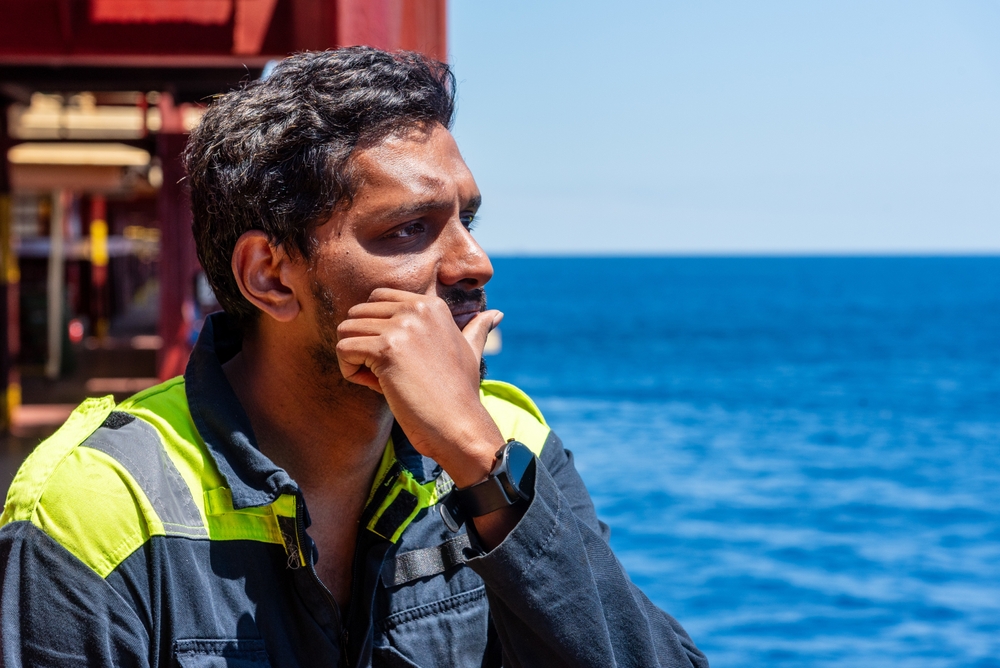
What keeps the Gulf running is not aircraft carriers or air defense systems or generals talking about “maritime security” in policy briefings and strategic forums. What keeps the Gulf running is people.
A welder from Tamil Nadu, India works 12-hour shifts on an offshore platform. A Filipino cook works in a kitchen of a tanker transiting through the Strait of Hormuz. An Indian chief engineer performs engine diagnostics at 3 in the morning to ensure that cargo reaches Dubai on schedule.
Thousands of these workers, largely invisible and consistently forgotten, constitute the actual backbone upon which the entire Gulf economic structure depends.
And they are currently leaving—in significant numbers. The prevailing policy and strategic discourse has failed to recognize that this departure represents not a peripheral concern but a fundamental security crisis. A ceasefire between the United States and Iran, reached in April 2026 has not reversed this trend. Despite the truce, the Strait of Hormuz remains largely shut to commercial traffic—mined, uninsured, and contested—and the UN’s International Maritime Organization reports that roughly 20,000 seafarers remain stranded in the Persian Gulf. The ceasefire ended the immediate military exchange; it did not restore the institutional trust that drives workers’ decisions to leave.
Gulf War
Three ships were hit in three days in June. Four Indian sailors died. One died not from the attack but from the failure of systems designed to protect him, namely the evacuation that came too late to save his life.
The strategic response was predictable. Governments issued diplomatic statements. Analysts debated U.S.-India relations and naval law. Think tanks published papers about blockade enforcement and proportionality in armed conflict. This body of analysis, while strategically relevant, fundamentally missed the actual point of what was unfolding.
Nearly 18,000 Indian seafarers work aboard commercial vessels in Middle Eastern maritime operations. Within 48 hours of the attacks, the Forward Seamen’s Union of India documented a qualitative shift in what workers were saying. These messages were not about salary negotiations or contract discussions. They were explicit requests for evacuation, statements of psychological distress, pleas to leave the region.
“I cannot do this anymore. Please, get me out.” That is what they wrote.
Meanwhile, something unprecedented was happening across recruitment agencies in India. Seafarers are staying away, because of the situation in the Gulf but also no doubt influenced by reports, documented by the International Transport Workers’ Federation, that shipping companies had abandoned 6,223 seafarers across 410 ships in 2025. Families were actively prohibiting their sons from accepting positions on tankers destined for the region. Workers were actually abandoning vessels entirely, forfeiting their final wages just to get home.
This was not a diplomatic problem requiring traditional foreign policy solutions. This was a structural economic crisis that nobody in power had yet recognized. Economies do not operate fundamentally on firepower. They operate on the belief that the system will protect you when you need protection, that your work matters, that your life has value beyond its instrumental utility. Workers maintain commitment to labor when they know with certainty that if they are killed in the course of essential work, someone will demand accountability and justice.
All the workers following the tragic death of the three sailors who died aboard MT Settebello lost that confidence in an instant. They watched their government issue a “strong protest” and then go silent. The message was unambiguous: the death of maritime workers is acceptable collateral damage in the calculations of great powers.
Workers understand that message, and their response is to leave. This mechanism is well-documented in contemporary labor economics. During the 2008 financial crisis, employment collapsed not because jobs had been eliminated but because workers observed that institutional systems would not protect them. The resulting psychological recalibration suppressed labor participation and stunted economic recovery for years after the immediate financial shock.
The Next Phase
What happens next has been documented across multiple conflict zones over the past two decades. Initial recruitment difficulty emerges as remaining workers demand risk premiums, compelling companies to offer higher wages. Companies respond by hiring fewer experienced workers at reduced cost, creating operational skill deficits that increase accident rates proportionally.
Subsequently, workers who accepted positions become risk-averse and attempt early exit. Operational disruption follows rapidly. Costs spike because trained crew members cannot be replaced overnight. Insurance premiums for vessels operating in contested zones increase substantially. Companies begin route diversification to avoid high-risk areas. Supply chain costs rise across the entire system.
The third phase involves visible labor market tightening. Small operations cannot find qualified personnel. Companies desperate for crews accept below-standard qualifications, leading to accelerating accident rates. Operational efficiency declines measurably. The entire regional economy begins to experience friction costs from the systematic contraction of a critical labor input.
This cycle has already started in the Gulf, and it has only been several weeks since the deaths of the Indian sailors.
The Forward Seamen’s Union is now demanding $5 million in compensation and a UN investigation. This demand is not fundamentally a monetary claim. The union leadership is saying instead that it does not believe that normal protests will work anymore and does not trust the system to respond to conventional approaches. The union is escalating to extraordinary measures because the system has failed in its basic function. When workers’ representatives abandon faith in conventional diplomatic channels, the underlying institutional system has broken down.
The Gulf did not create this crisis. The military attacks did. But the Gulf possesses the capacity to arrest the trajectory through explicit policy response.
Gulf Responses
The UAE spent five years constructing legislative and institutional frameworks for worker protection. The new Wage Protection System implemented this June establishes mechanisms designed to signal to global workers that the system functions reliably and protects those within it. Five years of labor reforms were explicitly constructed to communicate a single message: This invisibility has a body count.
Between 2010 and 2022, an estimated 6,500 migrant workers from India, Pakistan, Nepal, Bangladesh, and Sri Lanka died in Qatar—many of them building the stadiums that hosted the FIFA World Cup. Official figures attributed most deaths to “natural causes” and “cardiac arrest,” a bureaucratic classification applied to men in their twenties and thirties who collapsed in 50-degree Celsius heat. No accountability or structural reform followed. The Gulf’s prosperity was built on their labor, and their deaths were absorbed into the logistics of construction schedules.
The sailors dying in contested waters today are not an anomaly. They are part of a long pattern in which foreign workers power the Gulf economy and the Gulf’s institutional systems treat their deaths as acceptable overhead. Does that protection extend to workers on ships in contested waters during regional conflict, or exclusively to workers in conventional employment contexts?
To regain workers’ trust, the Gulf leadership has to join India in formally demanding compensation from the United States. Those leaders have to establish pre-arranged maritime safety protocols with labor-source countries, create explicit insurance mechanisms covering conflict-related fatalities, and publicly states that worker safety takes precedence over great-power strategic calculations. If these actions aren’t taken, workers will leave, shipping costs will spike dramatically, and the regional economy will contract. Crisis labor economics research documents a narrow window—typically measured in weeks, not months—during which visible institutional action can interrupt worker exit decisions before they become permanent. Beyond that window, worker decisions become permanent.
The Gulf built its entire prosperity on the assumption that its foreign workforce is reliable, willing, skilled, and abundant. That assumption has fractured. The clock is running. The workers are leaving. And the Gulf’s future depends on understanding why and acting before it is too late.