
The Trump administration marked the two-hundred-and-fiftieth anniversary of U.S. independence with a series of statements in support of American empire.
Despite the fact that Trump campaigned against endless war and the White House issued a National Security Strategy that rejected “global domination,” the Trump administration celebrated the nation’s two-hundred-and-fiftieth anniversary by glorifying empire as one of the country’s highest achievements. Administration officials praised moments in U.S. history when U.S. leaders embraced empire, such as when Thomas Jefferson and John Adams spoke in favor of an “empire of liberty” and Theodore Roosevelt acted to take Panama.
At a time when many people in the country were reflecting on the ideals of liberty and equality that Jefferson had emphasized in the Declaration of Independence, the Trump administration glorified the country’s imperial history, creating a rationale for Empire First.
“We just tamed the wilderness and conquered the frontier and built the empire,” Trump said in an address from the National Mall on the Fourth of July. “It’s called the empire of liberty.”
Imperial Apologia
In recent decades, several thought leaders have been making the case for American empire. Bucking the norm of empire denial, which holds that the United States is not an empire, they have characterized the United States as an empire and called on the United States to play an imperial role in the world.
Advocates of empire gained ground during the years before and after 9/11, when they produced an outpouring of work that brought discussion of empire into the mainstream of U.S. political discourse. Max Boot built momentum in articles such as “The Case for American Empire” and “American imperialism? No need to run away from label.” In a major feat of imperial apologia, Niall Ferguson constructed a lengthy defense of American empire in his book Colossus.
“Let me offer you the following straightforward conclusion,” Ferguson said in 2003. “The United States is an empire. It has long been an empire. It should be an empire.”
Strategists and diplomats also spoke in favor of empire, although they did so largely in unofficial roles. Before joining the Bush administration as its first director of policy planning, Richard Haass advocated for Imperial America. Prior to becoming ambassador to NATO in the Obama administration, Ivo Daalder insisted that the United States is an empire.
Perhaps the closest a high-level official came to calling the United States an empire occurred in 2004, when a senior adviser to Bush told The New York Times that “we’re an empire now.” Various observers have speculated that the adviser was Karl Rove, one of the president’s closest aides, but Rove was careful not to openly advocate for empire.
In public, the Bush administration accepted the norm of empire denial. Again and again, Bush denied that the United States is an empire.
“We have no desire to dominate, no ambitions of empire,” Bush said in his State of the Union address in 2004. “Our aim is a democratic peace, a peace founded upon the dignity and rights of every man and woman.”
The Latest Imperial Turn
Although the country’s imperial apologists grew quiet as the Bush administration’s military operations turned into unpopular forever wars, the Trump administration is now bringing imperial rhetoric back into the mainstream of U.S. political discourse. Having spent much of its initial time in office calling for the annexation of other lands and countries, it is now openly talking about empire, something previous administrations avoided.
A major turning point came during the country’s celebrations of its two-hundred-and-fiftieth anniversary. Rather than simply delivering platitudes in praise of freedom and democracy, as many U.S. leaders did, the Trump administration added an extra dimension by openly glorifying empire.
During his visit to the Theodore Roosevelt Presidential Library in early July, Trump repeatedly commended the country’s imperial history. He praised Roosevelt for his role in seizing colonies from Spain during the War of 1898.
“We got them all,” Trump said, citing Guam and Puerto Rico, both of which remain U.S. colonies today. He also cited Cuba, a country which he wants to take for the United States. “After many, many decades, it’s coming our way,” he said.
In addition, Trump hailed Roosevelt for taking action to seize Panama, which had been part of Colombia. The acquisition of the Panama Canal Zone, Trump indicated, may have been the former president’s greatest achievement.
Roosevelt made the United States into “one of the greatest empires,” Trump said, making the point in both a speech and statement posted on the White House’s website.
After returning to Washington, Trump then gave a major speech in which he openly celebrated American empire. Speaking from the National Mall on the Fourth of July, Trump praised the conquest of the continent and declared that the United States is “the empire of liberty.”
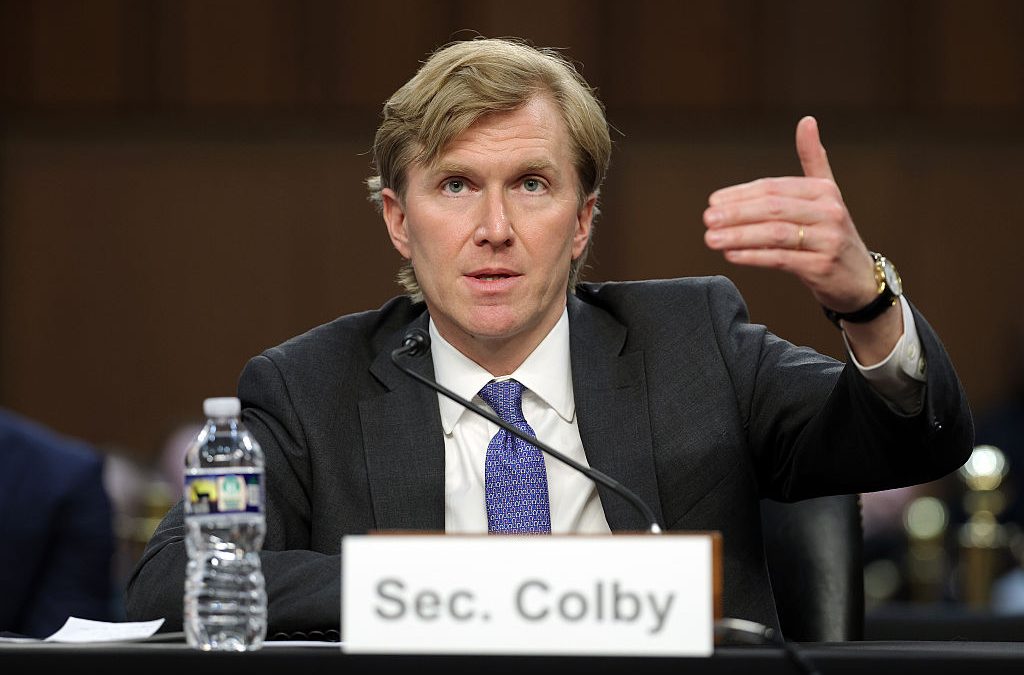
Although many commentators dismissed the president’s remarks, with Rolling Stone calling them “bizarre,” he was not alone in bragging about empire. War Department official Elbridge Colby also delivered remarks in which he boasted that the United States is an empire.
“We are already, as our Founders put it, an empire of liberty unto ourselves,” Colby told a conference of defense ministers on July 8th. “I say this with pride, of course, not arrogance.”
With his remarks, Colby made an effort to reframe some of the president’s commentary. Providing context for the concept of an empire of liberty, Colby connected it to the country’s origins, when founders such as Thomas Jefferson and John Adams had used the phrase.
In addition, Colby attempted to disassociate American empire from imperialism. Whereas Trump had glorified American conquest and expansion, Colby insisted that “we do not need imperial possessions or dependencies.”
The American empire has nearly always featured imperial possession and territories, however, from its earliest history to the present day. By invoking the concept of an empire of liberty, both Trump and Colby appealed to an imperial idea that featured conquest and expansion at its very core.
When the country’s founders envisioned the United States as an empire of liberty, they were thinking of white U.S. settlers moving into new territories, displacing indigenous people, taking over their lands, and creating new states for entry into the United States. The founders may have claimed that expansion would provide liberty for white U.S. settlers, but they also knew that it would mean dispossession and extirpation for indigenous people.
“If ever we are constrained to lift the hatchet against any tribe, we will never lay it down till that tribe is exterminated, or driven beyond the Mississippi,” Jefferson wrote. “In war they will kill some of us; we shall destroy all of them.”
A Basis for Empire First
Apologia for American empire may not have been a main theme of most people’s celebrations on the Fourth of July, but the Trump administration presented its own vision. Rather than sticking to the liberal ideals of the Declaration of Independence, including its powerful symbolism of opposition to empire, the Trump administration lauded the United States for being an imperial power.
The Trump administration’s actions marked a significant shift in modern U.S. politics. Whereas previous administrations let pundits and strategists do the dirty work of advocating for empire, the Trump administration is presenting its own arguments.
The administration’s empire talk is also promoting imperial values. With the president flouting international law and threatening countries with war crimes, the administration is cultivating an imperial culture. U.S. military forces are taking pride in conducting extrajudicial killings in the Caribbean and Eastern Pacific.
“The United States military is killing people and bragging about it,” Senator Tim Kaine (D-VA) observed last month.
Congressional leaders have refrained from condemning American empire, but they may not be able to ignore the issue much longer now that the Trump administration is glorifying empire as an ideal to be praised and celebrated rather than avoided and condemned.
Indeed, the Trump administration is providing its own apologia for American empire, creating a basis for Empire First, with the president playing the leading role.