
On a recent Piers Morgan show, the guest was Robert Pape, a University of Chicago political scientist. The subject was a set of wars that now feed each other: Russia and Ukraine, the Yemen and Saudi Arabia, the United States and Israel against Iran.
Pape, who founded the Chicago Project on Security and Threats, turned to the danger of moral certainty in war. He began with the protesters killed in Iran:
Whether the numbers are several thousand protesters that were killed by the Iran regime, or higher than that, the fact of the matter is, killing protesters is not something we think of as just OK.
Then he asked how wars cross their own thresholds:
How do you break thresholds and get cycles of violence? Where you get wars of the cities, … and how you get this is moral certainty on each side, which causes then civilians to be attacked more and more and more aggressively as if they (the civilians) deserve it.
His research on suicide terrorism, in Dying to Win and Cutting the Fuse, finds foreign occupation to be the leading driver. “Moral certainty is the fuel for the escalation trap,” he said, naming the framework he uses to anticipate how wars widen.
Moral certainty identifies who is to blame. It cannot predict who is about to get hurt.
What Is Documented, What Is Not
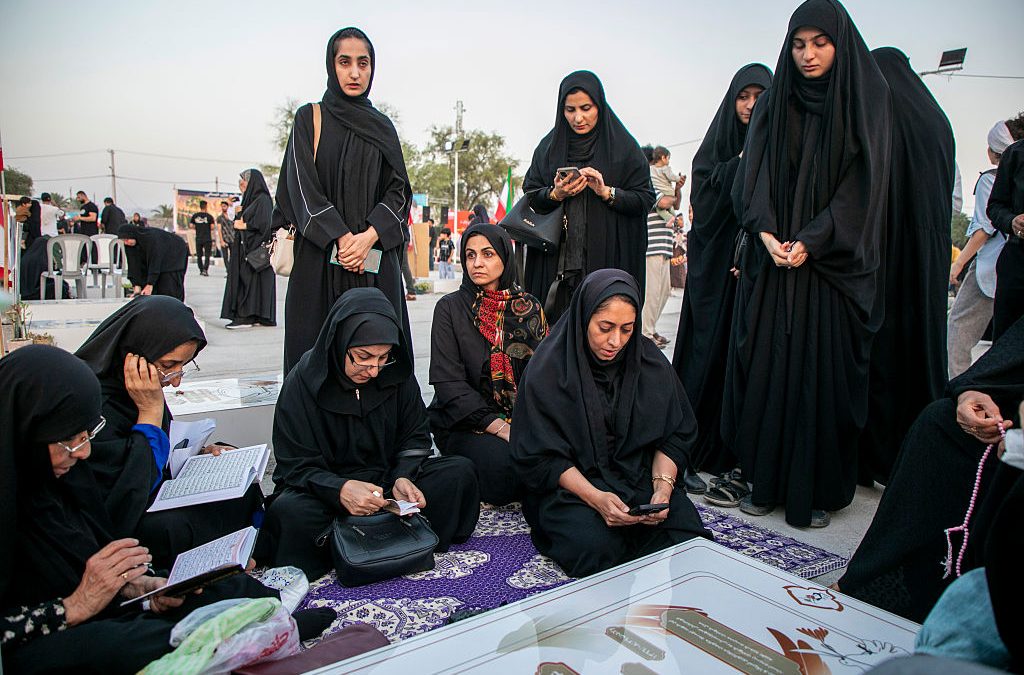
On February 28, the first day of the Iran war, a missile hit the Shajareh Tayyebeh elementary school in Minab, in southern Iran. The AP counts about 120 children among the dead, Iranian state media put the total at 168, and AFP reported at least 155 killed, most of them children. Reporters have had limited access, so the exact toll is still disputed.
The school stood beside a Revolutionary Guard compound, visibly separated from it since 2016. The Congressional Research Service reports that a Tomahawk hit the school and that a preliminary U.S. military investigation found the United States responsible, working from outdated targeting information. Secretary of State Marco Rubio said that the United States “would not deliberately target a school.” Months later, AP reported that the Pentagon had still not published its findings.
The details that stay with me are small ones. The AP found that teachers phoned parents to collect their children before Iran’s government ordered schools closed that morning, and some parents did not make it in time.
You can blame Tehran’s repression and its nuclear program, or you can blame Washington’s decision to strike. Either way, the children in that building chose neither, were responsible for neither, and paid the ultimate price.
Minab was also not the last time. In early September, Reuters reported that Iran counted 18 civilians dead in U.S. strikes, including four at a wedding, and the UN secretary general said he was deeply alarmed. Iranian missiles and drones have also hit Gulf cities, with airport strikes in Dubai and Abu Dhabi. Civilians on every side of this war have paid for decisions they did not make.
The Next Building
On PBS’s Amanpour & Company on March 25, Robert Pape said that “even with smart bombs, there’s going to be collateral damage of a serious nature,” and that the anger it leaves behind has consequences: “we are setting in train exactly the anger for how you get indiscriminate terrorism and you get people willing to die (in order) to kill.” In his weekly Escalation Trap conversations, he has said he expects that the next wave of violence will come from inspired attackers rather than centrally directed ones.
The distinction matters. Counterterrorism scholar Bruce Hoffman told KERA’s Think on March 18 that in the war’s first nine days, “we’ve seen three serious attacks in the United States, one in Austin, of course, where two people were murdered,” and that the attackers seemed “completely self-motivated outside any kind of identifiable terrorist command and control chain.”
The Austin gunman killed two people and wounded 14 on March 1. He wore a shirt with an Iranian flag, and the FBI said it was investigating terror links, but police said it was too early to name a motive, and an internal counterterrorism update noted a history of mental health conditions. In mid-March, a man drove a vehicle into Temple Israel, a synagogue near Detroit, with about 140 people inside, roughly 106 of them children; no attendees were reported hurt. An anonymous Lebanese official told the AP that the attacker’s two brothers and their two children had died in an Israeli strike days earlier. The AP could not verify that, and officials had not established a motive.
Neither case proves that the war caused the violence. There is also a serious counterargument: CSIS analyst Daniel Byman noted in April that Iran has not used terrorism in this war, and offered several explanations, including lost capacity, fear of escalation and the usefulness of missiles and shipping disruption. He also warned that this restraint may be a pause, not an ending. The American Conservative likewise argued that Iran has few incentives to orchestrate attacks, while Hoffman warned that the risk of lone-actor incidents rises the longer the war lasts. The dispute is about who and when. Almost no one claims that the risk shrinks as the war goes on.
Nor does the harm stop at Iran’s borders. In Yemen, the UN human rights chief said on September 24 that civilians are “bearing the brunt of this latest upsurge in fighting,” with 32 civilians killed since August, 15 of them children. In Ukraine, the UN has documented 15,280 civilians killed or injured in the first eight months of 2026.
Why Diplomacy Loses the Room
On September 17, the UN’s fact-finding mission on Iran found reasonable grounds to believe that U.S. forces committed war crimes in two February strikes, including Minab. It said the school was clearly civilian, that the intelligence behind the strike was not adequately verified, and that the attack went beyond negligence. In the same report, the mission found that Iran’s crackdown on protesters since late December amounted to crimes against humanity. Iran’s own official toll is 3,038 dead, which the mission believes understates the real number.
Both findings stand together. The U.S. government has not accepted the first: President Trump said in June that “nobody” purposely attacked the school, and the Pentagon has not published its findings. Anyone who wants a single villain has to look away from one of them. That is exactly what Pape meant by moral certainty. Each side sees only the victims the other side made.
Speed is the second problem. The Pentagon relied on an AI targeting platform called Maven to strike more than 13,000 targets in the first 38 days of the war. “For U.S. military officials, Maven’s speed in selecting and reselecting targets represents a distinct combat advantage, allowing U.S. forces to disable Iranian combat capabilities swiftly and incessantly, preventing their reconstitution,” writes Michael Klare at Arms Control Today. Politico reported in March that Pentagon staff focused on reducing civilian casualties had fallen from about 200 to fewer than 40. One former official told the AP that the Minab strike was a natural result of those cuts and of Secretary Hegseth’s emphasis on lethality.
Early in the war, Hegseth said that the operation was “just getting started” and “accelerating not decelerating.” Force comes with a slogan and a victory lap. Diplomacy comes with compromise, and compromise has no one to cheer it. A debate about who is right will always make more noise than a question about who is next.
What It Would Take
Five shifts would help in preventing the next Minab.
It’s important to change the first question. Hosts and producers of news programs can ask “who is most likely to be hurt next, and what would stop it?” before they ask “who is right?” They can seat civilian-protection investigators, humanitarian workers, and mediators beside the partisans. They should likewise make civilian harm a standing story. Minab returns to the headlines only when a new document leaks. Washington cannot keep ignoring Minab, but to do so lawmakers and citizens must demand accountability. An independent review and a public explanation must be required after there is credible evidence of grave harm from an AI-assisted targeting system.
To fight against amnesia, it’s critical to remember the names of the victims. The AP calls the ruined school in Minab a memorial: “This will never be a school again.” In March, Win Without War laid children’s backpacks on Capitol Hill for the dead. Ordinary people can keep such memorials in front of lawmakers who would rather not look.
Diplomacy is essential. A Pakistan-brokered ceasefire in April, which FPIF’s Imran Khalid described as “a shift in the center of the diplomatic world,” showed that diplomacy can still find a way. Pape has said that a deal resembling the 2015 nuclear agreement is still possible, with low enrichment, sanctions relief and inspections. Voters can tell their representatives that this is the outcome they want.
Finally, multiple truths must be upheld simultaneously. The UN found grounds for war crimes at Minab and crimes against humanity against Iranian protesters. Saying so is accuracy, not equivalence, and it is the primary method of challenging the moral certainty that Pape describes.
The next building is somewhere. It is not yet a headline. There’s still time to make sure it never becomes one.