
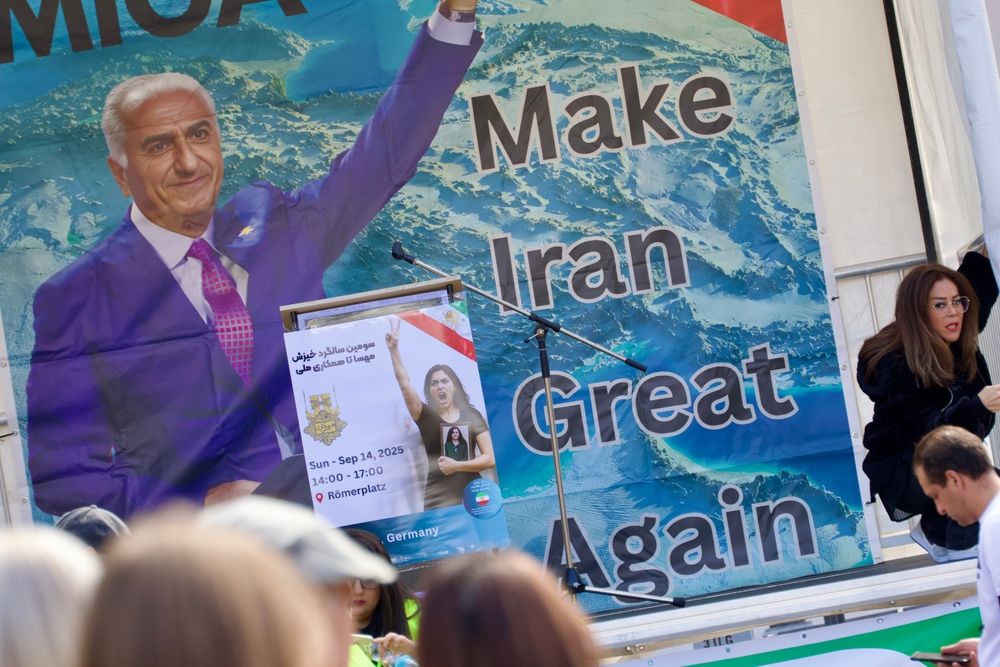
The Islamic Republic of Iran is under unprecedented pressure. Internally, the violent protests and their bloody aftermath have severely undermined the legitimacy of the system. Externally, the Trump administration has amassed military forces in the region. It struck Iranian nuclear facilities last year, and, while stating a preference for a diplomatic deal with Tehran, has made clear a willingness to use force again should negotiations fail.
Yet one question remains conspicuously unanswered. What—or who—is the alternative?
For years, a small but vocal network of exiled monarchists has insisted that Reza Pahlavi, the son of Iran’s deposed shah, is that alternative. They have lobbied Western capitals, organized diaspora rallies, and spent decades positioning him as the rightful heir to a post-Islamic Republic Iran.
By every measurable metric, their project is failing—and failing visibly.
Washington’s Cold Shoulder
President Trump has increased military and economic pressure on Tehran to levels unseen since 1979. He has mused publicly that regime change in Iran “would be the best thing that could happen.”
And yet he has refused to meet with Pahlavi. When asked directly about the exiled prince’s level of support inside Iran, Trump sounded skeptical—a devastating signal from an administration that has otherwise shown little restraint in embracing the regime-change narrative.
Pahlavi, reduced to pleading on X and in interview after interview, now spends his time imploring the West to intervene militarily. “Intervention is a way to save lives,” he told Reuters on the sidelines of the Munich Security Conference in February 2026.
This is not leadership. An alternative that must beg others to fight its battles is not an alternative at all.
The European Debacle
Things are not much better in Europe. Pahlavi’s most reliable institutional ally has been the right-wing European Conservatives and Reformists (ECR) Group in the European Parliament.
Their campaign to elevate him has been a study in diminishing returns. First, the Finnish member Sebastian Tynkkinen launched an open petition to European Parliament President Roberta Metsola, requesting that Pahlavi be invited to address the full plenary amid the protests in Iran in January—an honor ordinarily reserved for heads of state.
This effort exposed the Pahlavi supporters’ lack of procedural savvy. The plenary agendas are not shaped by public petitions but by backroom maneuvering among political groups. During the January session the king of Spain was scheduled to address the chamber to mark the fortieth anniversary of Spanish accession to the EU. As a result, the petition languished, with only 35 MEPs out of 720 signing it—fewer than 5 percent of the assembly—a public relations fiasco that was easily avoidable with some elementary planning.
Undeterred, Tynkkinen attempted to insert the invitation into the European Parliament’s resolution on Iran. He failed at that, too, but then his ECR group tabled it as a plenary amendment. It was rejected, making the defeat all the more visible and embarrassing to Pahlavi.
One reason for that debacle is the long shadow of the MEK (Mujahedin-e-Khalq), the bizarre cult-turned-lobbying-operation that styles itself as Iran’s exiled opposition, with a long history of terrorism. MEK, irrevocably opposed to Pahlavi, has spent decades cultivating relationships with European lawmakers, something the monarchists conspicuously failed to do.
Now, Pahlavi supporters are pursuing a consolation prize: an invitation for him to address the European Parliament’s Foreign Affairs Committee. If secured—and that is not certain given opposition by left-leaning groups—it will be a pale shadow of the statesman’s platform they once envisioned. From plenary to committee room—that is the trajectory of a project in decline.
The pattern repeats at the national level. In Sweden, a parliamentary initiative was launched to endorse Pahlavi as the legitimate alternative to the Islamic Republic. The result? A grand total of 12 MPs signed on. Of those, 11 belong to the Sweden Democrats—a party with roots in the neo-Nazi movement.
This is not a coalition of mainstream democratic legitimacy. It is a fringe finding its natural home among other fringes. The monarchist project’s strongest foothold in Scandinavia is a party that until recently was shunned by all others as beyond the pale.
The Munich Test
At the Munich Security Conference in January 2026, Pahlavi had his most visible platform yet. He did not seize it.
During a press encounter, he insulted a BBC Persian journalist, reflecting a conspiracy theory, popular in monarchist circles, that the outlet is somehow a vehicle for the Islamic Republic propaganda. This is an absurd claim given the well-documented repression the network’s journalists are facing in Iran.
When another journalist raised uncomfortable questions about human rights abuses under the monarchy of his father—the late Shah Mohammad Reza Pahlavi, the CIA-backed ruler whose authoritarianism helped precipitate the 1979 revolution—Pahlavi’s response was defensive, testy, and dismissive.
The real test of leadership is the ability to engage with critical media, acknowledge uncomfortable truths, and demonstrate the temperament required of a head of state. So far, Pahlavi has failed that test.
Any honest assessment of Pahlavi’s project must also confront the behavior of his most ardent supporters. Across social media, a network of self-appointed monarchists wages daily campaigns of insults, harassment, and violent threats against anyone who questions Pahlavi’s leadership. Such actions increasingly spill over to real life—as seen in Munich, where Pahlavi supporters hurled insults at CNN anchor Christiane Amanpour for daring to ask Pahlavi fairly soft questions.
This is not the behavior of a movement confident in its popular appeal. Rather, it is the behavior of a cult—or at least of a movement that has absorbed the worst habits of the MEK, whose own history of intimidation and abuse is well-documented. It is a measure of the monarchists’ strategic incompetence that they have handed the regime in Tehran this opportunity to paint their movement as intolerant and lacking social base in Iran.
The Zahedi Precedent
Even by the standards of monarchist nostalgia, Pahlavi’s current posture represents a steep decline from the generation that preceded him. Consider the late Ardeshir Zahedi—a stalwart of his father’s regime, and the Shah’s last ambassador to Washington. An unabashed monarchist until his dying day, Zahedi was something Pahlavi has yet to prove himself capable of being: an Iranian nationalist who placed his country’s sovereignty above all else.
When, in the final years of his life, Zahedi was asked about exiled Iranians calling for foreign military intervention against the Islamic Republic, his response was withering. Such appeals, he said, were “dishonorable.” Whatever his disagreements with the regime that had supplanted his own, Zahedi understood that no political order imposed by foreign bombs could ever be legitimate in the eyes of Iranians. He understood that the road to Tehran did not pass through Washington, Brussels, or Paris.
Pahlavi has taken the opposite path. His public statements are now consumed with pleas for American and European intervention. He has positioned himself not as a leader who will liberate Iranians, but as a supplicant asking others to do it for him. If even his father’s most loyal ambassador understood the dishonor of such a posture, what does it say about the son who has made it his central message?
The contrast is illuminating. Zahedi grasped that Iranian dignity was non-negotiable. Pahlavi, for all his handlers’ PR efforts, has yet to demonstrate that he grasps anything of the sort.