
Earlier this month, Britain, France, and Canada announced a coordinated round of sanctions on Israeli settlements in the occupied West Bank: an import ban on settlement goods, measures against the firms that sustain them, and sanctions on Israeli settlers. British officials used language usually reserved for adversaries, not allies, accusing “settler terrorists” of “ethnic cleansing” against Palestinians. Nine other Western governments signed on, and it followed a similar round in June, when Britain, Canada, France, and Norway sanctioned individuals and entities, including a travel ban tied to Israel’s finance minister, Bezalel Smotrich.
Predictably, Washington took none of these steps. Asked about the September measures, Secretary of State Marco Rubio was blunt: “we’re not going to do what the UK did.” The United States has condemned settler violence in specific incidents, its ambassador called one siege of Palestinian homes “disgusting”, but it has not joined its allies in sanctions or pressure. Israel’s retaliation, closing the UK consulate in Jerusalem and barring 11 British lawmakers, was aimed at London alone, because only London had acted.
A starker disagreement is playing out over the International Criminal Court. In August, Washington sanctioned the court’s president, Tomoko Akane, and a senior trial lawyer, on top of sanctions already in place against roughly a dozen ICC officials, including former chief prosecutor Karim Khan. Rubio called the court “corrupt and fatally politicized” and vowed to dismantle it “brick by brick.” Europe’s response came quickly and nearly unanimously: the European Commission and Council presidents defended the court’s independence, Germany said that it stands by the ICC, and a senior European Parliament figure called for shielding European banks from the sanctions. The court itself called Washington’s move a “flagrant attack” on judicial independence, aimed at the alliance leader since 1945.
Several of America’s closest allies are sanctioning the same Israeli government that Washington continues to arm, while Washington sanctions the court Europe treats as the human rights order’s main guarantor. That is a disagreement over what the rules-based order requires, not just how to enforce it. Speeches by Macron and Trump at the UN General Assembly on September 22 made the divide plain. Macron warned against a “new order of impunity,” argued that peace requires justice, and called for international law to constrain the powerful. Trump, by contrast, attacked the ICC, urged countries to leave it, and cast international accountability as a threat to American sovereignty.
For anyone who’s paid attention, this consensus was never as cohesive as it looked. In 1986, Congress overrode Reagan’s veto on South Africa sanctions, while Thatcher’s Britain held out against the tougher measures the rest of the Commonwealth had already agreed to, an open break among allies who claimed a shared standard. Washington’s earlier response to Saddam Hussein’s gassing of the Kurds at Halabja went the other way: the State Department initially implied Iran shared the blame and helped delay a UN response for seven weeks, because Baghdad was still useful against Tehran, while Europe stayed quiet rather than break ranks. Allies can and do split at times.
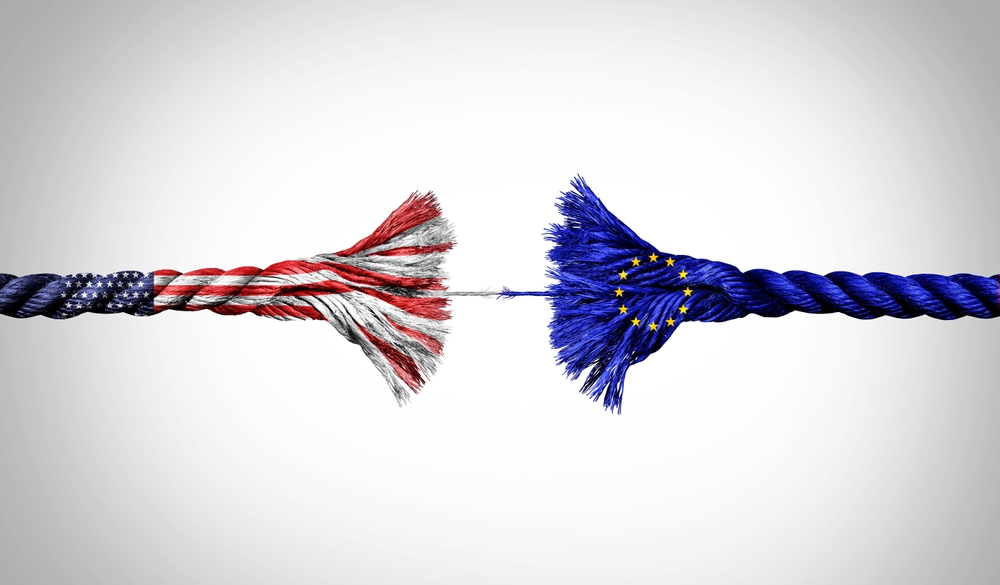
What has changed is that the United States and its European allies no longer seem to be operating from a shared understanding of international human rights norms or the responsibilities they impose. One side is sanctioning officials accused of facilitating ethnic cleansing, the other is sanctioning members of the court responsible for adjudicating the underlying allegations.
Who gets to decide what accountability means, and what it looks like, now depends on individual governments’ interpretations, not on a shared reading of international law. Europe treats the ICC and coordinated sanctions as a rules-based approach. Washington, under the current administration, treats the same mechanisms as a threat to sovereignty, an argument it has made before, including when the ICC investigated American conduct in Afghanistan. What is new is the willingness to act on that argument against a sitting ICC president even as a formal ally uses nearly identical reasoning to sanction that ally’s own security partner.
Neither the United States nor its EU allies have clean records. Germany, whose postwar identity rests on the promise of “never again,” has approved close to a billion dollars in arms exports to Israel this year, nearly four times its 2025 total, even as its own chancellor has warned against West Bank annexation. This month, Serbia gave a state funeral, with military honors, to Ratko Mladić, the man responsible for the Srebrenica genocide, and Brussels’ rebuke was muted, with no clear plans for accountability. Washington’s own claim to a rules-based order sits awkwardly next to a year of strikes on suspected drug boats in the Caribbean—which have resulted in 227 dead so far without any trials—that Human Rights Watch calls extrajudicial killing and the ICC’s first chief prosecutor calls a crime against humanity. In each case, countries have reached for human rights law as a weapon against others while treating it as negotiable at home.
Quiet inconsistency could still pass for unity, but a clearly open fracture cannot. Governments in Ankara, Delhi, and Pretoria now have a concrete example to point to the next time they face a charge of double standards: the West cannot agree on what human rights accountability requires, or whom it should apply to. As the West calls for accountability in places like Sudan over mass atrocities, its voice is fraught with hypocrisy for the standard it claims to champion has too often been farcical and selective. The Genocide Convention, the Rome Statute, and the doctrine of the Responsibility to Protect are clear enough about what states owe each other. The West Bank and ICC disputes show that this clarity on paper has never translated into a consistent standard in practice.
That is the real cost of an open fracture. The West looks divided, and its claim to a shared standard of rights and legitimacy is losing whatever standing it still has. Washington and its allies clearly do not agree on what accountability means. The harder question is whether accountability still means anything as a shared concept. If it does not, what does that say about the universality of human rights, and the West’s commitment to them?