
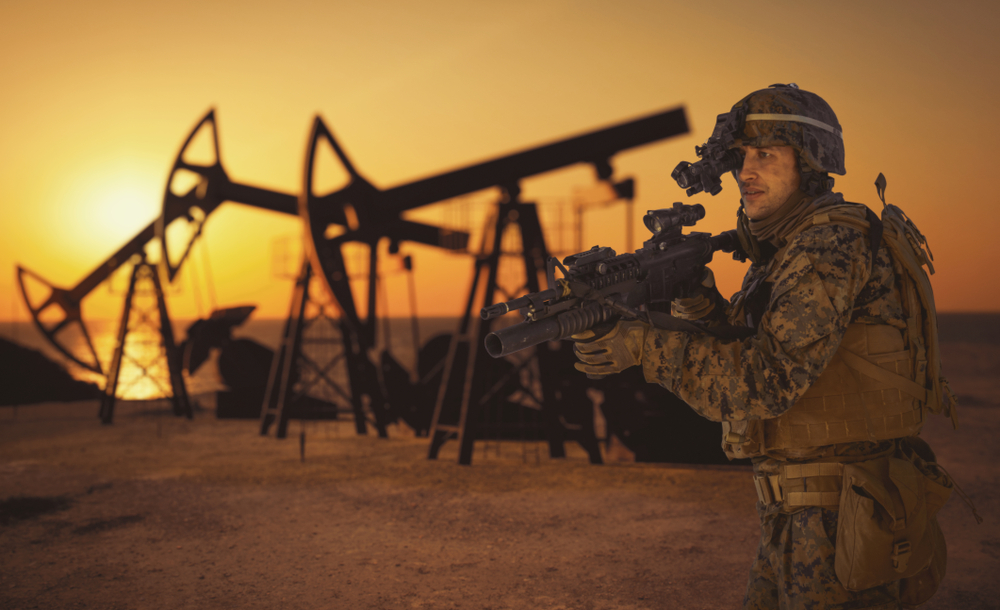
The Trump administration is implementing a new imperial scheme to gain control of Iraq’s oil.
Although President Trump appears to be winding down U.S. involvement in Iraq, declaring on September 30 that “we’re getting the hell out of there,” he is working on a new plan to crack open the country’s oil industry. By intervening in the country’s politics, including the selection of its prime minister, the president believes he can pressure the Iraqi government into accepting new oil deals that will enable U.S. energy companies to begin taking vast amounts of oil out of the country.
“We’re going to be taking out a lot of oil,” Trump said in July, when he welcomed Iraqi Prime Minister Ali al-Zaidi to the White House. “A lot of oil is coming out, and the American companies are doing it.”
Trump’s Approach
For several months now, the Trump administration has been quietly laying the foundation for a new era of U.S. imperialism in Iraq. Although it has withdrawn U.S. military forces from the country, sticking to a deal reached between the Biden administration and the Iraqi government, it has begun exploiting U.S. economic and political power to exercise powerful influence over the Iraqi government.
Earlier this year, the Trump administration intervened in the country’s parliamentary process to prevent former Prime Minister Nuri Kamal al-Maliki from returning to power and clear a pathway for wealthy businessman Ali al-Zaidi to become the country’s next prime minister. Putting extraordinary pressure on the Iraqi government when it was trying to choose its new leaders, the Trump administration suspended funding for the country’s security forces, which provide security for government officials. At the same time, it prevented the Iraqi government from receiving revenues from its oil sales, which are held in accounts at the Federal Reserve Bank of New York.
Although the administration presented its moves as a matter of pressuring the Iraqi government into distancing itself from Iran, it provided leeway for al-Zaidi, who is an owner of a bank with alleged ties to Iran. In fact, Trump openly supported al-Zaidi, encouraging Iraqi leaders to accept him as the country’s next prime minister.
After the Iraqi government caved to U.S. pressure and made al-Zaidi prime minister, the Trump administration then began organizing its approach to Iraq around al-Zaidi, believing he would open the country’s oil industry to U.S. oil companies. The administration restarted transfers of the country’s oil revenues to the Iraqi government, providing a boost to al-Zaidi. Some Iraqi insiders even began describing the new Iraqi prime minister as “the Trump of the Middle East,” according to former State Department official Victoria Taylor.
This past July, the Trump administration showcased its efforts to transform relations with Iraq with two major events in Washington. First, the Trump administration welcomed al-Zaidi to the White House, where Trump and al-Zaidi announced the creation of new oil partnerships.
“Our oil companies are going in there at levels that have never been seen before,” Trump said.
A few days later, the U.S. Chamber of Commerce hosted senior U.S. and Iraqi leaders at a business summit to finalize more than $60 billion in new business deals. The agreements, which were planned by Iraqi officials and U.S. executives, included several major U.S. energy companies, including Chevron and ConocoPhillips.
Secretary of Energy Chris Wright, who spoke at the event, celebrated the deals and praised business leaders for being “the tip of the spear that are going to drive these investments and partnerships with companies and the government of Iraq.”
Establishment Concerns
Although the Trump administration has displayed tremendous confidence in its imperial maneuvers, believing it will accomplish what previous administrations failed to achieve over decades of war, many establishment leaders remain skeptical. Recognizing that the administration has been struggling with similar efforts in Venezuela, an oil-rich country that it is trying to open to U.S. energy companies, establishment leaders are unconvinced that the administration will fare any better in Iraq, where many armed groups have spent decades resisting U.S. imperialism.
At a forum hosted by the Atlantic Council in September, several experts and former officials warned that the Iraqi government will struggle to disarm militias that operate in the country, some of which receive support from Iran. Although al-Zaidi has promised to bring the militias under the control of the Iraqi government, he has already postponed his initial deadline for disarming them.
Former U.S. Ambassador to Iraq Alina Romanowski, who participated in the negotiations over the U.S. withdrawal during the Biden administration, warned that the militias remain powerful actors inside Iraq. Pressure from the militias, she indicated, was a factor leading to the U.S. military withdrawal.
“There was a tremendous amount of pressure from the militias and…a little bit of a wobbly government that wanted us out and wanted us out quickly,” Romanowski said.
The former U.S. ambassador also noted that U.S. corporations would struggle to operate in Iraq as long as the militias remain active. If the Iraqi government “can’t get the militias under control,” she said, then “it’s just going to be too difficult, too expensive for new companies, new American companies, to get in there.”
While establishment leaders have remained concerned about the militias, they have also indicated that the United States is losing influence in Iraq. They worry about ceding ground to the militias, especially now that Iraqis and militias are celebrating the U.S. withdrawal as a triumph against the United States.
Andrew Tabler, a former Trump administration official who participated in the forum hosted by the Atlantic Council, lamented that the United States will no longer be able to conduct rapid military interventions against the militias and other armed forces in Iraq. Although Tabler acknowledged that U.S. military forces can still launch operations from “over the horizon,” meaning neighboring countries, he said that they would remain limited by the countries that host them.
“When you withdraw troops, you remove the ability directly to take your thumb on and off the scale,” Tabler said.
Panelists at the forum also questioned the Trump administration’s strategy. Romanowski wondered whether the Trump administration is “completely withdrawing and ending the security relationship.” She noted that there are “all sorts of implications,” especially for business deals, saying that “you can’t at the same time encourage investment.”
Tabler, who insisted on the need for strategic “engineering,” said that he saw little in the way of military strategy and warned about half-baked schemes for the country’s oil industry. “We have some really far-out schemes that are out there,” Tabler said. They “are in Washington but elsewhere, too.”
Even within the Trump administration, there are concerns about U.S. policy. Although administration officials support the president’s goal of breaking open the country’s oil industry, they worry about the possibility of disaster, including the potential for Iraq to collapse.
Secretary of State Marco Rubio has warned about the “balkanizing” of Iraq, meaning the breakup of the country. It is critical that “you don’t have these independent forces operating and balkanizing the country,” Rubio said last month, as the U.S. withdrawal got underway.
Fallout
While current and former officials have anticipated many challenges, the Trump administration has been facing problems of its own making that may prevent it from achieving its imperial objectives, no matter how much leverage it wields over the Iraqi government.
For starters, the Trump administration is struggling to manage the fallout over its military aggression in Iran. Although the Trump administration repeatedly insists that it is achieving great success against Iran, having collaborated with Israel to assassinate the country’s former leaders, it is failing to keep open the Strait of Hormuz, the region’s most critical oil transit chokepoint.
Uncertainty over the Strait of Hormuz is creating major challenges for countries that rely on it to export oil, including Iraq. With traffic through the strait curtailed, Iraq is experiencing an economic crisis due to significant declines in its oil exports and oil revenues.
At the same time, the Trump administration is facing pushback from its allies in the Middle East. Some of the administration’s top Arab allies have been limiting their support for the administration’s military aggression in Iran, especially now that they are facing attacks. Without full support from U.S. regional allies, the Trump administration is finding it more difficult to sustain its military operations in the region.
“I think the U.S. military and its relationship with the region is in serious question,” Tabler said.
The Trump administration is also finding it difficult to maintain support from the people of the United States. Although congressional Republicans and some Democrats continue supporting the administration’s military aggression, Trump is facing growing skepticism from the American people, who are broadly opposed to the war and increasingly concerned about rising gas prices.
“I think the problem in the end is they just don’t trust the architects anymore,” Tabler said, referring to growing public distrust of the architects of U.S. wars. “I think it’s going to be harder going forward to convince Americans to vote for this far-out architecture.”
Regardless, the Trump administration is continuing its imperial maneuvers in Iraq. Rather than seizing the opportunity to end decades of U.S. imperialism in Iraq and bring an end to U.S. wars in the Middle East, it is forging ahead with new plans to exploit Iraq and take control of its oil resources. The administration is trying to live by the president’s imperial mantra that the United States must “take the oil.”
Indeed, the Trump administration is continuing to chase imperial dreams in Iraq, despite all the damage that it has already done to the region and the world.