
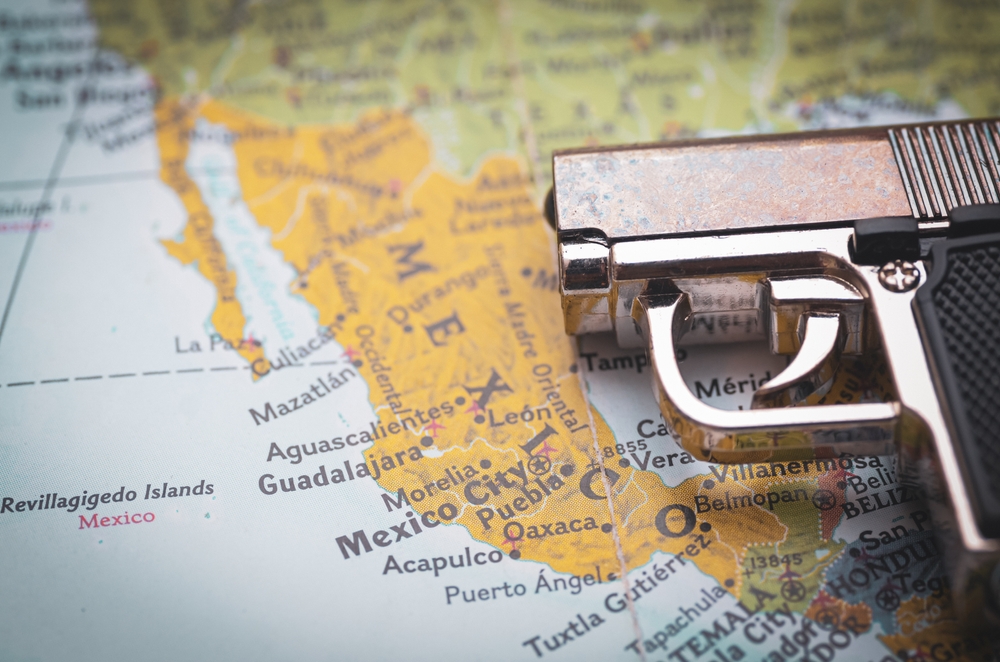
Officials in Washington are quietly acknowledging that U.S. guns are contributing to violence and instability in Haiti and Mexico.
Although U.S. leaders typically blame Haitian gangs for destabilizing Haiti and Mexican cartels for terrorizing Mexico, they are warning that U.S. guns are implicated in criminal violence in both countries. Some officials have confirmed that most weapons used by Haitian gangs and Mexican cartels originate in the United States, where they are purchased and then smuggled into Haiti, Mexico, and other countries.
Some of the highest-level officials in the Trump administration have even grown critical of U.S. guns, despite their dubious claims that U.S. guns do not cause violence in the United States. Secretary of State Marco Rubio has insisted that the United States must stop U.S. guns from being smuggled into Haiti and Mexico, and State Department official Christopher Landau has acknowledged that they are creating instability.
“I’ve been very involved in Haiti,” Landau said last month. “It really stemmed out of trying to stop the flow of guns that are going from our country into Haiti and destabilizing it.”
The Case of Mexico
For decades, the leaders of the United States have been debating the causes of criminal violence in Mexico, where a horrific drug war has taken the lives of hundreds of thousands of people.
Typically, U.S. officials have blamed Mexican cartels for terrorizing the population and destabilizing the country. Since the Mexican government launched a war against the cartels in 2006, U.S. officials have come to its aid, providing it billions of dollars in security assistance with programs such as the Mérida Initiative and the Bicentennial Framework. Although the drug war has led to an increase in drug-related violence, U.S. officials have often attributed the violence to cartels, insisting that they must be confronted.
Still, U.S. officials have sometimes considered U.S. determinants of violence. They have acknowledged that strong U.S. drug demand keeps the cartels in business. They have also indicated that the trafficking of guns and ammunition enables the cartels to amass large arsenals and outgun local police forces.
A major turning point came in 2021, when the Mexican government began pressuring the United States to take responsibility for its role. The Mexican government let the Mérida Initiative expire, as it had failed to stop drug-related violence. Mexico also brought a lawsuit against U.S. gun manufacturers, blaming them for facilitating criminal violence in the country.
In response, the Biden administration tried to reassure the Mexican government that it was addressing the issue. In 2022, Biden signed into law legislation that prohibited gun trafficking and empowered federal law enforcement agencies to target traffickers. Some officials began to acknowledge that gun trafficking remained a serious problem.
“We see the criminal enterprises and cartels being able, in some part, to do what they’re doing and protect themselves because of…guns that are coming from the United States into Mexico,” Antony Blinken said in 2023, when he was secretary of state in the Biden administration.
The Trump administration has also acknowledged the gun problem. Although Trump has sought to shift attention back onto the cartels, even threatening to take military action against them, several administration officials have noted that U.S. guns remain implicated in criminal violence. At the State Department, Rubio has been directing an effort to examine the issue, including ways of addressing it.
“Many of the weapons that are in the hands of these cartels are weapons that have been purchased from a source in the United States,” Rubio acknowledged in 2025. “These weapons have been trafficked.”
Part of the Trump administration’s response has been driven by ongoing pressure from the Mexican government, which has continued its legal efforts against U.S. gun manufacturers. Although the Supreme Court rejected Mexico’s lawsuit, officials in Washington have been trying to reassure Mexican leaders that their concerns are being taken seriously.
At the same time, the Trump administration has been responding to ongoing reports that the cartels are acquiring hundreds of thousands of guns from the United States every year. According to The New York Times, the cartels have even been able to get access to some of the most advanced U.S. weaponry, including ammunition produced for the U.S. military.
“Guns are going right to the cartels and increasing their lethality and threatening not just Mexican security forces but U.S. citizens in Mexico,” State Department official Chris Landberg said during a congressional hearing last year.
Officials from several federal agencies insist that they are working to stop gun trafficking, empowered by the 2022 legislation signed into law by Biden, but it remains unclear whether their actions are having any effect. In September, the U.S. Government Accountability Office (GAO) reported that U.S. federal agencies lack the performance measures needed to assess their efforts.
“The agencies do not know the extent to which their efforts are meeting objectives and cannot determine whether they are directing resources to the most effective programs,” the GAO noted. “This could lead to waste and, potentially, missed opportunities to more effectively counter firearms trafficking.”
The Case of Haiti
While U.S. officials have been considering the determinants of criminal violence in Mexico, they have also been debating the reasons for the surge in criminal violence in Haiti, where thousands of people are being killed every year.
Generally, U.S. officials have blamed criminal elements, just as they have done in Mexico. They have been especially critical of Haitian gangs, which began taking over the Haitian capital of Port-au-Prince following the assassination of the country’s president in 2021.
In response to the situation in Haiti, U.S. officials have been mobilizing an international police force that is now operating in the country. Although this police force has failed to stop criminal violence, U.S. officials have continued to support it, insisting that it is necessary for confronting the country’s gangs. The Trump administration has been reorganizing it as a gang-suppression force, pushing it to take lethal action.
Still, some U.S. officials have considered alternative explanations for the country’s descent into criminal violence, even giving some attention to U.S. determinants of violence.
The thinking in Washington began to shift in 2023, when the UN Office on Drugs and Crime published a major report that identified the United States as the “principal source” of weapons in Haiti. Researchers found that traffickers were moving vast amounts of guns and ammunition into the country, circumventing an arms embargo established by the UN.
Although the UN report received little attention in the U.S. mass media, several U.S. leaders became aware of its findings and began to reconsider the extent of U.S. responsibility for criminal violence in Haiti.
The Biden administration began promoting its law enforcement efforts, including the 2022 legislation that Biden had signed into law to prohibit gun trafficking. Kamala Harris visited the Caribbean, where she insisted that “our administration is committed to disrupt gun trafficking.”
In 2024, a group of senior Democratic lawmakers demanded additional action, urging the Biden administration to increase its efforts to deter arms trafficking to Haiti.
“The United States is the number one source of firearms entering Haiti today,” the lawmakers noted in a letter to the administration.
The Trump administration has also been looking into the gun problem. Although Trump has sought to shine the spotlight back onto Haitian gangs, pushing for more aggressive action, high-level officials have remained focused on gun trafficking. Several administration officials have indicated that Haiti will remain plagued by violence as long as U.S. weapons continue flowing into the country.
“It’s not just Mexico,” Rubio said in 2025. “Those arms are flowing to Haiti, they’re flowing to Jamaica, they’re flowing to Trinidad, they’re flowing into the Caribbean.”
Some U.S. federal agencies are now making efforts to prosecute traffickers. This past August, a South Florida man pleaded guilty to smuggling weapons into Haiti, where he had once been a police officer.
Still, officials in Washington are failing to stem the flow of arms into Haiti. Hundreds of thousands of guns continue circulating in the country, where they are empowering the gangs that control much of the capital.
“Weapons and ammunition, they come in some cases direct from Florida and New York through the Dominican Republic,” Colonel Justin Gorkowski, who co-leads an oversight team for the gang-suppression force in Haiti, told Congress in July.
Dilemmas
Now that U.S. leaders are coming to terms with one of the major U.S. determinants of violence in Haiti and Mexico, they are finding themselves facing several dilemmas.
One is that U.S. guns continue to facilitate criminal violence in Haiti and Mexico. Although U.S. officials remain committed to the narrative that criminal elements in both countries are the primary sources of violence, they are recognizing that Haitian gangs and Mexican cartels continue wielding arms that originate in the United States.
Another is that U.S. guns are fueling endless conflict. Although Haitian gangs and Mexican cartels remain awash in U.S. guns and ammunition, the armed security forces that are confronting them are in many cases armed with weapons that are made by U.S. gun manufacturers or supplied by the United States. In other words, armed combatants on both sides in Haiti and Mexico are fighting with arms and equipment that come from the United States.
Perhaps the greatest dilemma facing U.S. leaders, however, is that the Trump administration is actively making the problem worse. Even as some administration officials are warning about gun trafficking, the Trump administration is dismantling the new enforcement tools that the Biden administration had developed to address the problem. Rather than building on those earlier efforts, the Trump administration is making it more difficult for federal agencies to stop the flow of weapons into Haiti and Mexico.
Indeed, the Trump administration is knowingly acting in ways that are worsening endless violence in Haiti and Mexico. Despite the fact that some of the highest-level officials in the Trump administration are now blaming U.S. guns for violence and instability, they remain complicit in the rampant smuggling of guns and ammunition that continues bringing death and ruin to both countries.