
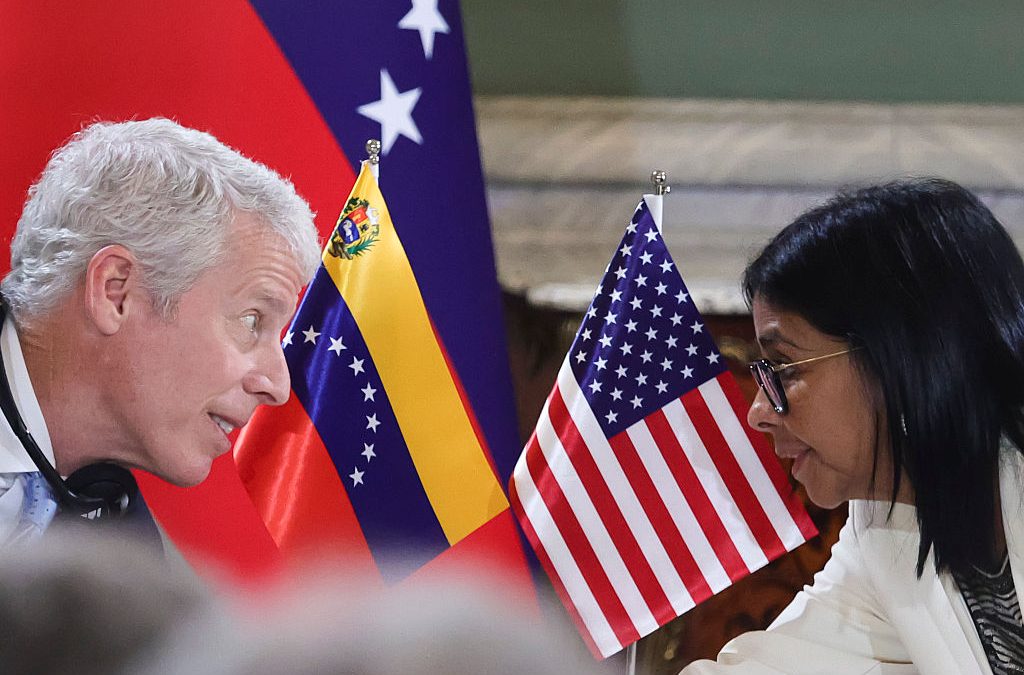
In his first week as Venezuela’s foreign minister, Oliver Blanco sat down with Marco Rubio at the State Department on November 2. The official readout spoke of electoral reforms, political prisoners and the president’s three-phase plan: stabilization first, then economic recovery and reconciliation, and only then a democratic transition. It said nothing about soldiers.
A day later, The New York Times reported that the State Department, under Rubio, is negotiating a status of forces agreement with Caracas that would lay the foundation for a long-term American military presence. Troop numbers and locations would be settled in later agreements.
Washington will sell this as paperwork. The State Department says it has negotiated such pacts with more than 100 countries, which give American forces a predictable legal footing for ship visits, training, and exercises. Seen from outside Washington, Venezuela is not merely the latest entry on that list. It is a country whose president was seized by American troops on January 3, whose interim leader holds no electoral mandate, and whose oil now carries a Pentagon stake.
A status of forces agreement signed under those conditions does not regulate a relationship between two sovereign governments. It writes a protectorate into law before the protected get a vote.
The soldiers, in fact, are arriving ahead of the lawyers. On October 30, Venezuelan drones and helicopters struck a Colombian National Liberation Army (ELN) camp in Apure state near the border with Colombia, and four U.S. officials told The Times that Washington supplied intelligence and drone support. The border rights group FundaRedes counted 23 victims. Back in June, a Southern Command airstrike killed Héctor Rusthenford Guerrero Flores, a founder of Tren de Aragua, with CIA intelligence and Venezuelan forces taking part. After the June earthquakes, about 2,000 American troops moved into and around the country before pulling out again. The reopened U.S. embassy in Caracas already has a military attaché.
The readout leaves out an important motive for a future military base: the oil fields. In September, the administration announced a deal giving Washington a stake in about one-fifth of Venezuela’s oil resources. Caracas handed North American Blue Energy Partners, the vehicle of oilman Alejandro Betancourt, 100-year rights over 17 oilfields holding 65 billion barrels of proven reserves. The Pentagon owns 35 percent of that company, and Washington is guaranteed the right to buy a fifth of its output at cost.
Nobody leaves a century-long concession, part-owned by the Defense Department, without a guard. Donald Trump, speaking in Washington the same Monday Blanco visited, did not bother with euphemism. He referred to “our conquest of Venezuela.” Oil contracts are written for decades. So, it seems, are the garrisons that guard them.
Latin America has lived through this imbroglio before. In 1901, Cuba had to accept the Platt Amendment before American forces would leave, and the State Department’s historians list among its conditions the sale or lease of land for naval stations. The Guantánamo lease followed in February 1903. Washington repealed the amendment in 1934 and kept the lease, and the naval base still operates. The political tutelage was renegotiated. The military footprint signed during the tutelage outlived everyone who signed it.
The interim authority across the table from Rubio is in no position to bargain hard, and it has no mandate to bargain at all. Delcy Rodríguez has given no election date. Trump says Venezuela is not ready for elections. María Corina Machado, back after ten months in exile, wants a presidential vote by July. On Monday, teachers, nurses and university unions held a 12-hour national stoppage, demanding a $960 year-end payment that the government had left unanswered. The minimum monthly income stands at $240. A government that cannot settle with its teachers is settling the legal status of foreign soldiers. Venezuelans can read that order of priorities. So can every capital in the hemisphere.
The counterargument deserves a fair hearing. Status of forces agreements are mundane instruments, and most of them govern exercises rather than occupations. The ELN and Tren de Aragua are real, and a Venezuelan army that sheltered guerrillas for years is now bombing them. The State Department insists that no base talks are under way.
But that is exactly the design of the deal. The framework comes first, and everything that matters (numbers, locations, duration) would be part of follow-on arrangements that neither an elected Venezuelan legislature nor the U.S. Senate will ever vote on.
The Democratic majorities that won both chambers on November 3 have three ways to keep this interim arrangement from hardening.
First, demand the text. State Department officials briefed some congressional aides on the talks in late October. A briefing for aides is not oversight.
Second, insist on the treaty form. Basing and status arrangements are usually concluded as executive agreements, not treaties. Venezuela is the case for the exception. An open-ended military presence in a country the United States attacked 10 months ago is the kind of commitment the Constitution leaves to two-thirds of the Senate.
Third, use the purse. A rider barring funds for any permanent presence in Venezuela until an elected government ratifies the arrangement would cost Washington nothing it needs this year. It would cost the oil concession its armed guarantee, and for obvious reasons the White House will fight it.
The timing gives the game away. If Rubio signs the agreement before the new Congress convenes in January, an outgoing majority and an unelected partner will have settled the matter between them, and Venezuelans will inherit the deal the way Cubans inherited Guantánamo. If the deal waits for a Senate vote and an elected government in Caracas, it may still go through. At least it will have voters behind it.