
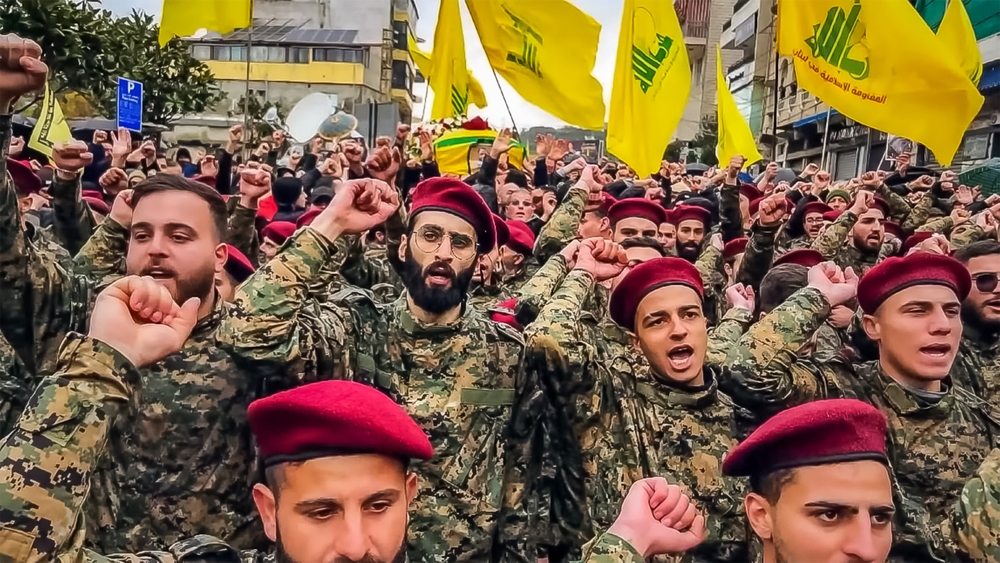
Washington brokered a 45-day ceasefire extension between Israel and Lebanon last week, scheduling a fourth round of talks for June 2-3. Presidential Special Envoy Simon Karam is leading the Lebanese delegation. Hezbollah is not at the table, and its leader Naim Qassem has called on the government to withdraw from the talks entirely. Hezbollah has viewed the negotiations as “free concessions” to Israel and has backed this position with repeated protests in Beirut.
During a ceasefire the United States has since allowed Israel to systematically violate, Israeli strikes killed six people in Southern Lebanon, including three paramedics, on the same day the extension was announced. This is the logical outcome of a U.S. policy that has, for over a year, demanded Hezbollah’s disarmament while undermining the conditions that could make it possible.
When President Trump declared in early April that Lebanon was not included in the conditional ceasefire with Iran and that Israel’s bombing of the country was a “separate skirmish,” he did so on a day when Israeli strikes killed more than 300 people. Nearly 2,900 Lebanese have died since Israel expanded its operations in early March, and 1.2 million have been displaced.
Washington can prevaricate all it wants, but Lebanon has been here before. Israel invaded Lebanon in 1982 under similar logic—that sustained military pressure could neutralize armed resistance and reshape the country’s political landscape. Instead of destroying resistance, it created Hezbollah.
The current catastrophe was predictable and predicted. In December 2025, days before the U.S.-backed disarmament deadline, Israeli drones circled daily not just in the south but over Beirut itself—over homes, schools, and refugee camps. People expected Israeli attacks, and everyone understood why. Except, apparently, Washington.
Hezbollah is not a foreign implant amenable to surgical removal. It has considerable parliamentary power, and it runs hospitals, schools, and social services. It has roots in Lebanese society that Iranian retrenchment alone cannot uproot. Lebanon’s new government, itself born of U.S. pressure following Hezbollah’s military weakening, sensibly avoided triumphalism over weapons seizures and took care not to alienate Hezbollah’s base.
No deeply embedded armed actor has ever been sustainably disarmed by coercion alone. Cases of successful disarmament follow political settlements that guarantee the actors’ survival after surrender. Washington has pursued the opposite sequence: demanding disarmament before the political conditions exist to make it realistic, while tolerating military conditions that make refusal rational.
An unusually weakened Hezbollah and a genuinely willing Lebanese government could be an opportunity. But Washington has conflated military weakness with political readiness. It pushed a disarmament framework in August 2025 on a timeline that the conditions made impossible, and it made reconstruction aid conditional on results the Lebanese state was unable to deliver. Rather than holding all parties to their obligations, the United States grew impatient with the slower, harder work of Lebanese state-building and tolerated Israel’s attempt to impose a military solution that’s not tied to any durable political outcome and risks the implosion of the Lebanese state. Having brokered the November 2024 ceasefire, Washington then acquiesced to Israel’s systematic violation of it—UNIFIL documented over 10,000 Israeli breaches—and formalized that acquiescence in side letters granting Israel wide latitude to strike inside Lebanon.
Washington operates on the assumption that sustained pressure and continued Israeli operations will eventually tip the balance toward disarmament. In reality, every strike that goes unchallenged erodes the only institution capable of making disarmament possible: the Lebanese state. Bombardments do not soften the political ground. Instead, they humiliate a government trying to assert sovereignty and widen the fractures in a society already broken by financial collapse and displacement.
Washington’s fallback solution is that the Lebanese Armed Forces (LAF) can deliver disarmament. This is a fantasy. Under-equipped and heavily dependent on U.S. support, the LAF is in no position to defend Lebanon against Israeli F-16s and U.S.-supplied munitions. Asking its Shia soldiers to disarm Hezbollah while Israel bombs their communities is a provocation, not a strategy.
The ceasefire side letters offered Lebanon no guarantee that Israeli operations would cease after disarmament. Disarmament, therefore, not only required Hezbollah to surrender its weapons, it asked the Lebanese population to accept permanent vulnerability, in accordance with the Arms Export Control Act requiring that U.S. military assistance not undermine Israel’s qualitative military edge. As one senior diplomat in Beirut told the Guardian last August: “How can you ask the LAF to do to Hezbollah what Israel couldn’t do to Hamas in a smaller space, with warplanes?”
Forced disarmament under these conditions risks either fracturing Lebanon along the fault line between those who blame Hezbollah for dragging the country into war and those who blame Israeli aggression, or else consolidating popular support behind Hezbollah as the only credible guarantor of security. Washington’s approach is producing both in different parts of Lebanese society.
Israel’s plans to occupy southern Lebanon indefinitely have resolved any remaining ambiguity. A buffer zone does not weaken Hezbollah politically. It recreates precisely the conditions that gave rise to the group in the first place.
Sustainable disarmament requires enforceable Israeli restraint, security guarantees that survive the next aid negotiation, and a state-building process that addresses the legitimate grievances of the communities Hezbollah represents. The real obstacle to disarmament is not in Beirut. It is in Washington, where the domestic political cost of admitting the limits of this framework remains too high.
Lebanese civilians are paying the heaviest price for that failure. The eight children killed in Lebanon last Wednesday were not casualties of disarmament. They were casualties of a framework that demands disarmament without making it possible. But America is also paying: in wasted credibility, diverted resources, and the slow erosion of its strategic position in a region that is watching closely.
Washington is not pressuring Hezbollah into surrender. It is making Hezbollah’s case.