
Donald Trump insists that oil is moving through the Strait of Hormuz above pre-war levels. Brent crude settled at $117.38 on Friday and was still trading near $114 on Monday, a day after Qatari mediators arrived in Tehran to head off the next round of fighting. The market heard the president and kept bidding.
It has cause. The U.S.-Israeli war on Iran is in its ninth month, and October has been its worst month yet for shipping. At least 12 ships were attacked in and around the strait in the week ending October 16, according to UK Maritime Trade Operations. Energy Secretary Chris Wright says that Gulf crude flows are back to 80-90 percent of pre-war levels; Kpler’s tracking put September’s Hormuz exports at about 44 percent of February’s. Washington and Tehran have both drawn up plans to resume the wider war, possibly after Americans vote on November 3.
The bill has not been split evenly. The International Monetary Fund now assumes that Hormuz traffic will not resume until March 2027, and it has warned that poorer economies dependent on imported oil are the most exposed. It cut its 2026 forecast for the Philippines, which draws 95 percent of its crude imports from the Middle East, to 3.4 percent from 5.6 percent in January. Fuel subsidies have widened budget deficits in Indonesia and Malaysia. Americans are paying as well: diesel has climbed about 70 percent in a year, to $6.28 a gallon.
Washington’s response has run to naval escorts, threats of more bombing, a sanctions waiver for Russian diesel, and appeals to European governments to release their own diesel stocks. Washington has also relied on China to absorb a large share of the shock.
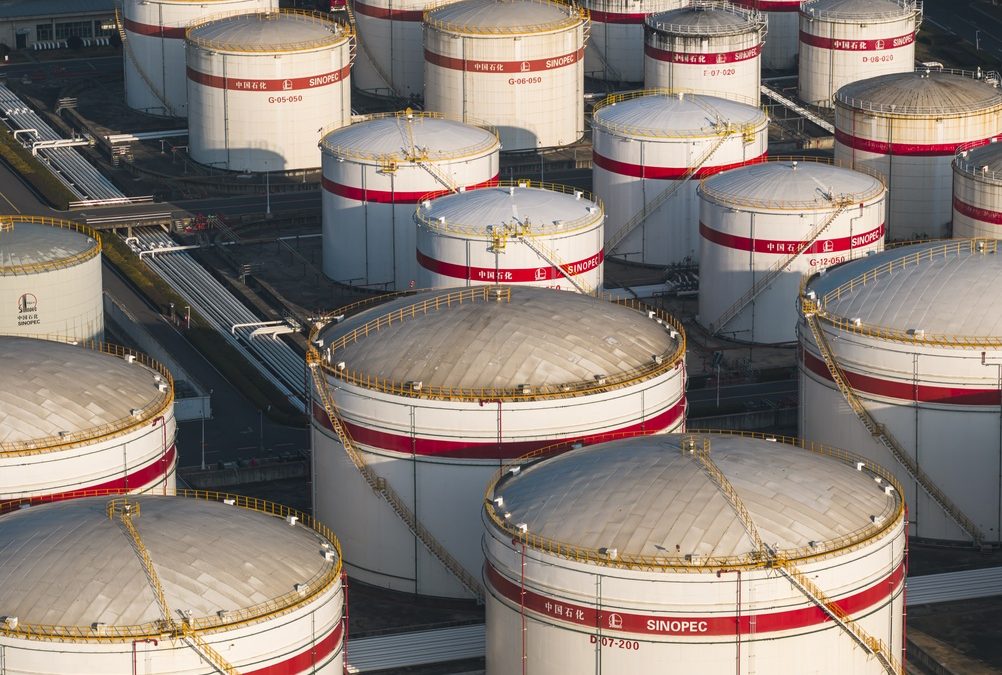
China imported a record 11.6 million barrels a day in 2025, filling storage while crude was at its cheapest since 2020. When the strait closed, Chinese refiners stopped chasing every cargo and ran down what they had banked. Second-quarter imports fell 32 percent from the first quarter, to 8.1 million barrels a day. In September they were 21.5 percent lower than a year earlier, and onshore crude stocks fell by 57 million barrels in the month on Vortexa’s count, the largest monthly draw in analysts’ records.
Beijing’s motive was commercial. Refiners facing $100 crude and thin margins had every reason to burn stock instead of buying. The effect spread well beyond China. The U.S. Energy Information Administration found that weaker Chinese buying reduced global demand and softened the price impact of the lost supply. Société Générale ranked the pullback among the largest offsets to the shock, behind only Saudi Arabia’s rerouting and ahead of the coordinated reserve releases by the United States, Europe, and Japan.
Western strategic reserves exist to steady markets in exactly this kind of emergency. China’s tanks, filled for China’s own security, did more of that work.
The neighbors felt it most. Kpler has described China as the oil market’s main balancing mechanism, and more than half of Southeast Asia’s crude imports come from the Middle East. Every cargo Chinese refiners passed up was one fewer bid against Manila or Hanoi in the spot market.
China kept buying, just not crude. Customs data show its imports grew 22.3 percent in yuan terms in the first nine months, faster than its exports, and September imports rose 31 percent in dollar terms. Some of that is price. For suppliers across Asia, China remained a growing customer in a year when their own fuel bills were climbing.
The cushion is not bottomless. Fuel is where it has worn thinnest: Chinese diesel and gasoline inventories fell in September to their lowest in more than a decade as refiners shipped product abroad. Beijing held back October export approvals over its Golden Week holiday, then resumed fuel exports, a step Reuters said would ease tight global fuel markets. Approvals now come month by month.
Crude is less stretched than it looks. A Reuters calculation shows that China drew on stocks in four of the past five months, yet heavy buying before the war leaves it with a small surplus for the first three quarters and a stockpile of at least 1.2 billion barrels. Imports are edging up again, and Kpler expects seaborne arrivals of 8-8.5 million barrels a day this quarter. If refiners rush back to refill at $115, China stops being Asia’s cushion and becomes one more bidder.
Beijing has a second buffer it has barely used: its own households. Third-quarter growth of 4.5 percent leaned on factories. Exports jumped 36.3 percent in September, while consumer prices rose just 0.9 percent and property investment fell 20.6 percent over nine months. Europe’s deficit with China hit a record $34.8 billion in September, and Ursula von der Leyen says that the European Commission is building an instrument, due in December, that could restrict the access of some Chinese goods to the single market.
Chinese households might be able to carry more. Retail sales rose 1.1 percent in September against a forecast of 0.5 percent; excluding cars they grew 3.9 percent, the fastest since October 2025. China’s top economic planner pledged on October 20 to expand domestic demand with greater force. December’s Central Economic Work Conference will show whether that means bigger rural pensions and health coverage that follows migrant workers into the cities, or another round of infrastructure that adds to the very output Brussels is counting.
Washington’s part is simpler. No stockpile, Chinese or American, substitutes for a settlement that lets tankers through without being shot at. The IMF has penciled in a closed strait until March 2027. Every month a deal arrives before then is a month Asia stops paying for a war it did not start.
November’s customs and retail figures will show which China Asia is dealing with this winter. If crude imports stay restrained while shoppers keep accelerating, the region gets a second cushion, made of Chinese demand rather than Chinese storage. If the tanks refill first and the shoppers stall, Asia loses the first cushion without gaining the second.
The strait will reopen on terms settled between Washington and Tehran. How much of the bill Asia pays until then is still being decided in Beijing.