
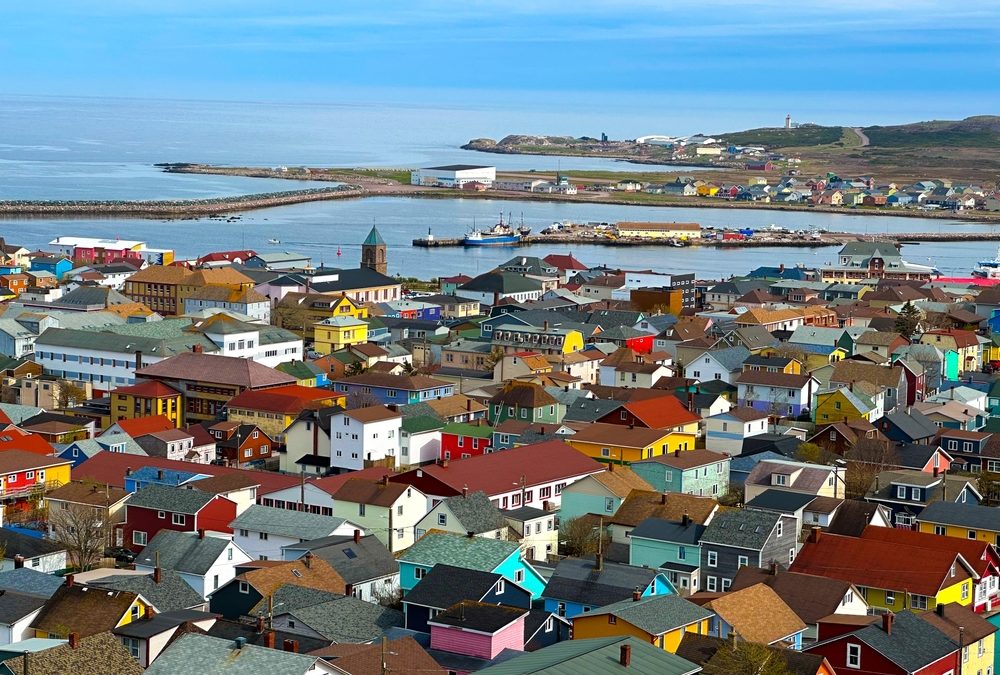
On September 19, French President Emmanuel Macron touched down in Saint-Pierre-et-Miquelon, France’s last remaining territory in North America. The tiny fishing archipelago is home to fewer than 6,000 people, all of them full French citizens, and it is relatively unknown even to those living in the Francophone parts of Canada. The archipelago is so small that many essential personnel, including medical professionals for its one hospital, must come from mainland France, and it imports its fruits and vegetables, among other things. Nevertheless, the French president would stay for three days.
Why would a French head of state make a multiday visit with a full delegation to this small island chain, and why would the Canadian prime minister join him there?
The two were teaming up as a show of force against Trump’s Washington.
Contested Island
Saint-Pierre-et-Miquelon has found itself caught between a rock and a hard place once before. The islands passed back and forth between Britain and France several times before being returned to France for good under the 1814 Treaty of Paris. During World War Two, they were held by the Vichy regime until December 24, 1941, when Free French corvettes and the submarine Surcouf arrived and rallied the islands to Free France. The archipelago went on to send soldiers to fight with the Free French against the German occupiers of mainland France, where many young men from the small islands perished. Today the archipelago is once again worried about its independence, but this time because of a threat from the United States.
On September 7, Trump made a very typical post on Truth Social showing a map of nearly the entire northern part of the Western Hemisphere, including the continental United States, Mexico, Central America, most of the Caribbean, Canada, Alaska, Greenland, and even Iceland, all covered in the U.S. flag. The post furthered his imperialist rhetoric toward his neighbors, especially Canada and Greenland, and this time even Iceland fell victim to Trump’s Truth Social digital invasion meme. In addition, and although potentially unintentionally, Saint-Pierre-et-Miquelon fell under the flag as well—nestled almost invisibly on the large-scale map just off the south coast of Newfoundland at the eastern tip of Canada—along with the French Caribbean territories of Guadeloupe, Martinique, Saint-Barthélemy, and Saint-Martin. The French took it personally, and within a week the Élysée announced that Macron and Mark Carney would visit the islands together to reaffirm the sovereignty of nations.
This was not the first time the islands had felt the effects of a Trump announcement. In April 2025, the administration claimed that Saint-Pierre-et-Miquelon charged 99 percent tariffs on U.S. goods and hit it with a 50 percent tariff, briefly among the highest in the world, before lowering it to 10 percent days later. On the islands themselves, reaction to the map was mixed, as residents interviewed outside Saint-Pierre’s only supermarket ranged from annoyed to skeptical to indifferent, and one said he would not mind seeing an American flag there.
The residents of Saint-Pierre-et-Miquelon are French and European citizens who vote in French and European elections and send their own deputy and senator to Paris. Although the islands were likely not the exact target of the Truth Social post, Macron told reporters when he arrived there that it was evident that Saint-Pierre-et-Miquelon is French and not up for discussion, and that France would not repeat it every morning just because some people have strange ideas or say strange things.
Saint-Pierre-et-Miquelon’s position in the North Atlantic also made it a particularly significant venue for Macron. The archipelago sits within a region that has assumed growing strategic importance as Trump has pressed for greater American control over Greenland, citing national security and the development of the Golden Dome missile-defense system. Trump has specifically argued that U.S. control of Greenland would strengthen the system, although Greenland is not currently part of Golden Dome’s architecture.
When Mark Carney arrived on the islands, the two leaders gave a joint statement in which Macron welcomed closer cooperation on security, energy, and even fishing. On the same day Macron gave a speech to residents announcing new investment in the ports of Saint-Pierre and Miquelon, along with approval of the second phase of relocating the village of Miquelon, which covers 98 parcels, over the next five years because of erosion and rising seas. He also said that about €500 million had gone into the archipelago over the last 10 years, making it by far the most invested overseas territory per resident.
Marc Albert Cormier, a local historian of Acadian descent who has written extensively on the archipelago’s history, told me that Macron was very interested in the development of satellite technology as well as in the trauma the islands still carry from 1992, when an international arbitration tribunal fixed the maritime boundary between France and Canada and left the islands only a narrow corridor of sea. In that same year, Canada closed the northern cod fishery that had sustained the region for centuries.
Global Response
Although the map was not official U.S. policy and did not change anything upon its release, it did prompt many leaders across the Western Hemisphere and beyond to respond. Mexico’s Claudia Sheinbaum answered on X the same day that Mexico is not and never will be a colony or protectorate of any foreign country, garnering over a million views within a few hours, Cuba’s Miguel Díaz-Canel declared that the island will never again be a colony of any empire. France’s overseas minister called the map extravagant.
Iceland’s response, summoning the U.S. ambassador, had a unique twist, since Billy Long had only formally taken up the post the month before. Thousands of Icelanders had petitioned against his appointment after he suggested earlier this year that Iceland could become the fifty-second state with himself as its governor, a remark he later apologized for. Iceland’s foreign minister also said that she had been repeatedly advised from within the American administration not to take the president literally but to take him seriously, which is something nations like Iceland, territories like Saint-Pierre-et-Miquelon, and administrative centers like Parisall have to keep in mind.
Annick Girardin, the islands’ senator and former overseas minister, wrote on Facebook that she did not know if the map was stupidity, ignorance, madness, or arrogance, that sovereignty was being attacked by a supposed ally, and that France could not just shrug it off because “we know how Trump is.”
Mark Carney, meanwhile, came straight from Strasbourg, where on Thursday he advanced a major rapprochement between Canada and the European Union, prompting Trump to threaten additional trade sanctions. This diplomatic union was also important because expectations remain high on fishing quotas after the cod wars of the 1980s, along with the unresolved dispute over France’s continental shelf around the islands. The Macron-Carney handshake was all the more meaningful since both leaders set aside real quarrels to present a united front against Trump.
The map did not move a single border, but it led French and Canadian leaders to hold their first joint visit to the islands and to pledge to work toward closer bilateral cooperation on fishing, security, energy, and other issues. The lesson from what might have seemed an insignificant incident a few years ago is that U.S. allies now take the social media musings of an American president seriously enough to answer them in person.