
All Commentaries
Allied to Race? The U.S.-Korea Alliance and Arms Race
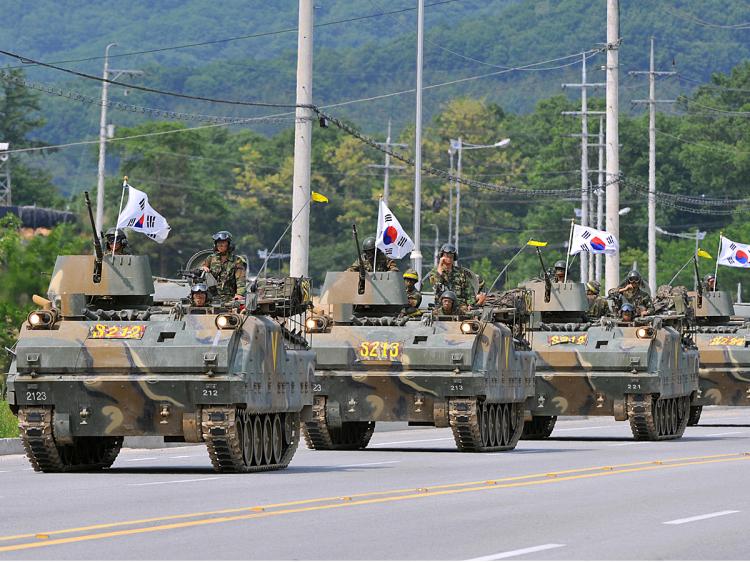
The Republic of Korea has rapidly increased its defense budget in recent years. Last year’s spending of 26.6 trillion won represents a twofold increase from ten years ago. Now the Ministry of National Defense projects an annual average increase of 7.6 percent to 53.3 trillion won by 2020, another doubling over the next decade. South Korea, notably, raised its defense spending at a higher rate than North Korea at a time when Seoul was taking a more conciliatory policy of engagement. While the Roh Moo-hyun administration increased defense spending ostensibly in response to its policy goal to build a more autonomous military, the U.S.-Korea alliance motivated and shaped South Korea’s military transformation. This article examines the degree to which external threats, domestic interests, and the alliance have affected the South’s military spending and transformation.

Shahzad: A Pretext, Not a Man
The competing assertions about Times Square-bombing suspect Faisal Shahzad’s links relationship with Pakistani Taliban reflects a broader debate both within the U.S. and between the U.S. and Pakistan over how to handle Taliban elements in Waziristan province.
A Final Survey of Nuclear Posture Perspectives
Once and for all, is the Obama administration nuclear posture review slumped or standing up straight? Here’s a sample of commentators whose insights — from fresh to just plain strange — jumped out at us. (The new START treaty is remarked upon as well.)
Okinawa and Obama’s Base-Based Addiction
Japanese PM Hatoyama’s modified base relocation plan looks like a lose, lose, lose proposition for Okinawa, Japan, and President Obama.

Arizona Rising
Summer is always hot in Arizona, but the summer of 2010 may be hotter than any in recent memory.
Reader Challenge: Is Jerusalem ‘crumbling under the weight of its own idealization’?
In a full-page ad in the Wall Street Journal last week, Eli Wiesel described Jerusalem as “the world’s Jewish spiritual capital” and “the heart of our heart, the soul of our soul.” The Sheikh Jarrah [Just Jerusalem] activists who, unlike Wiesel, actually live in Jerusalem, say: “We cannot recognize our city in the sentimental abstraction you call by its name.” They describe the city they call home as “crumbling under the weight of its own idealization.” . . . writes Paul Woodward at War in Context…Jerusalem is crumbling under the weight of its own idealization.
Fortress Guam: Resistance to US Military Mega-Buildup
United States presidents rarely visit the U.S. territory of Guam (or Guåhan in the Chamorro language), but President Obama may visit in June 2010. This will be a significant stop for residents of this small island, 30 miles long and eight miles wide, dubbed, “Where America’s day begins.” Guam is the southern-most island in the Northern Mariana chain that also includes Rota, Tinian, and Saipan. It is the homeland of indigenous Chamorro people whose ancestors first came to the islands nearly 4,000 years ago. Formed from two volcanoes, Guam’s rocky core now constitutes an “unsinkable aircraft carrier” for the United States military in the words of Brig. Gen. Douglas H. Owens, a former commanding officer of Guam’s Andersen Air Force Base.1
Bolivia Climate Conference: Indigenous Peoples Design Roadmap to New World
President Morales called the alternative climate summit following the failed United Nations Climate Change conference in Copenhagen, COP15, in 2009. Morales, in his opening address in Bolivia, urged individual lifestyle changes, with flagrant consumerism relying on disposable products and plastics to be replaced with new standards of living in harmony with the earth. Venezuelan President Hugo Chavez was among the dignitaries and participants from 150 countries. Although originally 5,000 to 10,000 people were expected, ultimately there were 30,000 at the gathering held April 20–22 in Cochabama, Bolivia.
Afghan Escalation Funding: More War, Fewer Jobs, Poor Excuses
In case you hadn’t noticed, our Afghan War, like some oil-slicked bird in the Gulf of Mexico, has been dragged under the waves. It’s largely off front pages and out of the TV spotlight (despite the possible linkage of the Times Square failed car bombing to the Pakistani Taliban). As a result, most Americans undoubtedly have little idea just how large the American war effort there has grown. The president’s massive surge — not just of troops, but of State Department civilians, CIA agents, drones, contractors, base building, and who knows what else — is actually going (if you’ll excuse the phrase) great guns.
Nuclear Modernization Making a Mockery of Disarmament
Last summer, the Economist published a letter from hawkish Arizona Senator John Kyl (currently neck deep in the springtime of his state’s immigrant shame). Cole Harvey of the James Martin Center for Nonproliferation Studies reports that Kyl wrote: “Every nuclear weapons power— with the exception of the US — is currently modernising its nuclear weapons and weapons delivery systems…Yet the US continues to permit its nuclear forces to atrophy and decline.”