Without technology and know-how, even the world’s largest oil reserves are worthless.
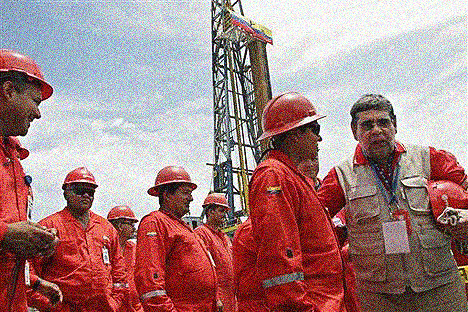
WikiLeaks: Venezuela’s Crude Awakening
read more

Without technology and know-how, even the world’s largest oil reserves are worthless.

For most states, oil wealth spells, to a certain extent, an end to ethics. Not Norway.
Is China smartening up its environmental and social act in Africa? It certainly wants to be seen as doing just that. One telling example was the recent Chinese government-sponsored ‘top Chinese enterprises in Africa’ competition, won by China Road and Bridge Corporation [CRBC].

Among the batch of classified diplomatic cables recently released by the controversial whistle-blowing website WikiLeaks, several have highlighted the vast extent of the financial infrastructure of Islamist terrorism sponsored by key U.S. allies in the ongoing “War on Terror.”

The UN Climate Conference (COP16) in Cancun is turning out to be both anti-climactic and anti-climatic.

As the United States continues to isolate Iran over its nuclear program, the Islamic regime is engaging in a foreign policy counter-attack with profound strategic consequences. The theater of strategic warfare between the United States and Iran has expanded well beyond the Middle East.From sub-Saharan Africa to Latin America, Iran is selling arms, offering aid and investments, and otherwise establishing a new pattern in south-to-south relations as it battles what President Mahmoud Ahmadinejad calls “Western arrogance.”
President Barack Obama’s upcoming visit to India will come just after the mid-term elections in the United States. Whether this timing is coincidental or deliberate, it will decide where Obama stands on several contentious issues between the two countries.
One of these issues is the outsourcing of U.S. jobs to India.

The Israel-Palestine conflict has been at the heart of regional affairs since the creation of the state of Israel in 1948. This is the context wherein the “de facto” Iran-Turkey-Syria axis should be understood, although substantive normalization of relations in the last decade between Turkey and its neighbors Iran and Syria served as a pre-requisite for the supposed alliance.
U.S.-India nuclear transactions are part of a broader set of agreements between the two countries that U.S.-based multinationals are hoping to use as a wedge to further open India to investment and sales.
Big oil spills are no longer news in Africa. The Niger Delta, where the wealth underground is out of all proportion with the poverty on the surface, has endured the equivalent of the Exxon Valdez spill every year for 50 years by some estimates