Human Rights

Habeas That Corpus

Just a few years ago, the United States could hold its head high for the freedoms enjoyed by those residing within its borders as well as its energy, leadership, and openness and compassion. Today we are fast becoming a closed society, suspicious not only of “outsiders” but of many within our borders who are in some way “not like us.” The lists of our freedoms have turned into lists of our enemies, giving them an unmerited significance that in turn diminishes the country’s international standing. Persuasion has been replaced by coercion, honor sacrificed to a corrupted “duty,” and morality to expediency.

read more

Regional Implications of the Iraq War

President George W. Bush’s vision for the Iraq War was nothing if not expansive. Liberal democracy and popular sovereignty were to supplant tyranny not only in Baghdad, but in nearby capitals as well. And the force of U.S. arms would not be needed to accomplish the latter missions. As Bush asserted to eager applause at the American Enterprise Institute on February 25, 2003, “a new regime in Iraq would serve as a dramatic and inspiring example of freedom for other nations in the region.” Democracy, the war party believed, would be contagious.

read more

A Cluster Bomb Treaty: Again, It’s the U.S. v. the World

On March 6, 2007, the U.S. Department of State released its Country Reports on Human Rights Practices for 2006. This annual report to Congress details the human rights practices of foreign governments, from restrictions on free press in Iran, to extrajudicial killings in Pakistan, to spiraling violence in the Darfur region of Sudan. The Country Reports do not, however, “purport to assess any human rights implications of actions by the United States Government or its representatives.” If they did, the reports would expose the grave consequences of U.S. policies in a world where the use and sale of inaccurate and unreliable weapons tends to trump humanitarian concerns.

read more
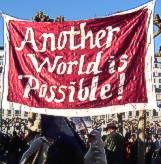
Another Africa is Possible: The World Social Forum

Another Africa is Possible: The World Social Forum

Tens of thousands of activists and advocates from around the globe gathered in Nairobi, Kenya for the seventh World Social Forum (WSF) in January. The rallying cry, “Another world is possible,” served as a catalyst for debate and mobilization: what might this new world look like, and how are we to achieve it? The agenda was expansive. It included discussions on many campaigns and challenges across the spectrum of social, political and economic justice issues. Notably, the 2007 WSF marked the first time that the gathering was hosted in Africa, shedding new light on the role of African civil society in the work towards global justice.

read more

Iraq: The Failures of Democratization

The failures of Iraqi democratization as advocated by the Bush administration should not be blamed primarily on the Iraqis. Nor should they be used to reinforce racist notions that Arabs or Muslims are somehow incapable of building democratic institutions and living in a democratic society. Rather, democracy from the outset has been more of a self-serving rationalization for American strategic and economic interests in the region than a genuine concern for the right of the Iraq people to democratic self-governance.

read more

China in Africa: It’s (Still) the Governance, Stupid

Deep inside the tropical forest of Gabon, 500 miles from the coast, China is going where no other investors dare. A Chinese consortium, led by the China National Machinery and Equipment Import and Export Corporation, has won the contract to develop Gabon’s massive Belinga iron ore deposit. In return for purchasing the entire output, Chinese operators will build not only the extractive infrastructure at Belinga but a hydro-electric dam to power it, a railway to the coast, and a deepwater port north of the capital, Libreville, for exporting the ore.

read more

No Democracy Yet in Thailand

In mid-September 2006, a bloodless “democratic coup” swept through Thailand, the region’s darling of democracy. Military leaders justified their actions as a purely temporary means to wrest the country back from a power-hungry tycoon and restore the functions of government.

read more

Lt. Watada-an American Hero

Lieutenant Ehren Watada is like many other Americans; as the intentions behind invading Iraq have become more obviously spurious, he has reshaped his perceptions of the war. He originally supported the war with so much vigor that he voluntarily enlisted in the Army, but he came to conclude that the Iraq War is both illegal and immoral. Unlike millions of his fellow Americans who have changed their minds he does not have the luxury of simply swapping out bumper stickers on his car. Instead, he faces potentially ruthless consequences.

read more

Villagers Challenge U.S. Military in South Korea

In Pyongtaek, a small rice-farming town 31 miles south of Seoul, Korea, an extraordinary struggle is taking place. Villagers are refusing to hand over their land to the U.S. military, which plans to expand its base Camp Humphrey by three times and occupy 2,470 acres of prime farmland. The villagers didn’t imagine four years ago that their struggle would force policymakers to reassess the role of the U.S. military on the peninsula. But it has.

read more