To curry favor with Egyptians, President Mubarak adopted the social conservatism of the Muslim Brotherhood.
Egypt Has Already Experienced Islamic Rule — and Found It Wanting
read more

To curry favor with Egyptians, President Mubarak adopted the social conservatism of the Muslim Brotherhood.

What if, facing a hyper-speed revolution in Egypt, Secretary of State Clinton and her advisors had sat together examining fractal structures, nonlinear dynamical systems, and models of self-organization? Say what?

The Frank Wisner debacle was a “who’s in charge here?” moment for both President Obama and Secretary of State Clinton.
Our choice of states to which we aid in developing democracy gives it a bad name.
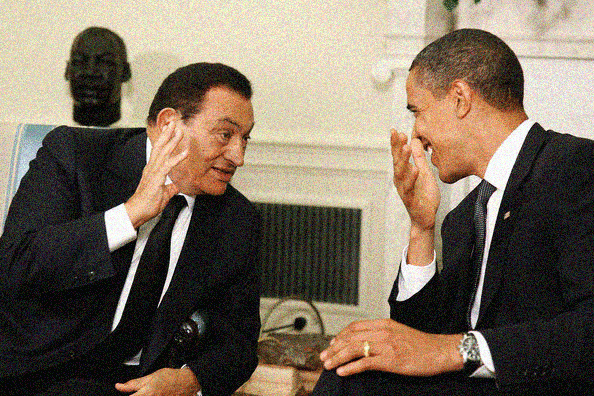
Heretofore, the United States has supported their oppressors and enforced their cooperation with Israel.
Today’s protests are a product of years of germination.
Microcredit’s odd link to police brutality.
When it comes to translating the protests into lasting social change, traditional organizers will be essential.
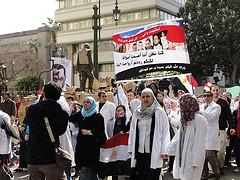
After deliberately raising the hopes of millions of Egyptians and millions more around the world, U.S.-backed Egyptian President Hosni Mubarak defied the rising demand of the millions of protesters who have taken to Egypt’s streets, to announce he will remain in office. Claiming he wouldn’t bow to “foreign pressure,” Mubarak, he said he had “laid down a vision…to exit the current crisis, and to realize the demands voiced by the youth and citizens…without violating the Constitution.”
The Egyptian army is outraged by how Mubarak and his son have sold out the country’s economy.