Despite pointing the way to nonviolent revolution, Gene Sharp was once viciously attacked by the left.
Wendy Navarro is an independent art critic and curator currently based in Barcelona, Spain. Since the mid-1990s, Navarro has been an active curator at the Visual Art Development Center in Havana, Cuba, while working as an editor of the magazine ArteCubano, and lecturing about Cuban contemporary art at the Higher Institute of Art and Havana University. She talks here with Blair Murphy, of the Washington Project for the Arts, about art and its relationship to U.S.-Cuban relations, globalization, and political utopias prior to her talk this week in Washington, DC.
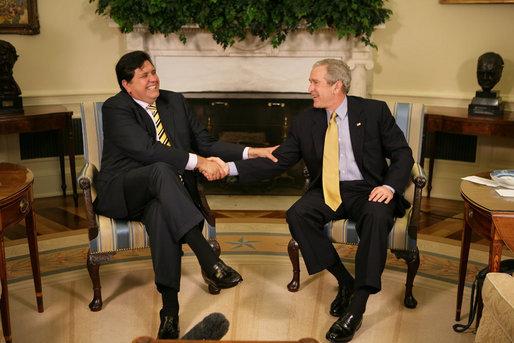
In 2007, a determined Democratic caucus put their collective feet down. They refused to consider any more free trade agreements without a new model, with stronger protections for labor, human rights, and the environment. And so in May, the caucus and its supporters cut a deal with the Bush administration for a new and improved FTA with Peru.
When George W. Bush left the White House, the rest of the world breathed a sigh of relief. The National Security Doctrine of unilateral attacks, the invasion of Iraq under the false pretext of weapons of mass destruction, and the abandonment of multilateral forums had opened up a new phase of U.S. aggression. Despite the focus on the Middle East, the increased threat of U.S. military intervention cast a long shadow over many parts of the world.
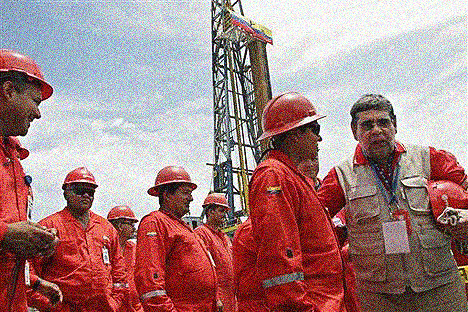
Without technology and know-how, even the world’s largest oil reserves are worthless.
Alvaro Colom signed an oil deal with Hugo Chavez while trying not to alienate the United States.
The new Republican chair of the powerful House Committee on Foreign Affairs plans to seek sanctions against Venezuela for its purported ties to Middle East terrorist groups and Iran’s nuclear program.
The Costa Rican legislature on December 20 approved another deployment of dozens of U.S. ships to its territory for the next six months, but denied permission for warships to deploy to the country until a full debate occurs after the New Year.
Apparently Washington fears that even a modest change to a 1961 convention could call into the question its drug control regime.
Outgoing Brazilian President Lula isn’t too optimistic about U.S.-Latin America relations.