Al Qaeda uses the same web gimmicks as games and social networks to rally its base.
Al Qaeda Has Its Own “Superusers” and “Badges”
read more

Al Qaeda uses the same web gimmicks as games and social networks to rally its base.
Done properly, the U.N.’s Responsibility to Protect entails deployment of peacekeepers, provision of food and shelter, and democratic elections.

If U.S. is improving drone-strike accuracy in Pakistan, what happened on March 17 when 41, including women and children were killed?
“Iraqis have broken the chains. But the world is silent and apparently deaf and blind. Where is the free Western press?”
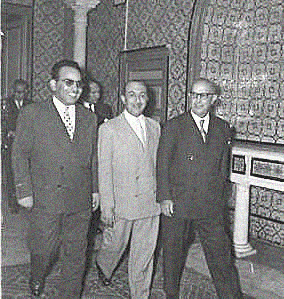
For the most part untroubled by anti-semitism, Tunisian Jews have little interest in emigrating to Israel.

Sixty years after the conclusion of World War II in North Africa, destroyed European weaponry once again litters Libya’s coastal roads as the civil conflict there enters its second month. But Europeans are not fighting on the ground in the former Italian colony. Rather, their arms are. In Libyan hands, European-made arms are part of a proxy battle that demonstrates the unintended consequences of the international arms trade.
You might think that the poor critical reception he received for his book about tribal politics would make Robert Kaplan think twice before resurrecting the “warrior” leitmotif in relation to Gaddafi, Gbagbo, and Saleh.
Zoologists get pretty excited when they discover an unusual animal. They happily devote many hours to the task of classifying the beast and, if it qualifies as a new species, giving it a name. A great deal of money and prestige rides on these scientific endeavors. The same applies to the political sphere, where new and unusual creatures frequently turn up. When it comes to Barack Obama, however, political zoologists remain undecided whether he is a new kind of political animal and if his foreign policy represents a unique departure from the same old, same old.
Humanitarian intervention, as in Libya, will never work until a time of — gasp! — world government.

As revolutions and reforms sweep the Arab world, Saudi women continue to push for their rights. Inspired by their sisters in Egypt and Tunisia, a national women’s movement called Saudi Women Revolution has coalesced with clear and wide-ranging demands. Chief among them is the ability to participate in the political process, including voting and running for election.