Israel is not confronting Arab armies or guerrilla movements, but an explosion of Arab democracy. It’s a “war” that it’s ill equipped to fight.
A War Israel Is Ill Equipped to Fight
read more

Israel is not confronting Arab armies or guerrilla movements, but an explosion of Arab democracy. It’s a “war” that it’s ill equipped to fight.
In the name of its War on Terror, Washington had for years backed most of the thuggish governments now under siege or anxious that they may be next in line to hear from their people. When it came to Egypt in particular, there was initially much polite (and hypocritical) discussion in the media about how our “interests” and our “values” were in conflict, about how far the U.S. should back off its support for the Mubarak regime, and about what a “tightrope” the Obama administration was walking.
Dear FPIF:
Thank you for your proposal for a new TV show about “a warm-hearted, middle-class Egyptian family named the Qosbis.” It’s an intriguing idea. Of course, we were thrilled by Katie Couric’s suggestion of addressing Islamophobia by creating a Muslim version of The Cosby Show. I believe, however, that she had in mind a Muslim-Americanshow, not a drama about an Egyptian family.
Which is worse: drone strikes or torture?

The pro-democracy movement must choose leaders with a clear commitment to democracy and should declare that no country interfere in the process of revolution.
To curry favor with Egyptians, President Mubarak adopted the social conservatism of the Muslim Brotherhood.

What if, facing a hyper-speed revolution in Egypt, Secretary of State Clinton and her advisors had sat together examining fractal structures, nonlinear dynamical systems, and models of self-organization? Say what?

The Frank Wisner debacle was a “who’s in charge here?” moment for both President Obama and Secretary of State Clinton.
Our choice of states to which we aid in developing democracy gives it a bad name.
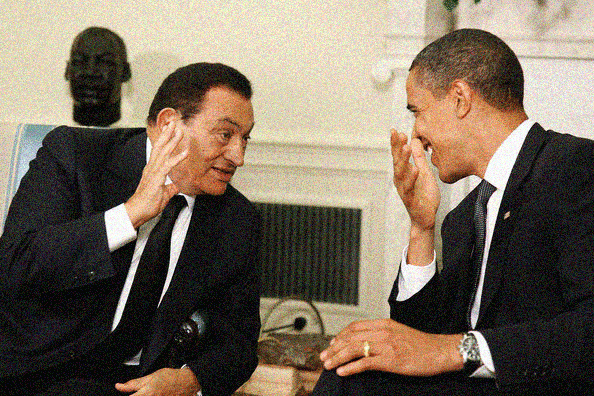
Heretofore, the United States has supported their oppressors and enforced their cooperation with Israel.