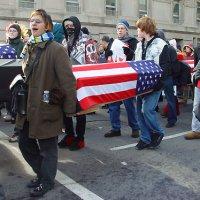
A new U.S. intelligence report, representing the consensus of all 16 intelligence agencies, comes to the same conclusion many have known for a long time: The Iraq War isn’t making us safer. It’s putting us all at greater risk. It’s making another terrorist attack more likely. The report is another piece of evidence that the Bush administration is lying about the war.
Iraq, Elections, and the Costs of War
For the first time in recent history, a foreign policy issue is at the top of the electorate’s mind as they head to the polls. Clearly the Iraq War loomed over the mid-term elections before October rolled around, but with the U.S. death toll reaching its highest mark since November 2004, reports arguing the Iraqi death toll now tops 655,000, new estimates on the cost of the war reaching 1 trillion dollars, and Bush’s PR team quickly putting window dressing on his vow to “stay the course”, the elections are being called a referendum on Iraq.
What Has Invasion Unleashed in Iraqis?
What has my new country, the United States, done to my old country, Iraq?
The Horrors of "Extraordinary Rendition"
Editors Note: Canadian citizen Maher Arar, who is barred from entering the United States, delivered his acceptance speech for the Letelier-Moffitt International Human Rights Award in a pre-recorded videotape. This is a transcript of his speech, which was viewed at the award ceremony hosted by the Institute for Policy Studies on Oct. 18, 2006 in Washington, DC.
Breaking Up That Old Gang of Mine
George Bush’s most steadfast backer in the March 2003 preventive war invasion and occupation of Iraq has been British Prime Minister Tony Blair. The Bush-Blair Âdynamic duo act is, however, about to end. Blair is soon to resign his post in favor of the Chancellor of the Exchequer Gordon Brown.
Operation Enduring Freedom: A Retrospective
It has become a given, even among many progressive critics of Bush administration policy, that while the U.S. war on Iraq was illegal, immoral, unnecessary, poorly executed, and contrary to America’s national security interests, the war on AfghanistanÂwhich was launched five years ago last weekÂwas a legal, moral, and a necessary response to protect American national security in the aftermath of 9/11. Virtually every member of Congress who has gone on record opposing the Iraq War supported the Afghanistan War. Similarly, a number of soldiers who have resisted serving in Iraq on moral grounds have expressed their willingness to serve in Afghanistan.
The Taliban is Back
On the fifth anniversary of the launch of the U.S.-led war against Afghanistan, the Taliban is on the offensive, much of the countryside is in the hands of warlords and opium magnates, U.S. casualties are mounting, and many, if not most, Afghans are actually worse off now than they were before the U.S. invasion.
Afghanistan: Five Years Later
On the fifth anniversary of the launch of the U.S.-led war against Afghanistan, the Taliban is on the offensive, much of the countryside is in the hands of warlords and opium magnates, U.S. casualties are mounting, and many, if not most, Afghans are actually worse off now than they were before the U.S. invasion.
Beware Empires in Decline
The common wisdom circulating in Washington these days is that the United States is too bogged down in Iraq to consider risky military action against Iran orÂGod forbidÂNorth Korea. Policy analysts describe the U.S. military as Âover-burdened or Âstretched to the limit. The presumption is that the Pentagon is telling President Bush that it can’t really undertake another major military contingency.
Sprouting from Inequality: The Root of the Middle East Crises
“The origin of tyranny is iniquity, and springing from a poisonous root, it is a tree which grows and sprouts into a baleful pestilent growth, and to which the axe must by all means be laid.” As true as this was to John Salisbury in the twelfth century, it remains the same in the 21st century, and it forms the basis from which many of the crises in the Middle East have sprung.