North Korean motives for attacking Yeonpyeong Island remain unclear, but U.S. South Korean military exercises run the risk of escalating the situation.


North Korean motives for attacking Yeonpyeong Island remain unclear, but U.S. South Korean military exercises run the risk of escalating the situation.
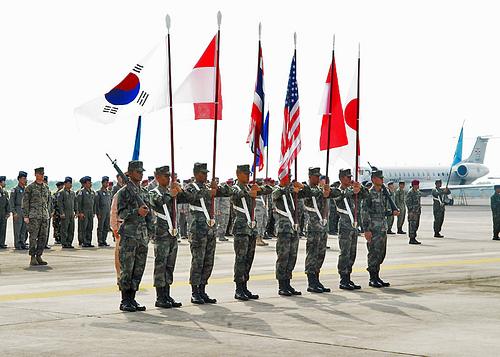
The Pentagon has more on its plate but, because of domestic factors, will have comparatively less money to deal with it all. Washington has concluded that the only way to solve this particular dilemma is to rely more on partners in the region. The United States has always emphasized its partnerships with Japan, South Korea, and (less so) Taiwan. At times of austerity, Washington is putting more emphasis on burden-sharing. Today, however, the United States will be pushing for more than just additional resources from its allies. More and more, these allies will have to do the heavy lifting themselves.
At the onset of the Third World debt crisis in the 1980s, many economic justice activists were afraid to engage on the issue because they felt it was just too complicated. Then, in the 1990s, the hot issue was trade. And again, many people thought, “I’ll never understand the World Trade Organization.” But eventually, in both of these cases, large numbers of people bit the bullet and learned enough to have a voice in these debates. And they built strong movements for debt and trade justice that continue today.

On the night of March 26, 2010, the South Korean naval vessel ROKS Cheonan split in half and sunk. Forty-six sailors lost their lives. In order to determine the cause, the South Korean government created the Joint Investigation Group (JIG), with representatives from the United States, United Kingdom, and Sweden, among others. The JIG has since issued its findings in stages, culminating with the release of the official report on September 12, 2010, concluding that a torpedo fired by a North Korean submarine sank the Cheonan. Despite the JIG’s goal of providing definitive proof of the cause of the incident, public skepticism has only increased.
The Bush-negotiated, NAFTA-esque trade agreement with Korea that President Obama is pushing makes him look more Clintonian than ever.
The U.S.-South Korea FTA is broken and not worth fixing.

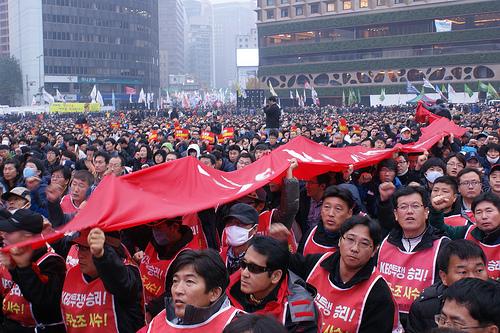
The free trade push has begun again. Both U.S. President Barack Obama and South Korean President Lee Myung-bak are calling for ratification of the U.S.-Korea Free Trade Agreement, which was signed by the two countries’ trade representatives in April 2007 but has yet to be approved by either the U.S. Congress or the South Korean parliament. Aware of how unpopular the agreement remains, President Obama wants the U.S. Congress to delay the approval vote until after the mid-term elections in early November but before the mid-November G-20 meeting in Seoul.
The people of South Korea, North Korea and the United States are already paying a tax, not for reunification, but for preparation for war

Two respected Korean-American researchers cast new doubt on South Korea’s conclusion that North Korea sunk the Cheonan.
Recent scrutiny of U.S.-Japan base realignment and Okinawan anti-base opposition has overshadowed U.S. military issues in South Korea. As others have argued, the struggle in Okinawa represents only one facet of the larger global struggle against U.S. bases.3