As the post-9-11 wars finally begin to end, we can shrink the Pentagon budget. Here is a three-part strategy for replacing the jobs currently dependent on military production we don’t need.

How We Can Replace Defense Jobs
read more

As the post-9-11 wars finally begin to end, we can shrink the Pentagon budget. Here is a three-part strategy for replacing the jobs currently dependent on military production we don’t need.
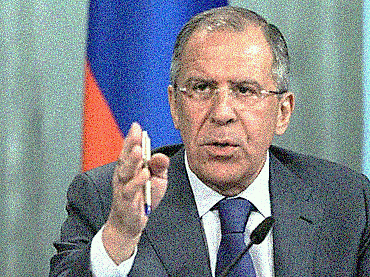
A more accurate bellwether of the tide turning in Syria will be if Russia decides it no longer needs President Assad.
Human Rights Watch has produced a damning report on Syria’s torture regime.
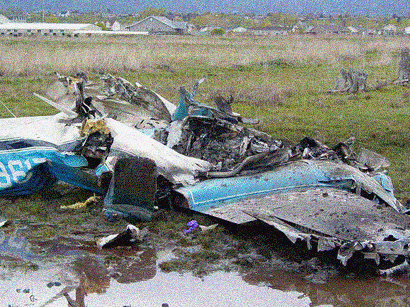
Most combat radar is kept in a passive mode to prevent a potential enemy from mapping out weaknesses or blind spots that can be useful in the advent of an attack.

Alex has a big problem. Since his earliest years he has been addicted to a potent combination of sex and violence. When he hangs out with his friends, their favorite activity is to break into people’s houses and terrorize them. But that’s actually not Alex’s big problem. That comes later, when he’s apprehended by the state and subjected to an extreme form of aversion therapy that makes him physically sick whenever he sees or contemplates violence. Worse, at least for Alex, is that he is repulsed by the art that once soothed his savage breast.

Progressives must seriously consider intervention in Syria despite our misgivings. Such an intervention, however, need not impose hegemony on Syria. Unfortunately, so far no one advocating intervention has pledged to abide by fundamental moral principles of respecting Syrians, their independence, and their future government.
Syria expects the armed opposition to take a leap of faith and turn in its weapons.
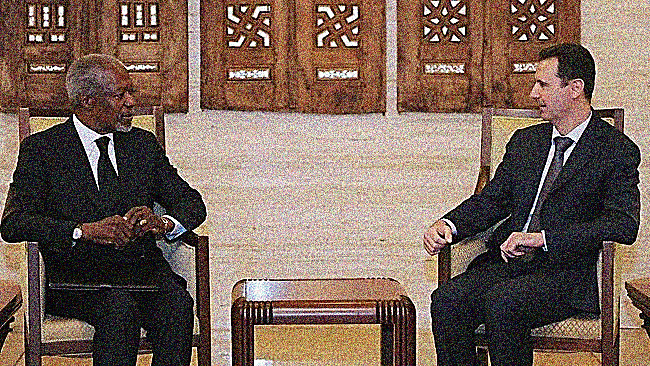
In all likelihood, the plan as set out by Annan will not be realized, but any failure will not be his, but that of Assad.
It’s time to identify those sectors, such as weapons, from which the Assad regime derives its power — and disrupt business as usual.

Despite the widespread international denunciation of Syrian President Bashar al-Assad, the government in Damascus continues to crack down hard on the country’s growing domestic opposition. “They are moving in a direction that completely shows that they are absolutely out of touch,” says Yasser Tabbara, the secretary general of the Syrian National Council (SNC), a government opposition group. Other countries in the region have experienced revolutions, but Syria remains in a state of uncertainty. At the UN, China and Russia vetoed a Security Council resolution condemning the Syrian government’s actions, making a coordinated international response even more difficult.