Iraq
Shiite vs. Sunni?

Shiite vs. Sunni?

In 1609, a terrible thing happened: not terrible in the manner that great wars are terrible but in the way that opening Pandora’s Box was terrible. King James I of England discovered that dividing people on the basis of religion worked like a charm, thus sentencing the Irish to almost four centuries of blood and pain.

read more
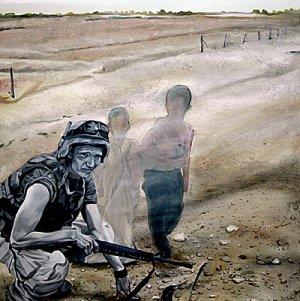
Tourist Photograph from Iraq

Tourist Photograph from Iraq

This is how I wanted to see my self…
This is what I thought we would do in Iraq
That’s what I always thought we were about…
Barefoot, little kids… I remember that one
there… he couldn’t have been five years old
Just a damn little kid, you know?
Little, black, cracked, bare… Dust covered
feet.
Tiny little kid… Tough as hell. His brother
too.
The sand must’ve been 150 degrees, fuckin’
hotter than that! Everything was so damn
hot; the heat
Would come up through my boots like standing on a stove.
The kid had baby toes that were like coarse
callused black elephant leather. That kid
had the craziest rough ass skin
I gave the kid an M.R.E. and some other
food. A bunch of crap I was sick of eating…
Kids would stand on the roads every damn day asking for that crap.
There was nothing else… bleak dead dust
days, powdered sand-lands of nothing for
miles and miles.
There was nothing but an unattainable horizon
and a damn long ass road.
But the fucking little ass kids would come
out of nowhere…
Nothing around! Not a damn thing! But these
damn kids would just appear.
I thought we were going over to help these
damn kids that would come out of nothing and go back into it. Feed the hungry, help the
oppressed, give relief from day in day out
pain.
That is what I wanted to think I was there
for.
Barefoot, all day long
All they wanted was food from us…
Like damn kids on the 4th of July… we were a spectacle, a parade of crazy floats passing
out food.
But then we hit one you know… That was it!
It all changed
We were told not to stop… Don’t stop not in
the towns. Keep the truck moving and don’t
stop. Forget the kids!
Now, now I can’t forget the kids. Damn kid.
I’m not even there. Hundred thousand miles
away and its still in my fucking head.
Ah fuck ’em they were just a part of the damn landscape anyway.

read more

Rep. Kucinich: Stop Funding the War

Dennis Kucinich is a Democratic congressman from Ohio. He was one of only 14 Democrats to oppose the current Iraq supplemental bill, which sets a deadline for a withdrawal of U.S. troops from Iraq. The bill, the Iraq Accountability Act, did not, however, cut funding for the war. Here he speaks with Michael Shank about the reasons for his vote, his fears of an attack on Iran, his concerns about the future of the Democratic Party, and his faith that new American leadership will craft a different partnership with the world community.

read more

Unbalanced Security: The Divide between State and Defense

On February 7, 2007 Secretary of State Condoleeza Rice informed the House Foreign Relations Committee that she had requested 129 military employees to fill State Department positions in support of the President’s new Iraq plan. Officials at the Pentagon, including Secretary of Defense Robert Gates, bristled at the request—insisting that they had personnel shortages of their own. This vignette may appear to be just another incident of bureaucratic turf battles, yet it has dramatic and far-reaching implications, both for national security and for the U.S. Government. Beneath this tussle lies a first order national security policy dilemma: What should our government’s division of labor be for the post Cold War security environment? And, how should manpower and funding resources be distributed to prepare for this environment?

read more

Budgeting for Empire: Ambitions Outweigh Strategy

One might think that given all the stresses and strains on the U.S. military caused by fighting wars in Afghanistan and Iraq that the Defense Department would at least be doing its utmost to grasp the geostrategic realities of the day. But the Pentagon’s last Quadrennial Defense Review (QDR), released on February 6, 2006 showed that American defense plans continue to fail engagements with reality. While the QDR was big on rhetoric, it was woefully short on action.

read more

Another Casualty: Coverage of the Iraq War

Iraq is the most dangerous place in the world for journalists. Along with names and dates, the Brussels Tribunal has listed the circumstances under which Iraqi media personnel have been killed since the U.S.-led invasion of Iraq in March 2003. This extremely credible report cites 195 as dead. If non-Iraqi media representatives are included, the figure goes beyond 200. Both figures are well in excess of the media fatalities suffered in Vietnam or during World War II.

read more

An Open Letter to My Fellow Veterans

As we enter our fifth year of occupation, and as Iraq continues to degenerate into sectarian violence and civil war, I think it important that we talk, vet to vet. Real talk, talk from the heart, as we did back in Iraq, in the Nam, in Korea, on the battlefields of Europe and the Pacific. Let us put aside, for a moment, all the bunk we have been fed over the years by those who were not there. You know who I mean. The politicians and war strategists who cavalierly make war, decide tactics, and send us off to fight, bleed, and die for a cause that is uncertain or non-existent. Self-proclaimed "patriots" who, while remaining safe at home, try to convince us that the threat to our way of life – – to America and to freedom – – is real and grave and that the disruption of our lives and the sacrifices we make, and that our brothers and sisters make, are necessary and glorious.

read more

Iraq and the Transatlantic Alliance

The Iraq War tore at the already frayed fabric of transatlantic security relations. Although European countries declared their solidarity with the United States after September 11, they were increasingly uncomfortable with Washington’s emphasis on unilateralist approaches to global problems. After President Bush took office in 2001, his administration upset many European leaders by refusing to sign the Kyoto Protocol on global warming, opposing the International Criminal Court, and killing the Anti-Ballistic Missile Treaty. In October 2001, Washington was reluctant at first to use the North Atlantic Treaty Organization (NATO) in the campaign to oust the Taliban in Afghanistan. While taken aback by U.S. reluctance, NATO leaders and Europeans generally approved of the U.S.-led operation.

read more