On top of everything else, workers across Egypt have been on strike.
Is Egypt Being Primed for a Coup?
read more

On top of everything else, workers across Egypt have been on strike.

Egypt is rapidly approaching its most acute political and economic crisis since the 2011 revolution that swept dictator Hosni Mubarak from power. Poverty is at an all-time high of 25 percent, with youth unemployment at a record 40 percent. Foreign currency reserves are on a rapid decline. And most importantly, President Mohamed Morsi is losing the most important commodity he possesses—the people’s confidence and trust.
President Morsi seems more interested in consolidating the power of the Muslim Brotherhood than in governing.
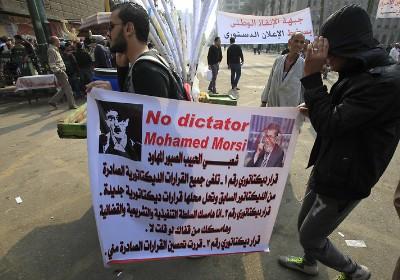
Given the thousands of people returning to Cairo’s Tahrir Square and growing discontent over the economy, security, and civil liberties, Egyptian President Mohamed Morsi may have inadvertently provided his critics with a temporary unifying device: rallying to defend the rule of law.

The demise of secular autocratic regimes in the Middle East and North Africa has heralded a renaissance for Islamist parties in the region, igniting a rivalry for the hearts and minds of the Sunni world between the Gulf powers of Saudi Arabia and Qatar. Although neither country is a bastion of democracy at home, Qatar has proven much more amenable than Saudi Arabia to bolstering democratic Islamist movements abroad.

Security considerations surrounding the unknown variables of a post-Assad Syria appear to have created a divide between U.S. and Israeli strategies, as the Netanyahu government has not followed Obama’s course on Syria. The Israeli concerns surrounding the collapse of Syria’s Ba’athist party are legitimate. Washington should also consider the security consequences of Assad’s ouster and avoid intervention in Syria.

This May, for the first time in their history, Egyptians voted for president in a largely free and fair election. For the second time in less than a year, a new democratic regime is emerging from the outgrowth of the Arab Awakening.
Neoconservatives are finding the entry of a Muslim Brotherhood candidate in the race for Egypt’s presidency hard to swallow.
Jihadists once flowed from Syria to Iraq. Now the favor is being returned.

The Egyptian electoral results, as in similar elections in Tunisia, Palestine, Iraq, and Turkey, suggest that in any fair and transparent elections in the Islamic world, Islamist parties and their affiliates can easily win at least 40 percent of the votes. In fact, in the case of Egypt, Islamist parties together won over 77 percent of the seats. These results can be used as predictors of future elections in other Arab and Islamic countries in the area. The question, then, is no longer whether Islamists can win a majority in elections, but which strain of Islamism and by how much.