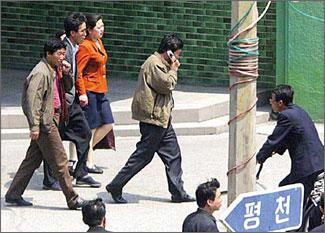
It’s not likely that an Occupy Pyongyang movement will set up tents in Kim Il Sung Square anytime soon. Protest, after all, is virtually non-existent in that society. But the same widening inequalities that plague the United States and the global economy can also be found inside North Korea. What was once a relatively equitable society, albeit at the low end of per-capita GDP, has been experiencing a rapid polarization in wealth. The implications of this widening gap on North Korean government policy–as well as on international policies promoting human security inside North Korea–are enormous.
North Korea’s Pivot
After three years of frozen relations between North Korea and the United States, the two longstanding adversaries are on the verge of a thaw. In what has been called the “leap day deal,” North Korea has pledged to stop uranium enrichment and suspend nuclear and missile tests. The United States, meanwhile, will deliver 240,000 metric tonnes of food to the country’s malnourished population.
Psychologists and Torture, Then and Now
History repeats itself, Marx famously warned, first as tragedy and then as farce. In the case of U.S. torture psychologists, the ” tragedy” occurred half a century ago when CIA-funded psychological research on electroshock treatment, sensory deprivation and the like found its way into the Agency’s counterintelligence interrogation manual. The 1963 KUBARK Manual and its later iterations were used widely by U.S. intelligence and disseminated to other governments in Latin America and Southeast Asia. The “farce” was played post-9/11, as psychologists became involved once again in aiding counterintelligence interrogators.
Resuming Contact with North Korea
On February 24, representatives from the United States and North Korea will meet for the first time since talks halted following the death of Kim Jong-il in December. Shortly after talks broke off, the two sides were reportedly close to brokering a deal that would have seen the DPRK halt uranium enrichment in return for much needed food aid. Such a deal would have represented a major diplomatic breakthrough, particularly in light of the tumultuous events of the last year and a half and a major step towards restarting the Six Party Talks. However, the death of Kim Jong-il prevented finalization of the agreement as North Korea inevitably shifted all its focus to ensuring the stability of the regime now centered on Kim Jong-il’s third son and heir, Kim Jong-un.
South Korea Cracks Down on Dissent
On February 8, the South Korean National Intelligence Service (NIS) raided the Seoul and Incheon offices of the South Korean NGO, Solidarity for Peace and Reunification in Korea (SPARK) for violating the National Security Law (NSL). The NIS also searched the homes of two of SPARK’s leadership, confiscated their notebooks and cell phones, andshut down the server of its website, Jinbo.net.
State of the Union’s Foreign Policy: Unilateral Triumphalism
Obama returned to his perceived strong suit in the end to discuss how the United States must operate from a position of strength. Unfortunately, he was talking about the strength of the U.S. military. The United States should indeed set an example: of wise diplomacy, global economic equity, and sensible budget priorities at home. Perhaps the next State of the Union can begin on a note of international cooperation instead of unilateral triumphalism.
Approaching North Korea in the Kim Jong Un Era
In the movie Memento, the main character suffers from short-term memory loss. He cannot remember anything from day to day, so must write himself notes to explain what happened to him in the recent past. He is desperate to resolve a central mystery in his life. But with his memory a blank, all he can rely on are the cryptic scribbles that he cannot even remember writing.
Cult of Personality
He is, in the words of Barbara Walters, a “mild-mannered ophthalmologist.” Indeed, the rather squeamish leader-to-be chose eye surgery because it didn’t involve much blood. He speaks fluent English and can get by in French as well as his native Arabic. His wife is a knock-out, a “rose in the desert” according to a Vogue profile. Reluctant to take over the family business from his father, he interrupted his medical training in London to return home only after his older brother died in a car accident. Then, once at the helm, he released a number of political prisoners and instituted economic reforms that got a thumbs-up from the international business community. He cooperated with the United States in the immediate aftermath of 9/11. Even today, he uses all the right words: transparency, dignity, reform.
A Korean Spring?
As 2011 came to a close, the death of North Korean leader Kim Jong Il took the world by surprise (including the CIA which, like the rest of us, only learned of his passing 48 hours later). Given the dearth of understanding about North Korea in the West, the media could only speculate about the future of the new regime in Pyongyang. The usual pundits also took the opportunity to renew their calls for regime change. After all, 2011 was the year when the masses rose up to overthrow repressive regimes; could the same fate be in store for North Korea?
North Korea More Dependent on China Than Ever
Support from China for Kim Jong-un would give him added weight with North Korea’s military.