
All Commentaries
House Reps Reach Across the Aisle to Block Palestinian Statehood
Influential Republican Ros-Lehtinen is sponsoring a bill that would make U.S. funding of UN agencies conditional on how the body votes on Palestinian statehood.
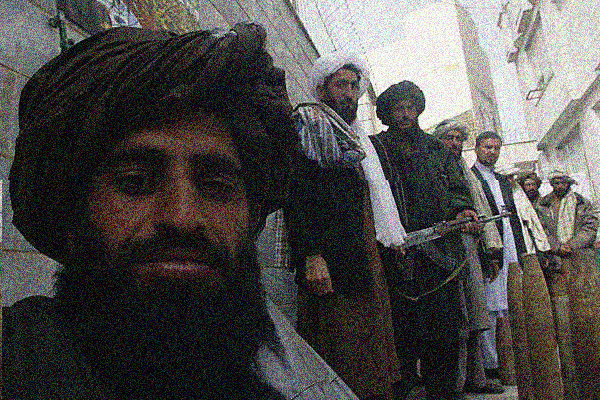
Light at End of Afghan Tunnel Recedes With Brazen Taliban Attacks, Army Desertion, and Flourishing Opium Trade
What generals don’t get is that wars like Vietnam and Afghanistan — occupations in effect — are political, not military affairs.

Review: Soviet Fates and Lost Alternatives
Why did the Soviet Union come to an end? Was the Soviet system reformable? Were there historical alternatives to Stalinism? These are the questions that Stephen F. Cohen raises in Soviet Fates and Lost Alternatives: From Stalinism to the New Cold War. In a series of seven essays, Cohen challenges conventional assumptions on the course of Soviet and post-Soviet history, examining the fates and lost opportunities of Stalin’s preeminent opponents.

Saudis to U.S.: You’re Sleeping on the Couch Tonight
However turbulent, the marriage between the United States and Saudi Arabia is nott headed for a divorce.
Libya Could Break Up Like Somalia
Libya is neither Tunisia nor Egypt. The ruling group (Gaddafi) and the forces fighting it are in no way analogous to their Tunisian and Egyptian counterparts. Gaddafi has never been anything but a buffoon, whose emptiness of thought was reflected in his notorious ‘Green Book’. Operating in a still-archaic society Gaddafi could indulge in successive ‘nationalist’ and ‘socialist’ speeches with little bearing on reality, and the next day proclaim himself a ‘liberal’.
The Game Changer
WikiLeaks is a game changer. Whether you are an ardent supporter of the enigmatic organization, or are calling for the head of its leader, Julian Assange, or your feelings lie somewhere in between, you cannot deny that the organization’s methods and activities have changed government interactions, media practices, corporate behavior, and instilled a sense of empowerment for the less powerful. The very existence of WikiLeaks and its fellow activists and organizations fundamentally alters the parameters of international affairs.
Would An Independent West Papua Be A Failing State?
On July 9, 2011 another irrational colonial border that demarcated Sudan was consigned to history when South Sudan achieved independence. In the process an often seemingly irrevocable principle of decolonisation, that boundaries inherited from colonial entities should remain sacrosanct, has been challenged once again. Indeed, a cautious trend in international relations has been to support greater self-determination for ‘nations’ without awarding full statehood. Yet Kosovo is another state whose recent independence has been recognised by most major players in the international community. In West Papua’s case, the territory’s small but growing elite had been preparing for independence from the Netherlands in the late 1950s and early 1960s, and Dutch plans envisaged full independence by 1970. However, in 1962 Cold War realpolitik intervened and the United States engineered a transfer of sovereignty to Indonesia under the auspices of the United Nations. To Indonesian nationalists their revolution became complete since West New Guinea had previously been part of the larger colonial unit of the Netherlands East Indies, which had realised its independence as Indonesia in 1949. In West New Guinea, most Papuans felt betrayed by the international community and have been campaigning for a proper referendum on independence ever since.
Nuclear Weapons Stewardship a Victim of Mission Creep
The National Nuclear Security Administration has seized on safety as its ticket to secure funding for major nuclear warhead modifications.

Zahra’s Paradise
Set in the aftermath of Iran’s fraudulent elections of 2009, Zahra’s Paradise is the fictional story of the search for Mehdi, a young protestor who has disappeared in the Islamic Republic’s gulags. Mehdi has vanished in an extrajudicial twilight zone where habeas corpus is suspended.

Global Warming, Global Violence
Last month the journal Nature published a paper examining the link between local climate variations and civil conflict around the world. The first quantitative study of its kind, it has received a fair amount of attention for its conclusion that climate shifts do indeed correlate with greater violence. The authors found that the rate of armed conflict doubled — from 3 to 6 percent — during El Nino-associated climate swings, a statistically significant and sobering increase.