On the small, remote island of Diego Garcia, in the Indian Ocean halfway between Africa and Indonesia, the United States has one of the most secretive military bases in the world. From its position almost 10,000 miles closer to the Persian Gulf than the east coast of the United States, this huge U.S. air and naval base has been a major, if little known, launch pad for the wars in Iraq and Afghanistan. In the past year, the Bush administration has made improvements that point toward its use in a possible attack on Iran. The administration recently admitted what it had long denied and what journalists, human rights investigators, and others had long suspected: The island has also been part of the CIA’s secret “rendition” program for captured terrorist suspects.
Arms Race in Space
When the United States recently shot apart a crippled spy satellite over the Pacific Ocean, it also tested an offensive anti-satellite weapon and the potential for ballistic missile defense. “The shot,” as the Pentagon called the $100 million operation conducted on February 20, came immediately after Russia and China put forward a detailed, but flawed, proposal for a treaty to ban space weapons at the United Nations. In response, the United States immediately reaffirmed its unwillingness to participate in any arms control accord covering space.
The Candidates and India
For the past few months it seems that New Delhi has been shrouded in a thick, meandering fog. For the auto rickshaw drivers and fruit vendors, the intelligentsia and the elite who occupy the steamy Gangetic Plains, the fog has become, as all things in India must, symbolic of an uncertain future. A Pakistan on the verge of doom? An Olympic China who this summer will put India in the shadows? An increasingly bellicose Russia? Wrong on all counts.
Korean Bases of Concern
Last month the New York Philharmonic grabbed the world’s attention by performing Dvorak’s New World Symphony in Pyongyang, the capital of North Korea. The Philharmonic may well have chosen Dvorak’s piece as an overture for a new world of peace. With negotiations over security issues in Northeast Asia making some progress, the United States and North Korea have been inching closer.
Postcard from…Nepal
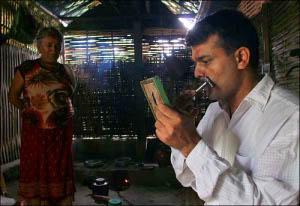
Photo of Chet Nath by Laura Elizabeth Pohl
The Second Shockwave
While the economic contraction is apparently slowing in the advanced industrial countries and may reach bottom in the not-too-distant future, it’s only beginning to gain momentum in the developing world, which was spared the earliest effects of the global meltdown. Because the crisis was largely precipitated by a collapse of the housing market in the United States and the resulting disintegration of financial products derived from the “securitization” of questionable mortgages, most developing nations were unaffected by the early stages of the meltdown, for the simple reason that they possessed few such assets.
Gender and U.S. Bases in Asia-Pacific
The power dynamics of militarism in the Asia-Pacific region rely on dominance and subordination. These hierarchical relationships, shaped by gender, can be seen in U.S. military exploitation of host communities, its abuse and contamination of land and water, and the exploitation of women and children through the sex industry, sexual violence, and rape. Women’s bodies, the land, and indigenous communities are all feminized, treated as dispensable and temporary. What is constructed as “civilized, white, male, western, and rational” is held superior to what is defined as “primitive, non-white, female, non-western, and irrational.” Nations and U.S. territories within the Asia-Pacific region are treated as inferiors with limited sovereignty or agency in relation to U.S. foreign policy interests that go hand-in-hand with this racist/sexist ideology.
Change in Burma?
The Burmese government has recently announced a number of political changes that have caught the attention of the international community. It has announced that a new constitution will soon be completed in time for a nation-wide referendum in May. More dramatically, the government has announced that “it is now time to change from military rule to a people’s democracy. There will be a multi-party general election in 2010 under the new constitution."
The China Syndrome
On February 4, President Bush announced a baseline military budget of $515.4 billion for the next fiscal year, not including funds for operations in Iraq and Afghanistan. This is the largest one-year Pentagon request in real, uninflated dollars since World War II. This Fiscal Year (FY) 2009 figure represents a 7.5% increase over the 2008 appropriation of $479.5 billion and is expected to be the first of many rising requests supposedly needed to replace equipment lost and damaged in Iraq and to gear up for the security threats to come. As Chairman of the Joint Chiefs of Staff Adm. Mike Mullen explained last October, “we’re just going to have to devote more resources to national security in the world we’re living in right now.”
Flogging a Dead Agreement
The Indian government suddenly finds itself under intense and mounting U.S. pressure to complete a nuclear agreement during the present U.S. administration. “We don’t have all the time in the world,” Nicholas Burns bluntly said this month. One of the chief architects of the agreement and the U.S. undersecretary for political affairs, Burns was referring to the India-specific agreements with International Atomic Energy Agency (IAEA) and change of rules at the Nuclear Suppliers’ Group (NSG) that are necessary for the export of nuclear plants and equipment to India. He reminded the Indians that “this is an election year” in the USA and hoped “very much that this process can now be completed.” David C. Mulford, U.S. ambassador in New Delhi, similarly pressed for the conclusion of the agreement during the Bush administration. He suggested that it is almost “now or never” for New Delhi to get behind such a deal before non-proliferation groups force additional conditionalities.