In a full-page ad in the Wall Street Journal last week, Eli Wiesel described Jerusalem as “the world’s Jewish spiritual capital” and “the heart of our heart, the soul of our soul.” The Sheikh Jarrah [Just Jerusalem] activists who, unlike Wiesel, actually live in Jerusalem, say: “We cannot recognize our city in the sentimental abstraction you call by its name.” They describe the city they call home as “crumbling under the weight of its own idealization.” . . . writes Paul Woodward at War in Context…Jerusalem is crumbling under the weight of its own idealization.
Many Palestinian Protestors Already Use Nonviolent Tactics
Israel is escalating its quiet campaign to round up and detain nonviolent Palestinian protesters, from leaders to children, in nighttime raids. And although these protesters remain committed to nonviolence, the world continues to believe the Palestinian struggle is mainly based on violence.
Obama Stumbles on Human Rights
It was a relatively short response to a question in a town hall-style meeting in Florida, yet it said much about President Barack Obama’s lack of concern about human rights in his foreign policy. The question came not from a hostile Republican opponent, but from a young college student who had volunteered on Obama’s campaign. She spoke directly to an issue that has alienated much of Obama’s Democratic base since the president took office: ongoing U.S. support for Israeli and Egyptian human rights abuses. The Israeli and Egyptian governments, both of which have notoriously poor human rights records, are the two largest recipients of U.S. security assistance.
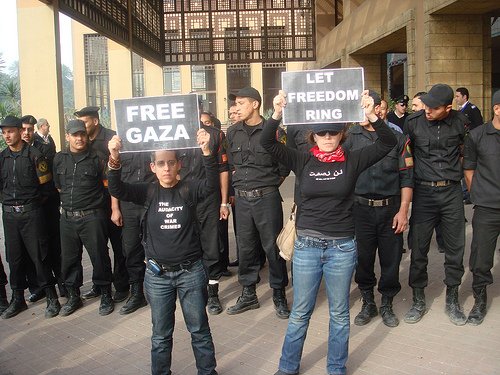
Lessons of the Gaza Freedom March
The latest attempt to highlight the crisis in Gaza captured some media attention. But a failure to balance principle with pragmatism meant that the Gaza Freedom March did not achieve its full potential.
Living by the Gate From Hell
A portrait of nonviolent resistance in one Palestinian village.
The Goldstone Report: Killing the Messenger
On October 1, the Obama administration successfully pressured the Palestinian delegation to the United Nations Human Rights Council (UNHRC) in Geneva to drop its proposal to recommend that the UN Security Council endorse the findings of the Goldstone Commission report. The report, authored by renowned South African jurist Richard Goldstone, detailed the results of the UNHRC’s fact-finding mission on the Gaza conflict. These findings included the recommendation that both Hamas and the Israeli government bring to justice those responsible for war crimes during the three weeks of fighting in late December and early January. If they don’t, the report urges that the case be referred to the International Criminal Court (ICC) for possible prosecution.
Beyond Muscle: Using Financial Leverage for Middle East Peace
In late August, the U.S. and Israeli governments appeared to have settled on a grand strategy to advance Middle East peace, one that traded a tougher U.S. stance on Iran for freezing Israeli settlement construction in the West Bank. But subsequent reports on plans for additional Israeli settlement construction and announcements by Tehran outlining its terms for talks at a September 9th, meeting of the P5+1 (that’s the five permanent members of the Security Council plus Germany) working group, indicate that the specific details of a bargain are still far from settled.
‘Palestinians’ without ‘Palestine’
"Obama welcomes Netanyahu acceptance of Palestinian state," the headlines blared. Well, at least that’s settled. With the U.S. president having shown the Israeli prime minister who is boss, both are headed toward the same long-term goal of a two-state solution — or so it seems.
Changing the Discourse: First Step toward Changing the Policy?
President Barack Obama’s much-anticipated Cairo speech reflected a significant shift away from the ideological framework of militarism and unilateralism that shaped the Bush administration’s war-based policy toward the Arab and Muslim worlds. His "not Bush" focus was perhaps most sharply evident in his public denunciation of the Iraq War as a "war of choice." Obama’s call for a "new beginning" based on "the truth that America and Islam are not exclusive and need not be in competition" was followed by a move to shift the official U.S. discourse toward something closer to internationalism — particularly by pointing to parallels between historical (and some contemporary) grievances and treating them as equivalent. This included his reference to the U.S. "role in the overthrow of a democratically elected Iranian government," along with Iran’s "role in acts of hostage-taking and violence against U.S. troops and civilians."
Postcard From…Bi’lin
The ritual occurs every Friday in Bi’lin, occupied West Bank.
Palestinian protestors — community members and activists — gather around the mosque following midday prayers to march against the construction of the separation wall and the proliferation of Israeli settlements.
What made last week’s march different was the overwhelming presence of foreigners. The fourth Bi’lin International Conference on Popular Resistance, a three-day conference that I attended from April 22-24, was intended to build solidarity and support for the Palestinian nonviolent struggle. Conference participants included Palestinian political leaders and community members, delegations from South Africa and Italy, and European Parliament Vice President Luisa Morgantini. The closing activity was a larger-than-usual protest against the construction of a wall that will arbitrarily cut across large parts of the village, separating families from each other and villagers from their land.
