In the chorus of condemnation that resounded after the massacre, Russia’s voice stood out for its glaring ambiguity.
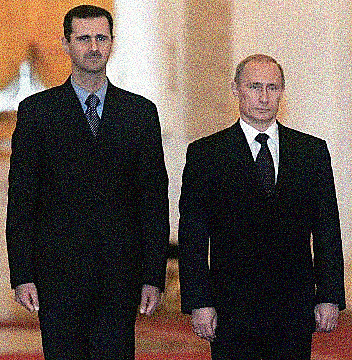
The Crisis in Syria Calls Out for an Intervention — with Russia
read more

In the chorus of condemnation that resounded after the massacre, Russia’s voice stood out for its glaring ambiguity.
That NATO missile defense in Europe as protection from Iran, not Russia, is a tough sell.
Jennifer Rubin of the Washington Post called President Obama’s remarks to Russian President Medvedev a “stunning gift” to Republicans.

Important as preventing nuclear proliferation is, it’s second to nuclear risk.

In September 2011, Vladimir Putin announced a program to begin offshore oil and gas exploration and drilling in the Russian Arctic. Putin is also interested in creating new sea terminals, which he said would rival the Suez and Panama Canals. In 2008, the U.S. Geological Survey (USGS) estimated that 13 percent of the world’s undiscovered oil and 30 percent of the world’s undiscovered gas lay beneath the Arctic Seas. The United States, Canada, Norway, Greenland, and Russia, which make up the Arctic 5, are each interested in tapping these Arctic energy reserves.
What shape will the convergence of Egypt’s civilian and military management with the Muslim Brotherhood take?
John F. Kennedy essentially bought his way into politics. His father, the wealthy Joseph Kennedy, picked out a nice congressional seat in Massachusetts and basically paid the occupant of the position to step down and run instead for the Boston mayoralty. JFK’s father then tried to pay off the Democratic frontrunner to drop out of the race, and when that didn’t work, persuaded William Randolph Hearst not to run any of the candidate’s ads or pictures in Hearst-owned newspapers. Joe Kennedy even paid a janitor named Joseph Russo to run in the race in order to dilute support for another leading candidate named Joseph Russo. Recognizing the importance of PR, the Kennedy family contributed $600,000 – an enormous sum in 1946 – for a children’s hospital in the district where JFK was running for office.
Standing the New START treaty on its head.

In the past two weeks a number of different rallies took place in Russia. The most memorable of these, on December 10, was the biggest protest in Russia since the fall of communism. People in cities all around Russia went onto the streets. In Moscow, estimates of the number of protestors ranged from 25,000 to 100,000. Although organized by a range of groups and political parties with few common goals, the protests are united around one issue: the alleged vote rigging by the United Russia party.
Unsafe construction practices may have been used to build Iran’s first nuclear energy facility, Bushehr.