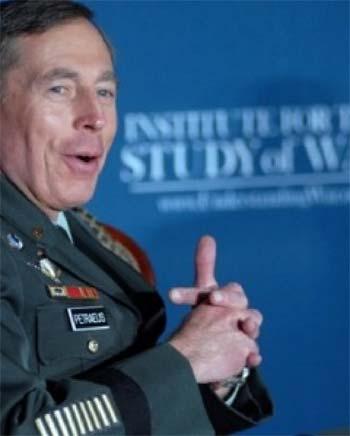
If Afghanistan is, in fact, a COIN engagement then the Obama administration should be using the best available COIN guidelines to assess it. Towards that end, the author has taken the liberty of extracting key points from Gen. Petraeus’s seminal work on the subject, Field Manual 3-24, to use as metrics.
Remember Vietistan?
The McChrystal debacle dramatizes how military thinking dominates U.S. policy — look at how much of the budget the Pentagon commands — as well as the utter hopelessness of achieving anything but draining defeat from the U.S. occupation of Afghanistan. This lesson should have been learned after Vietnam. As Yogi Berra said, it’s “déjà vu all over again.”
The Surge of Ideas
In recent years, there has been a growing tendency for think tanks and military brass to jointly pursue policy objectives, some of which are opposed by the public or the White House—take, for example, the campaigns to build support for the troop “surges” in both Iraq and Afghanistan. This trend, say critics, raises important questions about the appropriate role of the military in promoting particular policies and whether there is enough transparency and accountability in the work of policy groups. And, just as importantly, will there be a new joint campaign aimed at pressuring the Obama administration to delay troop withdrawal from Afghanistan?
Is Success in Afghanistan Really a Question of Command?
Surely, generals play an important role in winning and losing wars. But it is misleading to imagine that they determine the outcome of a conflict whose causes stem from the underlying political and social system.
BP and Sado-Messochism
Aside from the occasional asteroid and volcanic outburst, human beings are responsible for the greatest messes on the planet. We’ve polluted the air and water, punched holes in the ozone, and pumped enough carbon into the atmosphere to overwhelm the global thermostat. Nor is this merely a modern attribute of homo sapiens. As Jared Diamond points out in his book Collapse, we’ve repeatedly taxed the limits of our environment, from the heart of the Mayan civilization to far-flung Easter Island. We’ve hunted countless species into extinction and exhausted the soil to feed burgeoning populations. And what we once did on a local basis, we are now applying on a global scale.
Call the Politburo, We’re in Trouble: Entering the Soviet Era in America
Gorbachev had dubbed Afghanistan “the bleeding wound,” and when the wounded Red Army finally limped home, it was to a country that would soon cease to exist. For the Soviet Union, Afghanistan had literally proven “the graveyard of empires.” If, at the end, its military remained standing, the empire didn’t. (And if you don’t already find this description just a tad eerie, given the present moment in the U.S., you should.)
Leave Afghanistan and Declare bin Laden Dead in One Fell Swoop
What if we not only left Afghanistan but declared bin Laden dead? (The burden would be on jihadis to prove he’s alive.)
Reader Challenge: Is Afghan Mineral Find a Game-Changer?
Both Afghan elites and the Taliban have be drooling over the $1 trillion in mineral deposits in Afghanistan.
A Bad Week for the Monroe Doctrine
In her address to the delegates, Clinton complained that the OAS “has not always lived up to its founding ideals.” Now it is, and Washington is less than happy.
Outraged by Drone Strikes? Some Drone Operators Are Too
Some CIA officers involved in the agency’s drone strikes program in Pakistan and elsewhere are privately expressing their opposition to the program within the agency, because it is helping al Qaeda and its allies recruit.