Invasion would likely follow an air attack on Iran.
In an Attack on Iran, Oil Wells Will Be Spared
read more

Invasion would likely follow an air attack on Iran.

The South China Sea, although far from tranquil, has yet to revert to the volatility and violence witnessed in the late 1980s. However, current efforts to maintain stability and implement confidence-building measures could soon be overtaken by environmental changes in the region.

In September 2011, Vladimir Putin announced a program to begin offshore oil and gas exploration and drilling in the Russian Arctic. Putin is also interested in creating new sea terminals, which he said would rival the Suez and Panama Canals. In 2008, the U.S. Geological Survey (USGS) estimated that 13 percent of the world’s undiscovered oil and 30 percent of the world’s undiscovered gas lay beneath the Arctic Seas. The United States, Canada, Norway, Greenland, and Russia, which make up the Arctic 5, are each interested in tapping these Arctic energy reserves.

On January 1, 2012, Nigeria’s fuel regulator announced that the government was immediately discontinuing its fuel subsidy to help cut government spending, causing an overnight spike in fuel prices from $1.70 to $3.50 per gallon. Such a hike would be outrageous even for Americans. But for a drastically poorer country like Nigeria—where 70 percent of the population of 160 million lives below the poverty line—it was insufferable. Cheap fuel is one of the few benefits Nigerians enjoy as citizens of Africa’s largest (and the world’s 14th-largest) oil producer.

Nigeria is facing a perfect storm of crises including a national strike, widespread protests, and sectarian violence in the north. Although the strikes, attacks, and protests raise the specter of another civil war in Africa’s biggest oil producer, the United States and the international community should avoid aggravating the situation by seeming to encourage a military solution.
Hackers may soon cause massive disruptions in the oil industry.

China’s imminent replacement of the West as the dominant international economic and political force in Africa epitomizes the most dramatic shift in geopolitics since the collapse of the Soviet Union. Yet the United States and Europe, Africa’s traditional trading partners, seem incapable of responding to the challenge and retaking the initiative. Instead, their response has been to wring their hands in despair and make ineffectual noises about human rights and democracy.

Muammar Gaddafi’s misuse of governmental instruments and assets for over 42 years has left a gaping political vacuum, a severely impaired civil service, and a virtually non-existent civil society in Libya. Decades of intentional manipulation of state resources and a gross mismanagement of oil revenues have led to immeasurable social exclusion. According to the UN, over 40 percent of Libya’s population of 6 million lived below the poverty line under Gaddafi and reaped no direct benefit from its monumental oil riches.
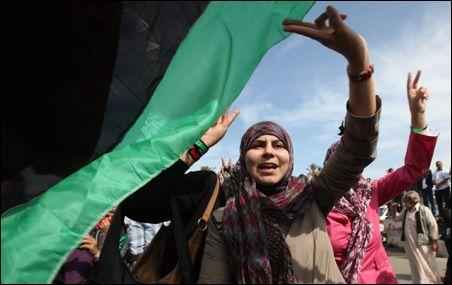
After Muammar Gaddafi’s demise, the future of Libya’s relationship with the United States remains uncertain.

According to Ghana’s Minister of Energy, 13 different petroleum operations are in different stages of oil exploration off Ghana’s shore, and more companies are seeking production rights all the time. The British, Dutch, Chinese, Italians, Russians and Americans are all salivating at Ghana’s front door. Ghana has long been a leading cocoa exporter, but cocoa and its end product chocolate do not elicit the intensity of lust that oil does.