Latin America & Caribbean

Learning to Live with Pluralism

The resilience of religion in public life in the early 21st century has surprised many secular observers who once confidently assumed that the overall thrust of history was toward secularization. The world, they expected, would follow the trajectory of post-Enlightenment Europe, which experienced steep declines in church attendance and the development of a decidedly lay public sphere. Much of the world, however, stubbornly refuses to fit that narrative. This applies certainly to the Islamic world, but even to the United States, where church attendance is one of the strongest predictors of voting behavior. Rather than fit different societies into a one-size-fits-all secularization narrative, we have to pay attention to the particularities.

read more

Hemispheric Hypocrisy

First Lady Cristina Fernandez de Kirchner’s recent decisive victory in Argentina’s presidential
elections, the first for a woman in that country, has meant inevitable comparisons. Frequently referred
to as "Argentina’s Hillary," the president-elect is the glamorous wife of current President
Nestor Kirchner, and despite a long personal political resume she is sometimes likened to Evita Peron.
Then there’s the widespread noting of how Argentina has followed in Chile’s footsteps in electing
a woman president. But Fernandez de Kirchner ‘s win probably matters more because of where she stands
on the political spectrum than because of her gender. As she takes office on December 10, the next
president of Argentina will deepen the consolidation of Latin America’s increasingly decisive "left
turn."

read more
How to be a Good Friend (When You are 4,000 Miles Away)

How to be a Good Friend (When You are 4,000 Miles Away)

Coming from small towns throughout the country-side, with stars overhead and veiled by the cover of darkness, Tania and 149 other families made their way in pick-up trucks and small vehicles, to a fazenda (farm) on the outskirts of Chatuba, a small town two hour’s drive from downtown Rio de Janeiro, Brazil. “Everyone was both […]

read more
Militarizing Mexico: The New War on Drugs

Militarizing Mexico: The New War on Drugs

President Richard Nixon invented the phrase “war on drugs” and used it in a political context similar in many ways to today’s. Bogged down in an unwinnable war abroad, with a growing deficit and rising inflation, Nixon declared illegal drugs “public enemy number one” on June 17, 1971.
Nixon took office promising to crack down on crime. Due to the characteristics of the problem and the division of powers that placed crime-fighting largely in the hands of state and local governments, he soon realized the difficulties of showing concrete results through a federal program. So Nixon devised a major, executive-led counternarcotics offensive to increase presidential powers and galvanize support from conservatives for his presidency and re-election.

read more

Keep the Freeze On Colombia

In April, the Democratic-controlled Congress froze $55.2 million in military assistance earmarked for Colombia. At issue were linkages between the Andean nation’s military and a paramilitary group on the State Department’s terrorist list. The administration response has largely been to marshal the troops and espouse the benefits of Plan Colombia, the vehicle that delivers U.S. assistance to Colombia.

read more

Moran on Guantanamo

James Moran (D-VA) has been in the House of Representatives since 1991. In 2002, he was one of 133 House members to vote against authorizing the invasion of Iraq. Most recently, he has proposed holding hearings in July on closing the detention facilities at Guantanamo Bay, Cuba, that currently holds several hundred detainees. FPIF contributor Michael Shank interviews him on the implications of his position on Guantanamo.

read more
Venezuelan Youth Street Culture Festival

Venezuelan Youth Street Culture Festival

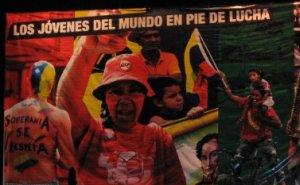
The brim of a young hip-hop artist’s beige beanie hides a quarter of his face as his peers observe cross-legged from the concrete below. His cheek and lips grip the microphone intensely. The timid posture of his thinly adolescent frame can barely contain the newly found power and energy budding from each stomp he plants on the rickety stage in a weedy university parking lot in Mérida, Venezuela.

read more
NAFTA: Kicked Up a Notch

NAFTA: Kicked Up a Notch

The North American Free Trade Agreement is the world’s most advanced example of the U.S.-led free trade model. It’s not just about economics any more. The expansion of NAFTA into the Security and Prosperity Partnership reveals the road ahead for other nations entering into free trade agreements. It is not a road most nations — or the U.S. public — would take if they knew where it led.

read more